
Compensation Trend Data Sources

By Dr. David Edward Marcinko MBA
Related chapters: Chapter 27: Salary Compensation and Chapter 29: Concierge Medicine and Chapter 30: Practice Value-Worth
***
PERSONAL PREAMBLE
***
Physician compensation is a contentious issue and often much fodder for public scrutiny. Throw modern pay for performance [P4P], and related metrics, into the mix and few situations produce the same level of emotion as doctors fighting over wages, salary and other forms of reimbursement.
This situation often springs from a failure of both sides to understand mutual compensation terms-of-art when the remuneration deal was first negotiated. This physician salary and compensation information is thus offered as a reference point for further investigations.
Introduction
More than a decade ago, Fortune magazine carried the headline “When Six Figured Incomes Aren’t Enough. Now Doctors Want a Union.” To the man in the street, it was just a matter of the rich getting richer. The sentiment was quantified in the March 31, 2005 issue of Physician’s Money Digest when Greg Kelly and I reported that a 47-y.o. doctor with 184,000 dollars in annual income would need about 5.5 million dollars for retirement at age.
Of course, physicians were not complaining back then under the traditional fee-for-service system; the imbroglio only began when managed care adversely impacted income and the stock market crashed in 2008.
Today, the situation is vastly different as medical professionals struggle to maintain adequate income levels. Rightly or wrongly, the public has little sympathy for affluent doctors following healthcare reform. While a few specialties flourish, others, such as primary care, barely move.
In the words of colleague Atul Gawande, MD, a surgeon and author from Brigham and Women’s Hospital in Boston, “Doctors quickly learn that how much they make has little to do with how good they are. It largely depends on how they handle the business side of practice.” And so, it is critical to understand contemporary thoughts on physician compensation and related trends.
Compensation Trend Data Sources
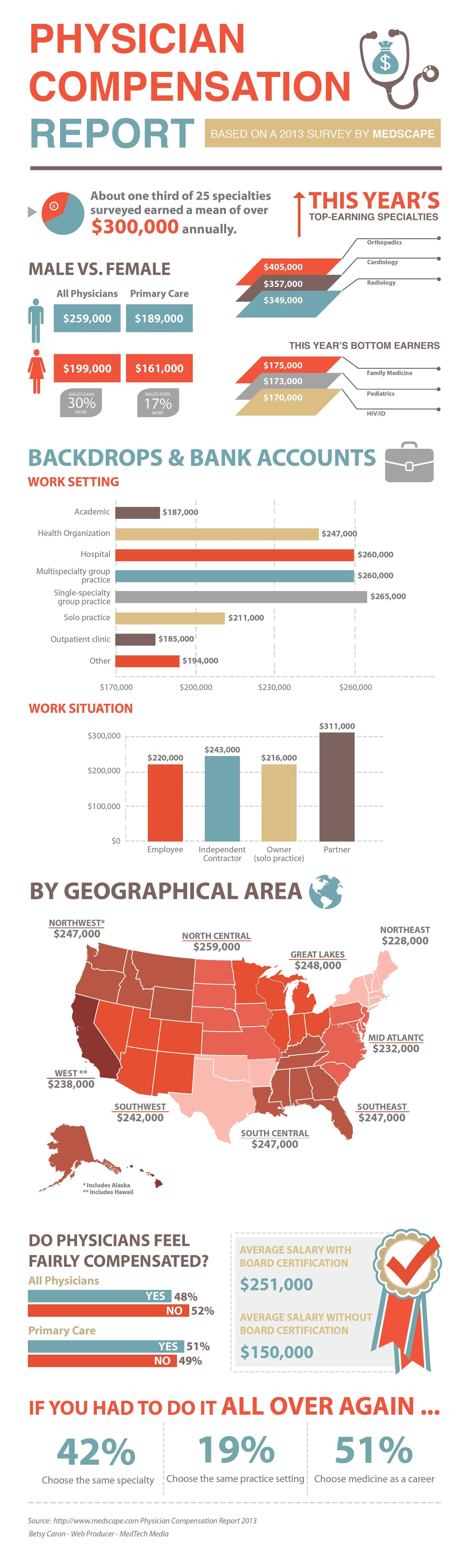
A growing number of surveys measure physician compensation, encompassing a varying depth of analysis. Physician compensation data, divided by specialty and subspecialty, is central to a range of consulting activities including practice assessments and valuations of medical entities. It may be used as a benchmarking tool, allowing the physician executive or consultant to compare a practitioner’s earnings with national and local averages.
The Medical Group Management Association’s (MGMA’s) annual Physician Compensation and Production Correlations Survey is a particularly well-known source of this data in the valuation community. Other information sources include Merritt Hawkins and Associates; and the annual the Health Care Group’s, [www.theHealthCareGroup.com] Goodwill Registry.
###

www.CertifiedMedicalPlanner.org
Assessment
However, all sources are fluid and should be taken with a grain of statistical skepticism, and users are urged to seek out as much data as possible and assess all available information in order to determine a compensation amount that may be reasonably expected for a comparable specialty situation. And, realize that net income is defined as salary after practice expenses but before payment of personal income taxes.
Conclusion
Your thoughts and comments on this ME-P are appreciated. Feel free to review our top-left column, and top-right sidebar materials, links, URLs and related websites, too. Then, subscribe to the ME-P. It is fast, free and secure.
Link: http://feeds.feedburner.com/HealthcareFinancialsthePostForcxos
Speaker: If you need a moderator or speaker for an upcoming event, Dr. David E. Marcinko; MBA – Publisher-in-Chief of the Medical Executive-Post – is available for seminar or speaking engagements. Contact: MarcinkoAdvisors@msn.com
OUR OTHER PRINT BOOKS AND RELATED INFORMATION SOURCES:
DICTIONARIES: http://www.springerpub.com/Search/marcinko
PHYSICIANS: www.MedicalBusinessAdvisors.com
PRACTICES: www.BusinessofMedicalPractice.com
HOSPITALS: http://www.crcpress.com/product/isbn/9781466558731
CLINICS: http://www.crcpress.com/product/isbn/9781439879900
BLOG: www.MedicalExecutivePost.com
FINANCE: Financial Planning for Physicians and Advisors
INSURANCE: Risk Management and Insurance Strategies for Physicians and Advisors


***
***
Filed under: Book Reviews, Career Development, CMP Program, Practice Management, Practice Worth | Tagged: Atul Gawande, concierge medicine, david marcinko, doctor salary, Goodwill Registry, Greg Kelly, Health Care Group’s, Medical Group Management Associations, MGMA, More on the Doctor Salary Conundrum, P4P, physician income, physician's money digest, private pay medicine, www.BusinessofMedicalPractice.com, www.CertifiedMedicalPlanner.org | 18 Comments »





 Support our online development, and advance our onground research initiatives in free market economics, as we seek to showcase the brightest Next-Gen minds.
THE ME-P DISCLAIMER: Posts, comments and opinions do not necessarily represent iMBA, Inc., but become our property after submission. Copyright © 2006 to-date. iMBA, Inc allows colleges, universities, medical and financial professionals and related clinics, hospitals and non-profit healthcare organizations to distribute our proprietary essays, photos, videos, audios and other documents; etc. However, please review copyright and usage information for each individual asset before submission to us, and/or placement on your publication or web site. Attestation references, citations and/or back-links are required. All other assets are property of the individual copyright holder.
Support our online development, and advance our onground research initiatives in free market economics, as we seek to showcase the brightest Next-Gen minds.
THE ME-P DISCLAIMER: Posts, comments and opinions do not necessarily represent iMBA, Inc., but become our property after submission. Copyright © 2006 to-date. iMBA, Inc allows colleges, universities, medical and financial professionals and related clinics, hospitals and non-profit healthcare organizations to distribute our proprietary essays, photos, videos, audios and other documents; etc. However, please review copyright and usage information for each individual asset before submission to us, and/or placement on your publication or web site. Attestation references, citations and/or back-links are required. All other assets are property of the individual copyright holder.




 The Leading Business Education Network for Doctors, Financial Advisors and Health Industry Consultants