







 Support our online development, and advance our onground research initiatives in free market economics, as we seek to showcase the brightest Next-Gen minds.
THE ME-P DISCLAIMER: Posts, comments and opinions do not necessarily represent iMBA, Inc., but become our property after submission. Copyright © 2006 to-date. iMBA, Inc allows colleges, universities, medical and financial professionals and related clinics, hospitals and non-profit healthcare organizations to distribute our proprietary essays, photos, videos, audios and other documents; etc. However, please review copyright and usage information for each individual asset before submission to us, and/or placement on your publication or web site. Attestation references, citations and/or back-links are required. All other assets are property of the individual copyright holder.
Support our online development, and advance our onground research initiatives in free market economics, as we seek to showcase the brightest Next-Gen minds.
THE ME-P DISCLAIMER: Posts, comments and opinions do not necessarily represent iMBA, Inc., but become our property after submission. Copyright © 2006 to-date. iMBA, Inc allows colleges, universities, medical and financial professionals and related clinics, hospitals and non-profit healthcare organizations to distribute our proprietary essays, photos, videos, audios and other documents; etc. However, please review copyright and usage information for each individual asset before submission to us, and/or placement on your publication or web site. Attestation references, citations and/or back-links are required. All other assets are property of the individual copyright holder.


By Country for our Domestic and International ME-P Readers
By Staff Reporters
There’s a lot of money in the world, but not all of it can be easily defined as “money.” Just where the money is and who has it is a complicated issue. The wad of money in your pocket is one form of money, but the money supply is hardly limited to that. So, where is the money and what exactly is it?
Finding Out
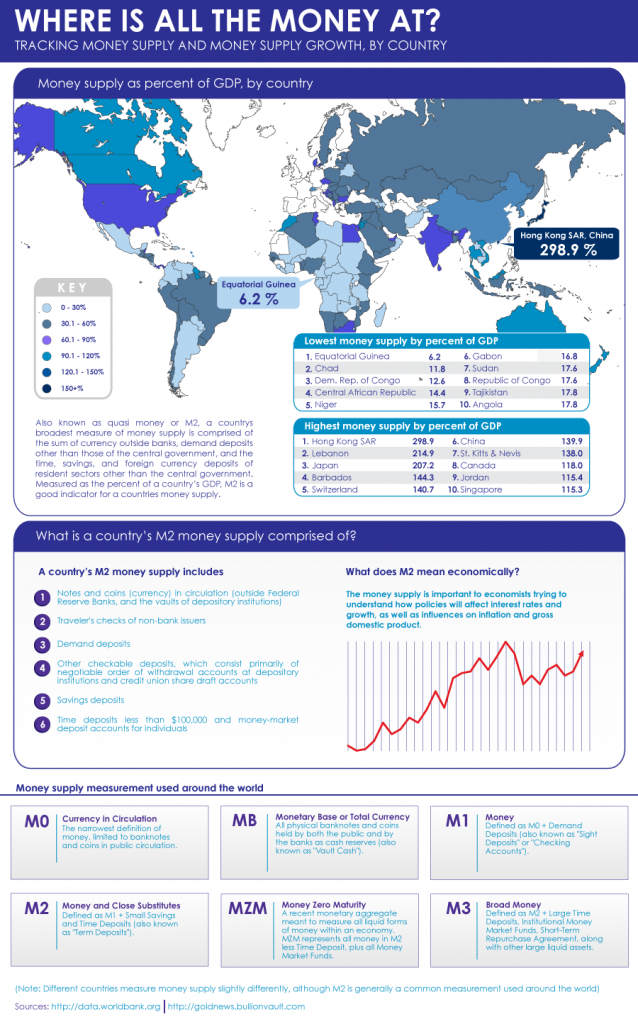
To find out what Broad Money, Money Zero Maturity, the Monetary Base, and Money and Close Substitutes mean, take a look at the graphic for an explanation. You’ll see that there is a lot more to money than you may have realized. The cash you use from day to day is M0, but there are also MB, M1, M2, M3 and more.
What Is Quasi Money?
If you want to measure how much money a country has, there is much more to consider than just how much printed money is within that country. If you think about how much money you have, it’s likely a lot more than just the cash you have on hand. You have bank accounts, checks and other forms of money that factor into how much money you have. The same is true for countries.
By Country
How much money a country can get pretty complicated, but there is a way to figure out each country’s quasi money. No, this doesn’t mean fake money or “sort of” money, like the name may imply. Quasi money may also sound like our paychecks these days, but what it refers to is actually a pretty neat assessment of the money that a country really has.
The money supply of every single country can be measured accurately by looking at a number of different things. To find out exactly what goes into the money that a country has, take a look at the graphic.
How Does Your Country Stack Up?
How does your country compare to other countries in terms of money? The amount of quasi money in each country when measured as a percentage of a country’s Gross Domestic Product (GDP) is pretty telling. Check out the graphic to see how your country rates and whether it makes the top 10, the bottom 10 or falls somewhere in the middle. If you know someone from a country on the top or bottom lists, forward the graphic to them and let them know about it. Depending on where their country falls, it may be time to gloat or to pretend not to be jealous.
Where are the top and bottom countries located?
Are they countries that are typically thought of as being rich and poor, or do they come straight out of left field for a sneak attack? There are certainly some countries in there that will surprise you as well as some that won’t. Take a look for yourself and see where the wealth of the world lies.
Conclusion
Your thoughts and comments on this ME-P are appreciated. Feel free to review our top-left column, and top-right sidebar materials, links, URLs and related websites, too. Then, subscribe to the ME-P. It is fast, free and secure.
Link: http://feeds.feedburner.com/HealthcareFinancialsthePostForcxos
Speaker: If you need a moderator or speaker for an upcoming event, Dr. David E. Marcinko; MBA – Publisher-in-Chief of the Medical Executive-Post – is available for seminar or speaking engagements. Contact: MarcinkoAdvisors@msn.com
Our Other Print Books and Related Information Sources:
Health Dictionary Series: http://www.springerpub.com/Search/marcinko
Practice Management: http://www.springerpub.com/product/9780826105752
Physician Financial Planning: http://www.jbpub.com/catalog/0763745790
Medical Risk Management: http://www.jbpub.com/catalog/9780763733421
Hospitals: http://www.crcpress.com/product/isbn/9781439879900
Physician Advisors: www.CertifiedMedicalPlanner.org


Share this:

Filed under: Financial Planning | Tagged: GDP, GNP, macro-economics, money supply, Money Supply as a Percent of GDP | 3 Comments »
 The Leading Business Education Network for Doctors, Financial Advisors and Health Industry Consultants
