







 Support our online development, and advance our onground research initiatives in free market economics, as we seek to showcase the brightest Next-Gen minds.
THE ME-P DISCLAIMER: Posts, comments and opinions do not necessarily represent iMBA, Inc., but become our property after submission. Copyright © 2006 to-date. iMBA, Inc allows colleges, universities, medical and financial professionals and related clinics, hospitals and non-profit healthcare organizations to distribute our proprietary essays, photos, videos, audios and other documents; etc. However, please review copyright and usage information for each individual asset before submission to us, and/or placement on your publication or web site. Attestation references, citations and/or back-links are required. All other assets are property of the individual copyright holder.
Support our online development, and advance our onground research initiatives in free market economics, as we seek to showcase the brightest Next-Gen minds.
THE ME-P DISCLAIMER: Posts, comments and opinions do not necessarily represent iMBA, Inc., but become our property after submission. Copyright © 2006 to-date. iMBA, Inc allows colleges, universities, medical and financial professionals and related clinics, hospitals and non-profit healthcare organizations to distribute our proprietary essays, photos, videos, audios and other documents; etc. However, please review copyright and usage information for each individual asset before submission to us, and/or placement on your publication or web site. Attestation references, citations and/or back-links are required. All other assets are property of the individual copyright holder.


What is it – How does it work?
By Hope Rachel Hetico; RN, MHA
[Managing Editor]
The Internet is a constantly evolving service that continues to grow at an exponential rate, despite late adoption by some physician practices.
History
Since 1995, the primary use of the internet was e-mail communications with peers, hospitals and others.
Next providers linked to hospitals and managed care organizations to obtain more direct connectivity for clinical information and insurance benefits coverage.
More recently, physicians are finding other beneficial avenues to expand their utilization of the Internet:
- Direct e-mail inquiries from patients.
- Patient educational newsletters and links to other educational sites.
- Continuing medical education (CME).
- Chat room, consultations, conferences or professional presentations.
- Nurse to patient e-mail connectivity.
- Immediate data on lab results with alerts for abnormal high or low values.
- CPOEs (Computerized Purchase Order Entry Systems).
- Radiology images.
- Appointment scheduling patient reminders.
- HIPAA compliant Application Service Providers (ASP) for dictation, recording, routing and speech recognition and transcription services.
- eMR (Electronic Medical Records) and clinical medical group ware, etc.
Health 2.0, Web 2.0 and Patient 2.0
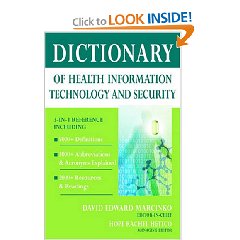
But, ever since the term “web 2.0″ was first used in 2004, there has been an inordinate amount of chatter about what web 2.0 really is and its true impact in medicine. No one’s defined it clearly, but we think the web evolution relative to healthcare essentially falls into 3 generations, as outlined in the new re-source: Dictionary of Health Information Technology www.HealthDictionarySeries.com and our related websites, wikis and professional blogs www.BusinessofMedicalPractice.com
Health 2.0 Journalists
According to healthcare visionary and uber-blogger Matthew Holt, http://www.health2advisors.com and similar other sources, Healthcare 2.0 may be defined as:
“A rapidly developing and powerful new business approach in the health care industry that uses the Web to collect, refine and share information. It is transforming how patients, professionals, and organizations interact with each other and the larger health system. The foundation of healthcare 2.0 is information exchange plus technology. It employs user-generated content, social networks and decision support tools to address the problems of inaccessible, fragmentary or unusable health care information. Healthcare 2.0 connects users to new kinds of information, fundamentally changing the consumer experience (e.g., buying insurance or deciding on/managing treatment), clinical decision-making (e.g., risk identification or use of best practices) and business processes (e.g., supply-chain management or business analytics)”.
And so, if Health 1.0 was a book, Health 2.0 is a live discussion.
Furthermore, Scott Shreeve, MD – http://blog.crossoverhealth.com [personal communication] of Cross-Over Health defines health 2.0 as:
“A New concept of healthcare wherein all the constituents (patients, physicians, providers, and payers) focus on healthcare value (outcomes/price) and use competition at the medical condition level over the full cycle of care as the catalyst for improving the safety, efficiency, and quality of health care.”

Assessment
By now, you probably realize that Health 2.0 empowers patients and worries doctors.
Writing for Time magazine recently, journalist Bonnie Rochman explored the ramifications of patients sharing information and tips online, an “empowerment movement” that she calls “Patient 2.0.”
In her piece, she profiled the newly created Society for Participatory Medicine, which “encourages patients to learn as much as they can about their health and also helps doctors support patients on this data-intensive quest,” as well as www.PatientsLikeMe.com, a free service which makes its money by selling anonymized patient information.
Source: http://www.healthjournalism.org/blog/2010/02/patient-20-empowers-patients-worries-doctors

Conclusion
And so, your comments on this ME-P are appreciated. Do doctors really fear Health 2.0? What do Health 2.0 and Patient 2.0 mean to you? How would you define the terms formally, and how do you use Web 2.0 in your medical practice? Or, are you a late-adopter still waiting for governmental or CCHIT definitional clarity?
Feel free to review our top-left column, and top-right sidebar materials, links, URLs and related websites, too. Then, be sure to subscribe to the ME-P. It is fast, free and secure.
Link: http://feeds.feedburner.com/HealthcareFinancialsthePostForcxos
 If you need a moderator or speaker for an upcoming event, Dr. David E. Marcinko; MBA – Publisher-in-Chief of the Medical Executive-Post – is available for seminar or speaking engagements. Contact: MarcinkoAdvisors@msn.com
Get our Widget: Get this widget!
Our Other Print Books and Related Information Sources:
Practice Management: http://www.springerpub.com/prod.aspx?prod_id=23759
Physician Financial Planning: http://www.jbpub.com/catalog/0763745790
Medical Risk Management: http://www.jbpub.com/catalog/9780763733421
Healthcare Organizations: www.HealthcareFinancials.com
Health Administration Terms: www.HealthDictionarySeries.com
Physician Advisors: www.CertifiedMedicalPlanner.com
Subscribe Now: Did you like this Medical Executive-Post, or find it helpful, interesting and informative? Want to get the latest ME-Ps delivered to your email box each morning? Just subscribe using the link below. You can unsubscribe at any time. Security is assured.
Link: http://feeds.feedburner.com/HealthcareFinancialsthePostForcxos
Sponsors Welcomed
And, credible sponsors and like-minded advertisers are always welcomed.
Link: https://healthcarefinancials.wordpress.com/2007/11/11/advertise
Share this:

Filed under: Career Development, Glossary Terms, Recommended Books, Research & Development | Tagged: Bonnie Rochman, health 2.0, Matthew Holt, patient 2.0, scott shreeve, Society for Participatory Medicine, web 2.0, www.healthdictionaryseries.com | 2 Comments »





 The Leading Business Education Network for Doctors, Financial Advisors and Health Industry Consultants