







 Support our online development, and advance our onground research initiatives in free market economics, as we seek to showcase the brightest Next-Gen minds.
THE ME-P DISCLAIMER: Posts, comments and opinions do not necessarily represent iMBA, Inc., but become our property after submission. Copyright © 2006 to-date. iMBA, Inc allows colleges, universities, medical and financial professionals and related clinics, hospitals and non-profit healthcare organizations to distribute our proprietary essays, photos, videos, audios and other documents; etc. However, please review copyright and usage information for each individual asset before submission to us, and/or placement on your publication or web site. Attestation references, citations and/or back-links are required. All other assets are property of the individual copyright holder.
Support our online development, and advance our onground research initiatives in free market economics, as we seek to showcase the brightest Next-Gen minds.
THE ME-P DISCLAIMER: Posts, comments and opinions do not necessarily represent iMBA, Inc., but become our property after submission. Copyright © 2006 to-date. iMBA, Inc allows colleges, universities, medical and financial professionals and related clinics, hospitals and non-profit healthcare organizations to distribute our proprietary essays, photos, videos, audios and other documents; etc. However, please review copyright and usage information for each individual asset before submission to us, and/or placement on your publication or web site. Attestation references, citations and/or back-links are required. All other assets are property of the individual copyright holder.


Wither the Patient-Assembly Line Product Mentality
By Dr. David Edward Marcinko MBA CMP™
[Editor-in-Chief]
 A cost-volume-profit relationship exists in any healthcare entity and emphasizes the point that the goal of an efficient emerging healthcare organization (EHO) should be profit optimization, rather than revenue or volume maximization.
The profit of any healthcare facility is what’s left after all financial outflows are removed from all financial inflows. This optimization is reached at the point where patient volume, fee per patient, and costs per patient produce highest profit, not the highest revenue.
This is the point of maximum efficiency and is where you want to be. It can be described in the equation below.
The Profit Equation
Medical profit traditionally can be defined by the equation:
Profit = (Price x Volume) – Costs
or P = (P x V) – C
whereas:
Revenue = Price x Volume
or R = PV
Making more Money
To make more money and increase profits, the [physician-executive] doctor must increase price (if possible), increase volume (if possible), or decrease costs (if possible); and ideally the doctor should perform all three maneuvers simultaneously.
Assumptions
If we assume that only costs are under the doctor’s control (a not altogether valid strategy), any strategic financial planning process that ignores them will not be beneficial.
A more efficient doctor addresses cost and volume together; but at some point, more volume does not equal more profit. This point is known as the average cost per patient and should be determined and known for each doctor, service segment, clinic, or hospital.
If visually graphed, the curve would be “U” shaped with both arms extending upward and the hump pointed downward at its most efficient point on the long-range average cost (LRAC) curve.
This tangent is the point of maximum efficiency and this is where the healthcare entity should be, as seen diagrammatically below.
Working harder by taking on more patients, performing additional procedures, or working additional hours in this scenario will not get the clinic, hospital, or medical practice ahead, only further behind and less economically efficient.
Thus, the main goal for all EHOs is profit improvement, not just revenue improvement …. DO-H!

The Cost Volume Relationship
Once the fixed and variable costs of a medical practice or hospital clinic are known, the effects of changes in volume on its cost structure can easily be determined.
This is known as the cost-volume relationship, as seen diagrammatically below.
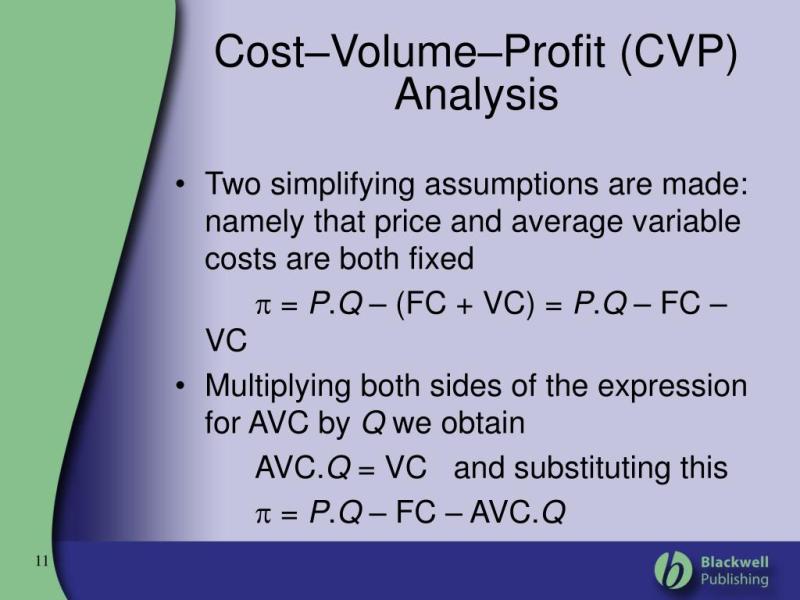
Cost-Volume-Profit Analysis
Once a basic understanding of medical cost behavior has been achieved, the techniques of cost-volume-profit analysis (CVPA) can be used to further refine the managerial cost and profit aspects of the office business unit. They can also help illustrate the important differences between the traditional office net income statement and the more contemporary contribution margin income statement.
***
***
Assessment
CVPA is thus concerned with the relationship among prices of medical services, unit volume, per unit variable costs, total fixed costs, and the mix of services provided.
MORE: Negotiating CVPA
Conclusion
Your thoughts and comments on this ME-P are appreciated. Feel free to review our top-left column, and top-right sidebar materials, links, URLs and related websites, too. Then, subscribe to the ME-P. It is fast, free and secure.
Link: http://feeds.feedburner.com/HealthcareFinancialsthePostForcxos
Speaker: If you need a moderator or speaker for an upcoming event, Dr. David E. Marcinko; MBA – Publisher-in-Chief of the Medical Executive-Post – is available for seminar or speaking engagements. Contact: MarcinkoAdvisors@msn.com
OUR OTHER PRINT BOOKS AND RELATED INFORMATION SOURCES:
LEXICONS: http://www.springerpub.com/Search/marcinko
PHYSICIANS: www.MedicalBusinessAdvisors.com
PRACTICES: www.BusinessofMedicalPractice.com
HOSPITALS: http://www.crcpress.com/product/isbn/9781466558731
CLINICS: http://www.crcpress.com/product/isbn/9781439879900
ADVISORS: www.CertifiedMedicalPlanner.org
PODIATRISTS: www.PodiatryPrep.com
BLOG: www.MedicalExecutivePost.com
Share this:

Filed under: iMBA, Inc., Practice Management | Tagged: cost-volume-profit relationships, Dr. Marcinko, Economics of Medical Practice, EHO, emerging health organizations, Medical Profit motive | 3 Comments »


 The Leading Business Education Network for Doctors, Financial Advisors and Health Industry Consultants