







 Support our online development, and advance our onground research initiatives in free market economics, as we seek to showcase the brightest Next-Gen minds.
THE ME-P DISCLAIMER: Posts, comments and opinions do not necessarily represent iMBA, Inc., but become our property after submission. Copyright © 2006 to-date. iMBA, Inc allows colleges, universities, medical and financial professionals and related clinics, hospitals and non-profit healthcare organizations to distribute our proprietary essays, photos, videos, audios and other documents; etc. However, please review copyright and usage information for each individual asset before submission to us, and/or placement on your publication or web site. Attestation references, citations and/or back-links are required. All other assets are property of the individual copyright holder.
Support our online development, and advance our onground research initiatives in free market economics, as we seek to showcase the brightest Next-Gen minds.
THE ME-P DISCLAIMER: Posts, comments and opinions do not necessarily represent iMBA, Inc., but become our property after submission. Copyright © 2006 to-date. iMBA, Inc allows colleges, universities, medical and financial professionals and related clinics, hospitals and non-profit healthcare organizations to distribute our proprietary essays, photos, videos, audios and other documents; etc. However, please review copyright and usage information for each individual asset before submission to us, and/or placement on your publication or web site. Attestation references, citations and/or back-links are required. All other assets are property of the individual copyright holder.


By Vitaliy Katsenelson CFA
***
***
The technology at the core of the mania is different every time. What doesn’t change over time is human emotion – the fear of missing out and then the fear of loss.
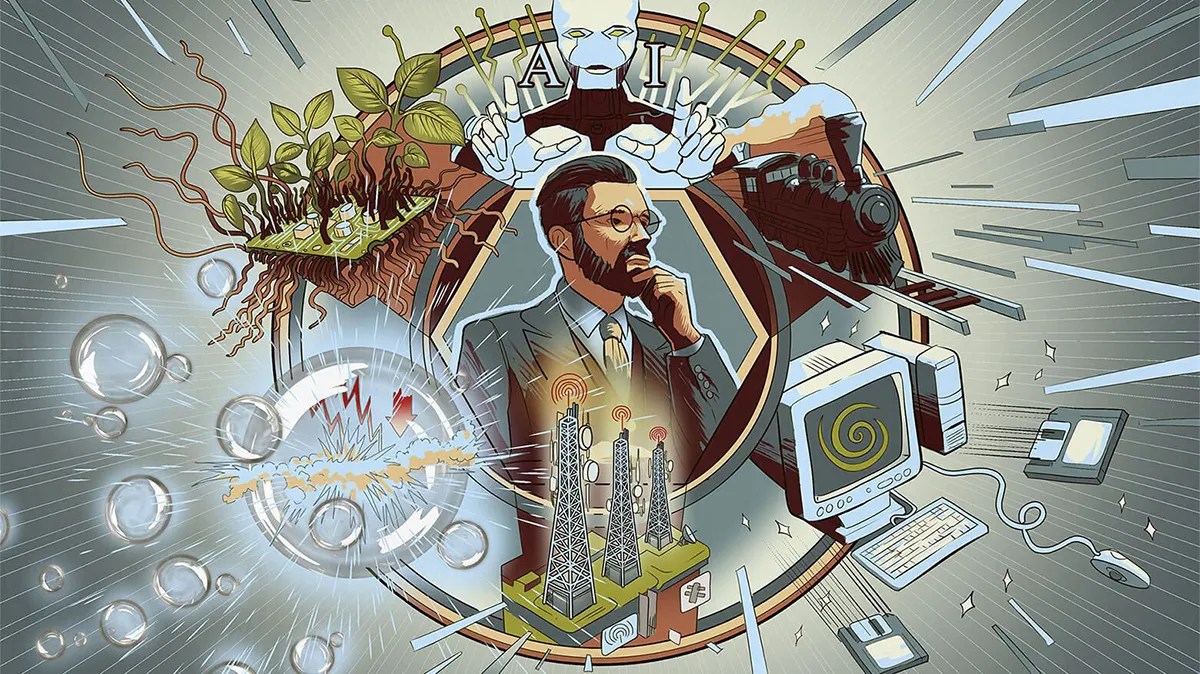
AI has a feel of “this time is different.” Optimism rarely erupts about the same technology twice; this is why history doesn’t repeat but rhymes. The technology at the core of the mania is different every time. What doesn’t change over time is human emotion – the fear of missing out and then the fear of loss, in that order.
Humans are an optimistic bunch. We need it; it’s essential to our survival and progress; but eventually, we take our optimism too far. The graveyard of financial ruins is full of these stories.
I have beat the dotcoms and Nifty Fifties to death, so let’s go to back another century. My friend the brilliant Edward Chancellor wrote about the railroad boom and bust in England in the 1800s. Here he is, edited for brevity:
The first railway to use steam locomotives opened in 1825 and was designed to carry coal, not passengers. Railway promoters simply did not appreciate the potential demand for high-speed travel. The successful launch of the Liverpool and Manchester Railway in 1830, however, demonstrated the commercial viability of passenger travel. By the early 1840s, Britain’s railway network stretched to more than 2,000 miles. Railway companies were delivering acceptable, if not spectacular, returns for investors.
Then railway fever suddenly gripped the nation. Enthusiasts touted rail transport not just for its economic benefits, but for its benign effects on human civilization. One journal envisaged a day when the “whole world will have become one great family speaking one language, governed in unity by like laws, and adoring one God.” In the two years after 1843, the index of rail stocks doubled.
Investment peaked at around 7% of Britain’s national income. Railway enthusiasts predicted that rail would soon replace all the country’s roads and that “horse and foot transit shall be nearly extinct.”
In 1845, Britain’s railways carried nearly 34 million passengers. If the 8,000 miles of newly authorized railways were to deliver their expected 10% return, then the industry’s total revenue and passenger traffic would have to climb five fold or more – all within the space of just five years. “This should have alarmed observers by itself … But they were deluded by the collective psychology of the Mania”, writes Odlyzko.
In 1847 a severe financial crisis broke out, induced in part by the diversion of large amounts of capital into unprofitable railway schemes. It turned out that the revenue projections provided by so-called “traffic takers” were wildly overoptimistic. Railway engineers underestimated costs. The vogue for constructing direct lines between large urban centers proved mistaken, as most traffic turned out to be local. As a result, Britain’s rail network was plagued with overcapacity. By the end of the decade, the index of railway stocks was down 65% from its 1845 peak.
The railroad bubble in England is just one example; there are hundreds of similar stories across market history. They all share this theme:
A new technology appears on the horizon. In the early stages, investment is rational, but then at some point excitement, imagination, and optimism take over, leading to overinvestment (usually creating a financial bubble). Investors make a lot of money until most lose it all. When the dust settles, only a few companies survive.
This AI boom reminds me of the telecom sector in the 1990s. The internet was going to change the world, and it did, but first we had tremendous overcapacity in global fiber and telecom equipment.
One could say that telecommunications companies overestimated demand for broadband and underestimated changes in technology, and that would be true. But there was a more nuanced dynamic at play, what economists call the fallacy of composition.
What’s true for one participant isn’t necessarily true for the group.
COMMENTS APPRECIATED
Like and Refer
***
***
Share this:

Filed under: "Ask-an-Advisor", Experts Invited, Financial Planning, Funding Basics, Information Technology, Investing, Portfolio Management | Tagged: AI, america, broadband, dotcoms, edward chancellor, IT, nifty fifties, social media, Technology, technology boom, techology, telecommunications, Vitaliy Katsenelson CFA | Leave a comment »
 The Leading Business Education Network for Doctors, Financial Advisors and Health Industry Consultants