







 Support our online development, and advance our onground research initiatives in free market economics, as we seek to showcase the brightest Next-Gen minds.
THE ME-P DISCLAIMER: Posts, comments and opinions do not necessarily represent iMBA, Inc., but become our property after submission. Copyright © 2006 to-date. iMBA, Inc allows colleges, universities, medical and financial professionals and related clinics, hospitals and non-profit healthcare organizations to distribute our proprietary essays, photos, videos, audios and other documents; etc. However, please review copyright and usage information for each individual asset before submission to us, and/or placement on your publication or web site. Attestation references, citations and/or back-links are required. All other assets are property of the individual copyright holder.
Support our online development, and advance our onground research initiatives in free market economics, as we seek to showcase the brightest Next-Gen minds.
THE ME-P DISCLAIMER: Posts, comments and opinions do not necessarily represent iMBA, Inc., but become our property after submission. Copyright © 2006 to-date. iMBA, Inc allows colleges, universities, medical and financial professionals and related clinics, hospitals and non-profit healthcare organizations to distribute our proprietary essays, photos, videos, audios and other documents; etc. However, please review copyright and usage information for each individual asset before submission to us, and/or placement on your publication or web site. Attestation references, citations and/or back-links are required. All other assets are property of the individual copyright holder.


By Staff Reporters and AI
SPONSOR: http://www.MarcinkoAssociates.com
***
***
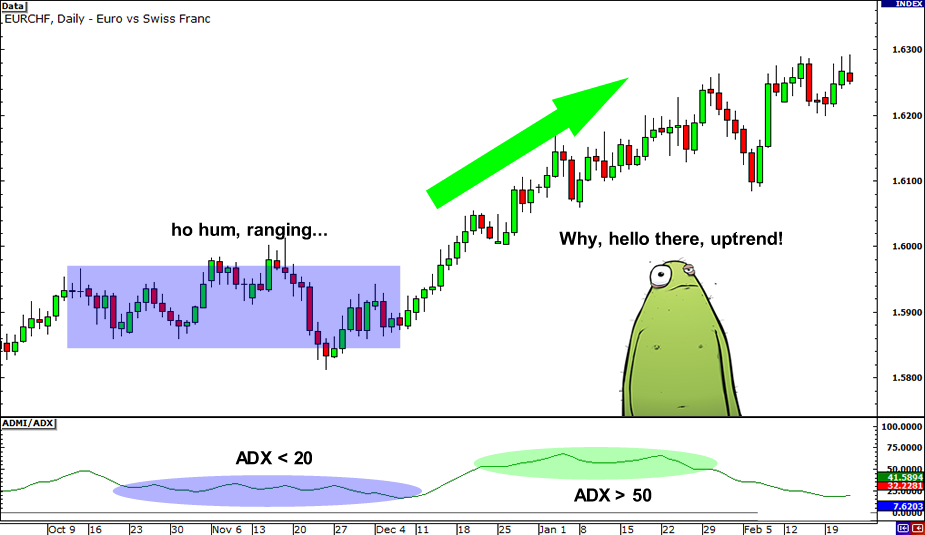
The average directional movement index (ADX) was developed in 1978 by J. Welles Wilder as a technical indicator of trend strength in a series of prices of a financial instrument. ADX has become a widely used indicator for technical analysts, and is provided as a standard in collections of indicators offered by various trading platforms.
The ADX is a combination of two other indicators developed by Wilder, the positive directional indicator (abbreviated +DI) and negative directional indicator (-DI). The ADX combines them and smooths the result with a smoothed moving average.
The average directional index (ADX) is a technical indicator used by traders to determine the strength of a financial security’s price trend. It helps them reduce risk and increase profit potential by trading in the direction of a strong trend. Many traders consider the ADX to be the ultimate trend gauge because it is so reliable.
ADX quantifies trend strength by measuring the degree of directional movement in price. ADX calculations are based on a moving average of price range expansion or contraction over a given period. The default setting is 14 periods, although other settings can be used.
ADX can be used with any financial security, including stocks, exchange-traded funds, and futures.
COMMENTS APPRECIATED
Like, Subscribe and Refer
***
***
Share this:

Filed under: "Ask-an-Advisor", economics, finance, Glossary Terms, Health Economics, Investing | Tagged: ADX, ADX: Average Directional Index, Average Directional Index, J Wells Wilder, trend | Leave a comment »
 The Leading Business Education Network for Doctors, Financial Advisors and Health Industry Consultants