







 Support our online development, and advance our onground research initiatives in free market economics, as we seek to showcase the brightest Next-Gen minds.
THE ME-P DISCLAIMER: Posts, comments and opinions do not necessarily represent iMBA, Inc., but become our property after submission. Copyright © 2006 to-date. iMBA, Inc allows colleges, universities, medical and financial professionals and related clinics, hospitals and non-profit healthcare organizations to distribute our proprietary essays, photos, videos, audios and other documents; etc. However, please review copyright and usage information for each individual asset before submission to us, and/or placement on your publication or web site. Attestation references, citations and/or back-links are required. All other assets are property of the individual copyright holder.
Support our online development, and advance our onground research initiatives in free market economics, as we seek to showcase the brightest Next-Gen minds.
THE ME-P DISCLAIMER: Posts, comments and opinions do not necessarily represent iMBA, Inc., but become our property after submission. Copyright © 2006 to-date. iMBA, Inc allows colleges, universities, medical and financial professionals and related clinics, hospitals and non-profit healthcare organizations to distribute our proprietary essays, photos, videos, audios and other documents; etc. However, please review copyright and usage information for each individual asset before submission to us, and/or placement on your publication or web site. Attestation references, citations and/or back-links are required. All other assets are property of the individual copyright holder.


A Mixed Picture
[By BNY Mellon]
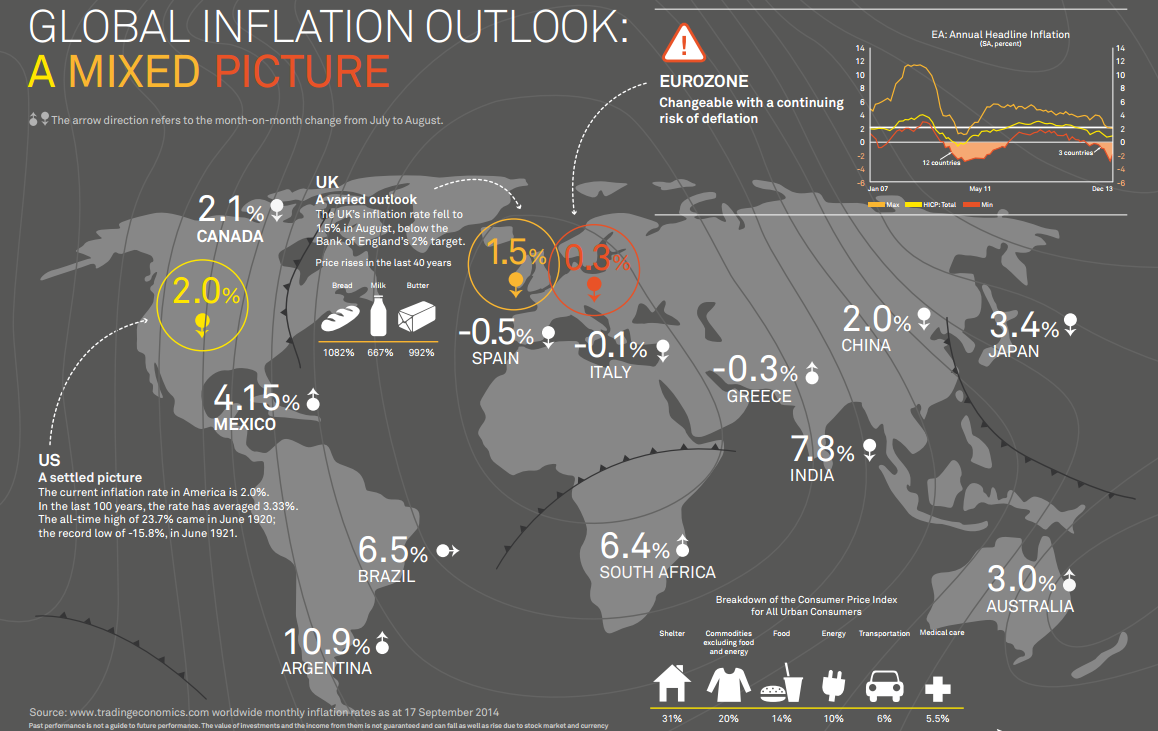
[Click to Enlarge]
Channel Surfing the ME-P
Have you visited our other topic channels? Established to facilitate idea exchange and link our community together, the value of these topics is dependent upon your input. Please take a minute to visit. And, to prevent that annoying spam, we ask that you register. It is fast, free and secure.
More:
- IS INFLATION STEALING YOUR FUTURE?
- Inflation Risk and Investing
- Understanding the New “Inflation Tax”
- Update on Tax Inflation Adjustments in 2013
Conclusion
Your thoughts and comments on this ME-P are appreciated. Feel free to review our top-left column, and top-right sidebar materials, links, URLs and related websites, too. Then, subscribe to the ME-P. It is fast, free and secure.
Speaker: If you need a moderator or speaker for an upcoming event, Dr. David E. Marcinko; MBA – Publisher-in-Chief of the Medical Executive-Post – is available for seminar or speaking engagements. Contact: MarcinkoAdvisors@msn.com
OUR OTHER PRINT BOOKS AND RELATED INFORMATION SOURCES:
- PRACTICES: www.BusinessofMedicalPractice.com
- HOSPITALS: http://www.crcpress.com/product/isbn/9781466558731
- CLINICS: http://www.crcpress.com/product/isbn/9781439879900
- ADVISORS: www.CertifiedMedicalPlanner.org
- FINANCE: Financial Planning for Physicians and Advisors
- INSURANCE: Risk Management and Insurance Strategies for Physicians and Advisors
- Dictionary of Health Economics and Finance
- Dictionary of Health Information Technology and Security
- Dictionary of Health Insurance and Managed Care
Share this:

Filed under: Portfolio Management | Tagged: Global Inflation Rates |


As Deflation Looms – It’s Europe’s Moment of Truth
Yep – Europe is in trouble again. But, this time it is on the brink of disastrous trouble.
http://www.msn.com/en-us/money/other/as-deflation-looms-it%e2%80%99s-europe%e2%80%99s-moment-of-truth/ar-BBgbNFh?ocid=iehp
This, unfortunately, seems to be news not yet delivered to many European Union technocrats—in particular, many Germans.
Rice
LikeLike
Russian Banks
Putin Just Announced A Massive Foreign Currency Bailout For Russia’s Collapsing Banks.
http://www.msn.com/en-us/money/markets/putin-just-announced-a-massive-foreign-currency-bailout-for-russias-collapsing-banks/ar-BBgkHIb?ocid=iehp
Igor
LikeLike
This is What Economic Sanctions Look Like
The Russian ruble is tanking, due to the decline in oil and economic sanctions imposed upon Russia following the invasion of Crimea, according to Bloomberg Businessweek. What is happening is all-out fear and panic by Russians who are rushing out to buy whatever they can to get rid of their cash.
http://www.businessweek.com/articles/2014-12-16/no-caviar-is-not-getting-cheaper-everything-you-need-to-know-about-the-russian-ruble-collapse#r=rss
Russia, in a surprise move, hiked interest rates to 17 percent to try and fight the ruble’s collapse.
http://www.msn.com/en-us/news/money/apple-closes-russian-website-because-of-rouble-crisis/ar-BBgUePi?ocid=iehp
Vladamire
LikeLike
Can you say deflation?
Will the falling ruble spread a Russian Contagion?
http://www.msn.com/en-us/money/markets/russias-ruble-ends-5-day-rally-drops-4-percent/ar-BBheBg7?ocid=iehp
Bank Bailouts?
http://www.msn.com/en-us/money/markets/russia-forecasts-economic-slump-as-bailed-out-bank-gets-more-funds/ar-BBheCe7?ocid=iehp
And, Putin in Crisis – Yikes!
http://www.msn.com/en-us/money/markets/in-crisis-mode-putin-cancels-kremlin-officials-vacations/ar-BBheyhr?ocid=iehp
Mendel
LikeLike
Home bias for investing?
What is investment home bias?
It’s the tendency to invest in your home country. You know many of the names in the S&P 500 or the NASDAQ, so it’s easy to buy funds that invest in those names. As with heading to that familiar beach or mountain retreat in the summer, such investing is easy and comfortable. But, maybe there’s something even more enticing out there you just don’t know about. And, it might be outside our borders.
A bigger world for investing
For all its heft, the United States makes up only about half the market capitalization (or value) of the world stock markets. Yet, U.S. investors put less than 30% of their investment dollars outside the States. In raw numbers, there are about 2,500 American companies to invest in. Include the world, and the number rises to about 8,500.
To invest only in the United States means playing a game with only part of the deck. Thinking bigger and broader means you expand the opportunity set. Plus, historically, such diversification can reduce portfolio volatility, offering the potential of a smoother ride over the long term.
Norris
LikeLike
Investment Lessons Learned from the Poker Table
“I don’t know.” These three words don’t inspire a lot of confidence in the messenger and probably will not get me invited onto CNBC, but that is exactly what I think about the topic I am about to discuss.
I received a few e-mails from people who had a problem with a phrase in one of my blog posts this fall. In that article I examined various risks that other investors and I are concerned about. The phrase was “the prospect of higher, maybe even much higher, interest rates.” These readers were convinced that higher interest rates and inflation are not a risk because we are not going to have them for a long, long time, that we are heading into deflation. These readers basically told me that I should worry about the things that will come next, not things that may or may not happen years and years down the road.
I am pretty sure that if that phrase had addressed the risk of deflation and lower interest rates ahead, I’d have gotten as many e-mails arguing that I was wrong — that we’ll soon have inflation and skyrocketing interest rates, and deflation is not going to happen.
I don’t know whether we are going to have inflation or deflation in the near future. More important, I’d be very careful about trusting my money to anyone holding very strong convictions on this topic and positioning my portfolio on the basis of them.
Any poker player knows that the worst thing that can happen is to have the second-best hand. If you have a weak hand, you are going to play defensively or fold (unless you are bluffing) and likely won’t lose much. But if you’re pretty confident in your hand, you may bet aggressively (god forbid you go all-in) — after all, you could easily have the winning cards. Four of a kind is a great poker hand unless your opponent has a straight flush.
Generally, the more confident you are in an investment, the larger portion of your portfolio will be placed in that position. Therefore superconvinced inflationists will load up on gold, and superconvinced deflationists will be swimming in long-term bonds. If their predictions are right, they’ll make a boatload of money. If they’re wrong, however, they will have the second-best-hand problem — and lose a lot of money.
The complexity of the global economy has been increased by monetary and fiscal government interventions everywhere. There is no historical example to which you can point and say, “That is what happened in the past, and this time looks just like that.” When was the last time every major global economy was this overlevered and overstimulated? I think never. (Okay almost never, but you have to go back to World War II.) What is going to happen when the Fed unwinds its $4 trillion balance sheet? I don’t know.
Also the transmission mechanism of problems in our new global economy is so much more dynamic now than it was even a decade ago. Just think about the importance of China to the global economy today versus 2004. That year U.S. imports from China stood at $196 billion. Just in the first eight months of 2014, they were $293 billion. China was single-handedly responsible for the appreciation of hard commodities (oil, iron ore, steel) over the past decade as it gobbled up the bulk of incremental demand.
I don’t want to sink to the level of the one-armed economist — but conversation about inflation and deflation is just that, an “on one hand . . . but on the other hand” discussion.
Just like in poker, second-best hands may be tolerable if, when you went all-in, you did not leverage your house, empty your kid’s college fund or pawn your mother-in-law’s cat. Even if you lost your money, you will live to play another hand — maybe just not today.
In the “I don’t know” world, second-best hands when you bet on inflation or deflation are acceptable on an individual position level (you can survive them) but are extremely dangerous, maybe fatal, on an overall portfolio level.
Investing in the current environment requires a lot of humility and an acceptance of the fact that we know very little of what the future holds. I’d want the person who manages my money to have some discomfort with his or her economic crystal ball and to construct my portfolio for the “I don’t know” world.
As a writer, you know you are in trouble when you have to quote both Albert Einstein and Mahatma Gandhi in the same paragraph, but when I ask readers to do something as difficult as I am in this column, I need all the help I can get.
“It is unwise to be too sure of one’s own wisdom,” Gandhi said. “It is healthy to be reminded that the strongest might weaken and the wisest might err.” Einstein took the idea a step further: “A true genius admits that he/she knows nothing.” Smarter and humbler people than me were willing to say, “I don’t know,” and it is okay for us mortals to say it too. Repeat after me . . .
Vitaliy Katsenelson CFA
LikeLike