







 Support our online development, and advance our onground research initiatives in free market economics, as we seek to showcase the brightest Next-Gen minds.
THE ME-P DISCLAIMER: Posts, comments and opinions do not necessarily represent iMBA, Inc., but become our property after submission. Copyright © 2006 to-date. iMBA, Inc allows colleges, universities, medical and financial professionals and related clinics, hospitals and non-profit healthcare organizations to distribute our proprietary essays, photos, videos, audios and other documents; etc. However, please review copyright and usage information for each individual asset before submission to us, and/or placement on your publication or web site. Attestation references, citations and/or back-links are required. All other assets are property of the individual copyright holder.
Support our online development, and advance our onground research initiatives in free market economics, as we seek to showcase the brightest Next-Gen minds.
THE ME-P DISCLAIMER: Posts, comments and opinions do not necessarily represent iMBA, Inc., but become our property after submission. Copyright © 2006 to-date. iMBA, Inc allows colleges, universities, medical and financial professionals and related clinics, hospitals and non-profit healthcare organizations to distribute our proprietary essays, photos, videos, audios and other documents; etc. However, please review copyright and usage information for each individual asset before submission to us, and/or placement on your publication or web site. Attestation references, citations and/or back-links are required. All other assets are property of the individual copyright holder.


A Dimensional Fund Advisors Survey
By Rick Kahler MS CFP® http://www.KahlerFinancial.com
 In this ME-P, I will focus on the three least important things investors want to know. The rankings came from a survey of investors, funded by Dimensional Fund Advisors, conducted in March 2014 by Advisor Impact.
All three deserved to be much higher on the list. In my experience, they are what most physicians and all investors really need to know.
The factors
These three factors are:
- What are the chances the investment will lose money? Only 10% of investors thought it was important to ask about factors that contributed to historic performance. Just one-third thought it important to even ask about historical performance in general.
- What type of volatility can they expect? Only 17% of investors considered this important.
- How and why did the advisor select the investment for their portfolio? Only 21% of survey respondents thought this was important, and just 8% asked about the investment managers chosen.
Drilling Down and Going Granular
Some of these factors may seem difficult to understand, but they do matter. Give your financial advisor a chance to explain them; it can help you become a more informed investor.

- Chances of losing money
This factor could be better addressed by asking about the specific factors that influenced historic performance of the security over various long-term economic climates. True, looking at the past performance of an investment is never a guarantee of future performance.
Yet, if the historical periods evaluated contain a variety of economic conditions (high inflation, various economic cycles, various political influences, etc.) and long-term holding periods (at least 10 years or more), looking backward may give you a reasonable idea of what future performance might look like.
- Volatility
Most investors will cognitively agree they fully understand that most investments that carry any chance of real (after inflation) significant long-term return will fluctuate. I say “cognitively” because, once that fluctuation happens on the downside, all cognitive understanding sometimes goes out the window and the emotional brain takes control.
One way of internalizing the potential fluctuation of an investment is to ask about its volatility. Specifically, it’s standard deviation. This measure of the amount of variation from the average is something an advisor can easily find out for almost every bond, stock, and mutual fund. Take the standard deviation times three, then subtract that number from the average return. This is the amount of value over one year your investment could drop (or rise) in 99% of all years. Stated conversely, there is only a 1% chance your investment would drop further in any one year.
- Portfolio Fit
I recently sent back a shirt that hung on me like a tent. While it would have been perfect for a larger guy, it was not a fit for me. Investments are similar. While some are perfect matches for one portfolio, they can be lethal in another. An over-allocation to emerging market stocks may make perfect sense for a newborn, but it could be a retirement disaster for a 90-year-old.

Assessment
It’s important to ask why an investment belongs in your portfolio. You want investments (asset classes) that complement one another by tending to fluctuate independently of each other.
In an ideal balance of investments, when some decrease in value the other half increase an equal or greater amount, and all of them earn a real return over time.
Conclusion
Your thoughts and comments on this ME-P are appreciated. Feel free to review our top-left column, and top-right sidebar materials, links, URLs and related websites, too. Then, subscribe to the ME-P. It is fast, free and secure.
Speaker: If you need a moderator or speaker for an upcoming event, Dr. David E. Marcinko; MBA – Publisher-in-Chief of the Medical Executive-Post – is available for seminar or speaking engagements. Contact: MarcinkoAdvisors@msn.com
OUR OTHER PRINT BOOKS AND RELATED INFORMATION SOURCES:
- PRACTICES: www.BusinessofMedicalPractice.com
- HOSPITALS: http://www.crcpress.com/product/isbn/9781466558731
- CLINICS: http://www.crcpress.com/product/isbn/9781439879900
- ADVISORS: www.CertifiedMedicalPlanner.org
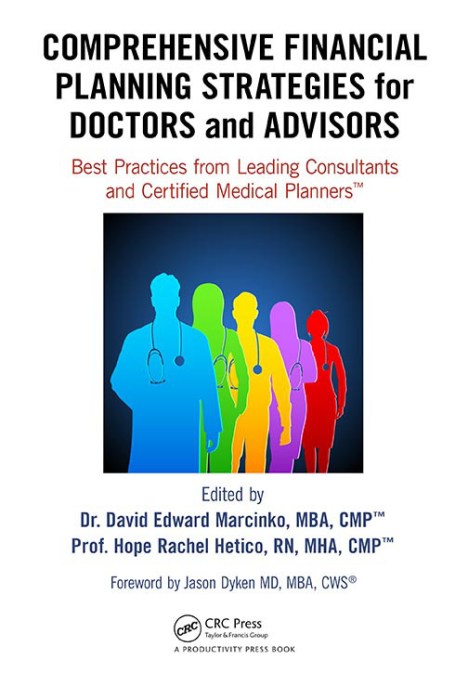
- FINANCE: Financial Planning for Physicians and Advisors
- INSURANCE: Risk Management and Insurance Strategies for Physicians and Advisors
- Dictionary of Health Economics and Finance
- Dictionary of Health Information Technology and Security
- Dictionary of Health Insurance and Managed Care

Share this:

Filed under: CMP Program, Investing, Portfolio Management | Tagged: Advisor Impact, Dimensional Fund Advisors, investing risks, Portfolio Management, Rick Kahler CFP® | Leave a comment »
 The Leading Business Education Network for Doctors, Financial Advisors and Health Industry Consultants