






 Support our online development, and advance our onground research initiatives in free market economics, as we seek to showcase the brightest Next-Gen minds.
THE ME-P DISCLAIMER: Posts, comments and opinions do not necessarily represent iMBA, Inc., but become our property after submission. Copyright © 2006 to-date. iMBA, Inc allows colleges, universities, medical and financial professionals and related clinics, hospitals and non-profit healthcare organizations to distribute our proprietary essays, photos, videos, audios and other documents; etc. However, please review copyright and usage information for each individual asset before submission to us, and/or placement on your publication or web site. Attestation references, citations and/or back-links are required. All other assets are property of the individual copyright holder.
Support our online development, and advance our onground research initiatives in free market economics, as we seek to showcase the brightest Next-Gen minds.
THE ME-P DISCLAIMER: Posts, comments and opinions do not necessarily represent iMBA, Inc., but become our property after submission. Copyright © 2006 to-date. iMBA, Inc allows colleges, universities, medical and financial professionals and related clinics, hospitals and non-profit healthcare organizations to distribute our proprietary essays, photos, videos, audios and other documents; etc. However, please review copyright and usage information for each individual asset before submission to us, and/or placement on your publication or web site. Attestation references, citations and/or back-links are required. All other assets are property of the individual copyright holder.


Drivers of Decline
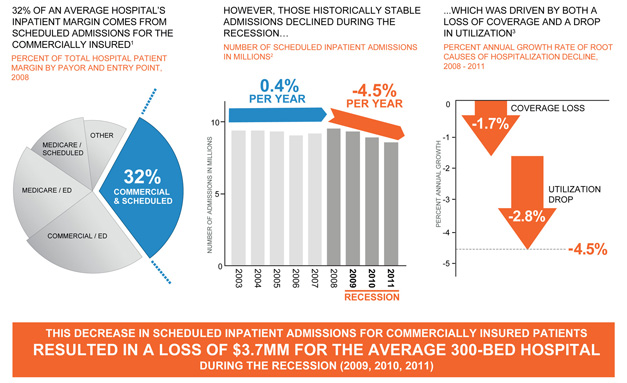
Commercially insured scheduled admissions are the largest contributor to inpatient margins for the average US hospital. During the US recession (2009-2011), volumes in this segment declined. There were two primary drivers of this decline.
####
Dual Causes
First, commercial insurance coverage decreased, stemming from unemployment and underemployment. This is expected to reverse and rebound as the economy recovers and as healthcare reform is implemented.
Second, even among those who retained coverage, utilization of inpatient services decreased as patients delayed or forewent elective and preventative care. This was influenced by a range of economic factors, including reduced household incomes, higher co-pays, and a reduced ability to leave work for medical care, as well as factor unrelated to the recession, such as a shift to outpatient management of disease.
More: Are Cost Estimates Leading To The Wrong Decisions in US Hospitals?
Assessment
It is unclear whether this second driver will diminish fully as the economy recovers. A slow recovery – or one that fails to see volumes to return to pre-recession levels – suggests that hospitals may need to refocus their strategies on service lines and segments that have historically been less attractive.
Channel Surfing the ME-P
Have you visited our other topic channels? Established to facilitate idea exchange and link our community together, the value of these topics is dependent upon your input. Please take a minute to visit. And, to prevent that annoying spam, we ask that you register. It is fast, free and secure.
Conclusion
Your thoughts and comments on this ME-P are appreciated. Feel free to review our top-left column, and top-right sidebar materials, links, URLs and related websites, too. Then, subscribe to the ME-P. It is fast, free and secure.
Speaker: If you need a moderator or speaker for an upcoming event, Dr. David E. Marcinko; MBA – Publisher-in-Chief of the Medical Executive-Post – is available for seminar or speaking engagements. Contact: MarcinkoAdvisors@msn.com
OUR OTHER PRINT BOOKS AND RELATED INFORMATION SOURCES:
- PRACTICES: www.BusinessofMedicalPractice.com
- HOSPITALS: http://www.crcpress.com/product/isbn/9781466558731
- CLINICS: http://www.crcpress.com/product/isbn/9781439879900
- ADVISORS: www.CertifiedMedicalPlanner.org
- FINANCE: Financial Planning for Physicians and Advisors
- INSURANCE: Risk Management and Insurance Strategies for Physicians and Advisors
- Dictionary of Health Economics and Finance
- Dictionary of Health Information Technology and Security
- Dictionary of Health Insurance and Managed Care

Share this:

Filed under: Health Economics, Practice Management, Recommended Books, Retirement and Benefits | Tagged: hospitals, Hospitals and Healthcare Organizations, Impact Of The U.S. Recession On Hospitals, recession |
 The Leading Business Education Network for Doctors, Financial Advisors and Health Industry Consultants
Paying for ObamaCare
http://news.msn.com/politics/arizona-governor-plans-to-tax-hospitals-to-expand-medicaid
Arizona governor plans to tax hospitals to expand Medicaid.
Howard
LikeLike
Recession Mentality Deeply Ingrained
The majority of consumers in the world’s richest markets have tightened their belts and are bracing for a sustained period of weak income growth.
https://www.bcgperspectives.com/content/articles/consumer_insight_consumer_products_recession_mentality_deeply_ingrained/
Sherlock
LikeLike
Why the Next Recession Will Be Different
It’s the time of year when analysts and pundits begin “marking their beliefs to market” – telling us what they got right or wrong in the previous year.
http://www.msn.com/en-us/money/markets/why-the-next-recession-will-be-different/ar-BBgergT?ocid=iehp
In that spirit, here are some of the things we got wrong about the Great Recession.
Simon
LikeLike
Healthcare Cost Inflation Has Decreased After Each of the Last 3 Recessions
Eric Bricker MD
via Ann Miller RN MHA
LikeLike