





 Support our online development, and advance our onground research initiatives in free market economics, as we seek to showcase the brightest Next-Gen minds.
THE ME-P DISCLAIMER: Posts, comments and opinions do not necessarily represent iMBA, Inc., but become our property after submission. Copyright © 2006 to-date. iMBA, Inc allows colleges, universities, medical and financial professionals and related clinics, hospitals and non-profit healthcare organizations to distribute our proprietary essays, photos, videos, audios and other documents; etc. However, please review copyright and usage information for each individual asset before submission to us, and/or placement on your publication or web site. Attestation references, citations and/or back-links are required. All other assets are property of the individual copyright holder.
Support our online development, and advance our onground research initiatives in free market economics, as we seek to showcase the brightest Next-Gen minds.
THE ME-P DISCLAIMER: Posts, comments and opinions do not necessarily represent iMBA, Inc., but become our property after submission. Copyright © 2006 to-date. iMBA, Inc allows colleges, universities, medical and financial professionals and related clinics, hospitals and non-profit healthcare organizations to distribute our proprietary essays, photos, videos, audios and other documents; etc. However, please review copyright and usage information for each individual asset before submission to us, and/or placement on your publication or web site. Attestation references, citations and/or back-links are required. All other assets are property of the individual copyright holder.


[By Staff Reporters]
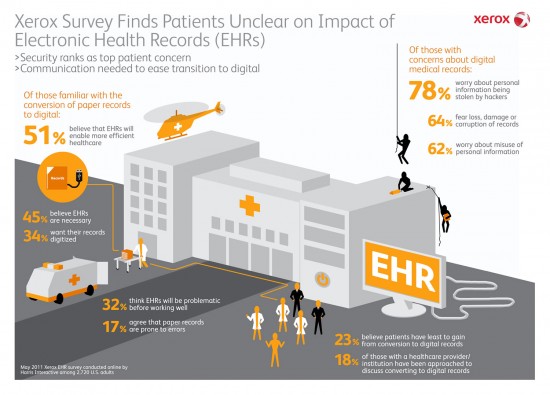
Patients are unclear on the impact of Electronic Health Records (EHRs) and cite security as a top concern, according to a recent survey conducted for Xerox.
Providers must focus on patient communication to explain benefits of EHRs as the country transitions from a paper-based system to digital as part of national healthcare reform.
Brought to you by Xerox
Conclusion
Your thoughts and comments on this ME-P are appreciated. Feel free to review our top-left column, and top-right sidebar materials, links, URLs and related websites, too. Then, subscribe to the ME-P. It is fast, free and secure.
Link: http://feeds.feedburner.com/HealthcareFinancialsthePostForcxos
Speaker: If you need a moderator or speaker for an upcoming event, Dr. David E. Marcinko; MBA – Publisher-in-Chief of the Medical Executive-Post – is available for seminar or speaking engagements. Contact: MarcinkoAdvisors@msn.com
OUR OTHER PRINT BOOKS AND RELATED INFORMATION SOURCES:
DICTIONARIES: http://www.springerpub.com/Search/marcinko
PHYSICIANS: www.MedicalBusinessAdvisors.com
PRACTICES: www.BusinessofMedicalPractice.com
HOSPITALS: http://www.crcpress.com/product/isbn/9781466558731
CLINICS: http://www.crcpress.com/product/isbn/9781439879900
BLOG: www.MedicalExecutivePost.com
FINANCE: Financial Planning for Physicians and Advisors
INSURANCE: Risk Management and Insurance Strategies for Physicians and Advisors



Share this:

Filed under: Information Technology | Tagged: EHRs, electronic health records, eMRs Xerox, Impact of Electronic Medical Records, national healthcare reform |
 The Leading Business Education Network for Doctors, Financial Advisors and Health Industry Consultants
Are eDRs safe? Let dental patients decide
If you are a HIPAA-covered dentist who maintains patients’ Protected Health Information (PHI), beware of the increasing number of hits heading your way. What’s more, as far as I can tell, every member of the ADA Electronic Health Record Workgroup are out of touch with our dental community. You are on your own.
“Nearly 80% of consumers surveyed earlier this year said they’re wary of electronic health records because they’re concerned that their personal information might be stolen or lost it if were kept in an EHR system.” (from “E-health records still scare most of us” by Lucas Mearian)
http://www.computerworld.com/s/article/9218652/E_health_records_still_scare_most_of_us#disqus_thread
If 80% of dental patients also happen to fear EDRs, and 95% of dentists in the nation are HIPAA-covered entities, at what point will consumers seek the other 5% whose paper dental records have a long track record of both safety and value?
(Beat the rush. Call now for an appointment while we can still fit you in!)
D. Kellus Pruitt DDS
LikeLike
Even as Xerox publishes the results of a study that says 80% of consumers fear that EHRs will expose their privacy, HIT stakeholders would revoke their ability to find out.
Yesterday, Janice Simmons posted “Unnecessary HIPAA ‘disclosures’ rule needs to go, critics maintain.”
http://www.fierceemr.com/story/unnecessary-hipaa-disclosures-rule-needs-go-critics-maintain/2011-07-27
The FierceEMR.com article’s opening words reveal unapologetic marginalization of the tenets of the Hippocratic Oath:
“Fearful that doctors might be hesitant to adopt electronic health record technology, the Medical Group Management Association called on the Department of Health and Human Services to withdraw its proposed HIPAA ‘accounting of disclosures’ rule this week.”
HIT stakeholders with lousy products that won’t sell even with federal subsidies will sooner or later recognize that if patients don’t trust the security of their certified EHRs, all sales will stop – mandate or no mandate.
D. Kellus Pruitt DDS
LikeLike
Health IT On Congressional Chopping Block?
Experts outline several ways that healthcare could be affected by deficit reduction committee’s $2.4 trillion in cuts to federal spending.
http://www.informationweek.com/news/healthcare/policy/231600240
Tom
LikeLike
I’m surprised it’s made it this far.
Darrell
LikeLike
Darrell
Q: Why are e-books so expensive?
A: Because they are profit centers.
E-books eliminate expenses ranging from paper to transportation – shouldn’t they cost less than their paper cousins? But, they don’t. No used e-book after market, either.
http://money.msn.com/shopping-deals/article.aspx?post=7fb568d9-f4a6-408b-9da2-4176dfa3f36c
Doesn’t this analogy seem to follow the huge expenses of eHRs. Paper records are safer too!
Regan
LikeLike
In the news
– “Research Reveals Why Hacked Patient Records Are So Valuable – New Report to U.S. Senate Describes How Criminals Put Data to Use” By Marianne Kolbasuk McGee for Gov Info Security, September 27, 2016.
http://www.govinfosecurity.com/interviews/research-reveals-hacked-patient-records-are-so-valuable-i-3341
McGee: “Why are hacked healthcare records so valuable? It’s because stolen patient records often end up for sale on the deep web as part of information packages called ‘fullz’ and ‘identity kits’ used by fraudsters to commit a wide variety of crimes, says researcher James Scott.”
– “Cyberattacks on personal health records growing ‘exponentially’” By Joe Davidson for The Washington Post, September 28, 2016.
https://www.washingtonpost.com/news/powerpost/wp/2016/09/28/cyberattacks-on-personal-health-records-growing-exponentially/
Davidson: “In 2015, 113 million electronic health records were breached, a major leap over the 12.5 million the year before. In 2009, the number was less than 135,000. The number of reported hacks and breaches affecting records of at least 500 individuals rose from none in 2009 to 56 last year, almost double from 2014.
‘The magnitude of the threat against health care information has grown exponentially,’ GAO said, citing a 2015 study by the KPMG accounting firm.”
– “HIPAA Experts Highlight Recent ‘Spike’ in Enforcement” By David Slaughter, JD, Senior Legal Editor for HR.BLR.com, September 28, 2016.
http://hr.blr.com/HR-news/Benefits-Leave/HIPAA-Health-Information-Privacy/HIPAA-Experts-Highlight-Recent-Spike-Enforcement/#
Slaughter: “A recent surge in monetary Health Insurance Portability and Accountability Act (HIPAA) settlements is altering the compliance landscape at a time when new technical and legal challenges also are coming into play, practitioners and regulators told a recent conference.”
D. Kellus Pruitt DDS
LikeLike