







 Support our online development, and advance our onground research initiatives in free market economics, as we seek to showcase the brightest Next-Gen minds.
THE ME-P DISCLAIMER: Posts, comments and opinions do not necessarily represent iMBA, Inc., but become our property after submission. Copyright © 2006 to-date. iMBA, Inc allows colleges, universities, medical and financial professionals and related clinics, hospitals and non-profit healthcare organizations to distribute our proprietary essays, photos, videos, audios and other documents; etc. However, please review copyright and usage information for each individual asset before submission to us, and/or placement on your publication or web site. Attestation references, citations and/or back-links are required. All other assets are property of the individual copyright holder.
Support our online development, and advance our onground research initiatives in free market economics, as we seek to showcase the brightest Next-Gen minds.
THE ME-P DISCLAIMER: Posts, comments and opinions do not necessarily represent iMBA, Inc., but become our property after submission. Copyright © 2006 to-date. iMBA, Inc allows colleges, universities, medical and financial professionals and related clinics, hospitals and non-profit healthcare organizations to distribute our proprietary essays, photos, videos, audios and other documents; etc. However, please review copyright and usage information for each individual asset before submission to us, and/or placement on your publication or web site. Attestation references, citations and/or back-links are required. All other assets are property of the individual copyright holder.


Patient 2.0 Collaborative Care Worries Doctors
By Staff Reporters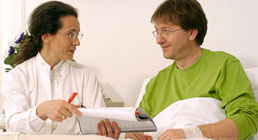
Writing for Time, Bonnie Rochman digs into the ramifications of patients sharing information and tips online, an “empowerment movement” she calls “Patient 2.0.”
Society of Participatory Medicine
In the piece, she profiles the newly created Society for Participatory Medicine, which “encourages patients to learn as much as they can about their health and also helps doctors support patients on this data-intensive quest,” as well as PatientsLikeMe.com, a free service which makes its money by selling anonymized patient information.
Assessment
Link: http://www.healthjournalism.org/blog/2010/02/patient-20-empowers-patients-worries-doctors/
Our New Book
For more information, please visit our new companion blog for the: Business of Medical Practice [Transformational Health 2.0 Profit Maximizing Skills for Savvy Doctors] – third edition.
Link: www.BusinessofMedicalPractice.com
Conclusion
And so, your comments on this ME-P are appreciated. What are your thoughts on health 2.0? Are doctors worried? Feel free to review our top-left column, and top-right sidebar materials, links, URLs and related websites, too. Then, be sure to subscribe to the ME-P. It is fast, free and secure.
Link: http://feeds.feedburner.com/HealthcareFinancialsthePostForcxos
Speaker: If you need a moderator or speaker for an upcoming event, Dr. David E. Marcinko; MBA – Publisher-in-Chief of the Medical Executive-Post – is available for seminar or speaking engagements. Contact: MarcinkoAdvisors@msn.com
Subscribe Now: Did you like this Medical Executive-Post, or find it helpful, interesting and informative? Want to get the latest ME-Ps delivered to your email box each morning? Just subscribe using the link below. You can unsubscribe at any time. Security is assured.
Link: http://feeds.feedburner.com/HealthcareFinancialsthePostForcxos
Sponsors Welcomed
And, credible sponsors and like-minded advertisers are always welcomed.
Link: https://healthcarefinancials.wordpress.com/2007/11/11/advertise
***
Share this:

Filed under: "Doctors Only", Ethics, Practice Management, Recommended Books | Tagged: Bonnie Rochman, Business of Medical Practice, collaborative care, health 2.0, patient 2.0, Society of Participatory Medicine |
 The Leading Business Education Network for Doctors, Financial Advisors and Health Industry Consultants
Many More eMR Project Updates for 2010
http://msofficeemrproject.com/Page7.htm
Alberto A. Borges; MD
LikeLike
Health 2.0 and Crowdsourcing
The incredible power of the internet is illustrated in the phenomenon of “crowd sourcing.”
In this context, the term means to harvest the reach and scope of social and professional networking on the Internet to solve a complex problem. A knowledge seeker asks a question and participants respond.
It demonstrates how the asynchronous participation of many participants inevitably converges on the right answer in less than 24 hours. You just have to be patient and let the truth emerge.
Ethical doctors embrace the concept while healthcare merchants loathe it.
Grayson
LikeLike
e-Visits to the Dermatologist
At the ME-P; we’ve been a fan of e-medical visits for a long time.
And, though some of the concerns from the medical establishment are warranted – It’s tough to know the nuances of a case without a pre-existing relationship with a patient, physicians aren’t often reimbursed for their time, there isn’t enough scientific evidence to show e-visits are effective, etc – much of the negativity likely was due to simple reluctance to change.
Here’s why: http://archderm.ama-assn.org/cgi/content/abstract/146/4/406
Ann Miller; RN MHA
[Executive Director]
LikeLike
When a Patient Has a Gripe
When faced with unhappy or even angry patients, some doctors may try to sweep the complaints under the rug. That’s a bad idea. There is a definite correlation between the number of complaints and the number of malpractice suits.
http://www.physiciansmoneydigest.com/your-practice/When-a-Patient-Has-a-Gripe
Fred
LikeLike
Al, Grayson and Fred,
Medicine traditionally relies on the unique truism that “patients may die, despite consummate skills of the practitioner.”
No other field has this ready, plausible explanation for poor outcomes. “My patients are sicker!” has been a nearly impenetrable defense for fending off serious inquiry into the sickly statistics.
Dr. David E. Marcinko MBA CMP™
http://www.BusinessofMedicalPractice.com
LikeLike
US doctors mixed on benefits of connected health
Doctors understand the basic benefits of connected health, including data-sharing via electronic health systems and health information exchanges, but don’t quite grasp the finer points, according to an international study of more than 3,700 doctors.
In fact, most doctors said healthcare IT improves access to quality data for clinical research (71 percent), improves care coordination (69 percent) and reduces medical errors (66 percent).
But reducing unneeded procedures, improving access to services and improving patient outcomes? Not so much: Roughly 40 percent said that connected health has a negative impact, no impact or unknown impact on these three areas.
The survey was conducted by technology services firm Accenture.
http://www.fiercehealthit.com/press-releases/doctors-agree-top-healthcare-it-benefits-generational-divide-exists-accordi?utm_medium=nl&utm_source=internal
So, is this new connected wave really health 2. do-h?
Hope R. Hetico RN MHA
LikeLike