







 Support our online development, and advance our onground research initiatives in free market economics, as we seek to showcase the brightest Next-Gen minds.
THE ME-P DISCLAIMER: Posts, comments and opinions do not necessarily represent iMBA, Inc., but become our property after submission. Copyright © 2006 to-date. iMBA, Inc allows colleges, universities, medical and financial professionals and related clinics, hospitals and non-profit healthcare organizations to distribute our proprietary essays, photos, videos, audios and other documents; etc. However, please review copyright and usage information for each individual asset before submission to us, and/or placement on your publication or web site. Attestation references, citations and/or back-links are required. All other assets are property of the individual copyright holder.
Support our online development, and advance our onground research initiatives in free market economics, as we seek to showcase the brightest Next-Gen minds.
THE ME-P DISCLAIMER: Posts, comments and opinions do not necessarily represent iMBA, Inc., but become our property after submission. Copyright © 2006 to-date. iMBA, Inc allows colleges, universities, medical and financial professionals and related clinics, hospitals and non-profit healthcare organizations to distribute our proprietary essays, photos, videos, audios and other documents; etc. However, please review copyright and usage information for each individual asset before submission to us, and/or placement on your publication or web site. Attestation references, citations and/or back-links are required. All other assets are property of the individual copyright holder.


By Staff Reporters
***
***
Tokenization is the process of converting an asset or the ownership rights of an asset to a unique unit called tokens. Tokens are commonly referred to when discussing blockchain technology, where they are used to indicate the ownership of a valuable asset.
Tokens can indicate ownership of tangible assets, like art, or they can indicate ownership of intangible assets, such as shares in a company or voting rights. Tokenization can occur for any item that is deemed valuable.
Tokens can then be used to transfer ownership of an asset, make payments and complete other financial tasks. An example of tokenization would be Bitcoin. It is a popular cryptocurrency that uses tokens to represent how much BTC a person owns.
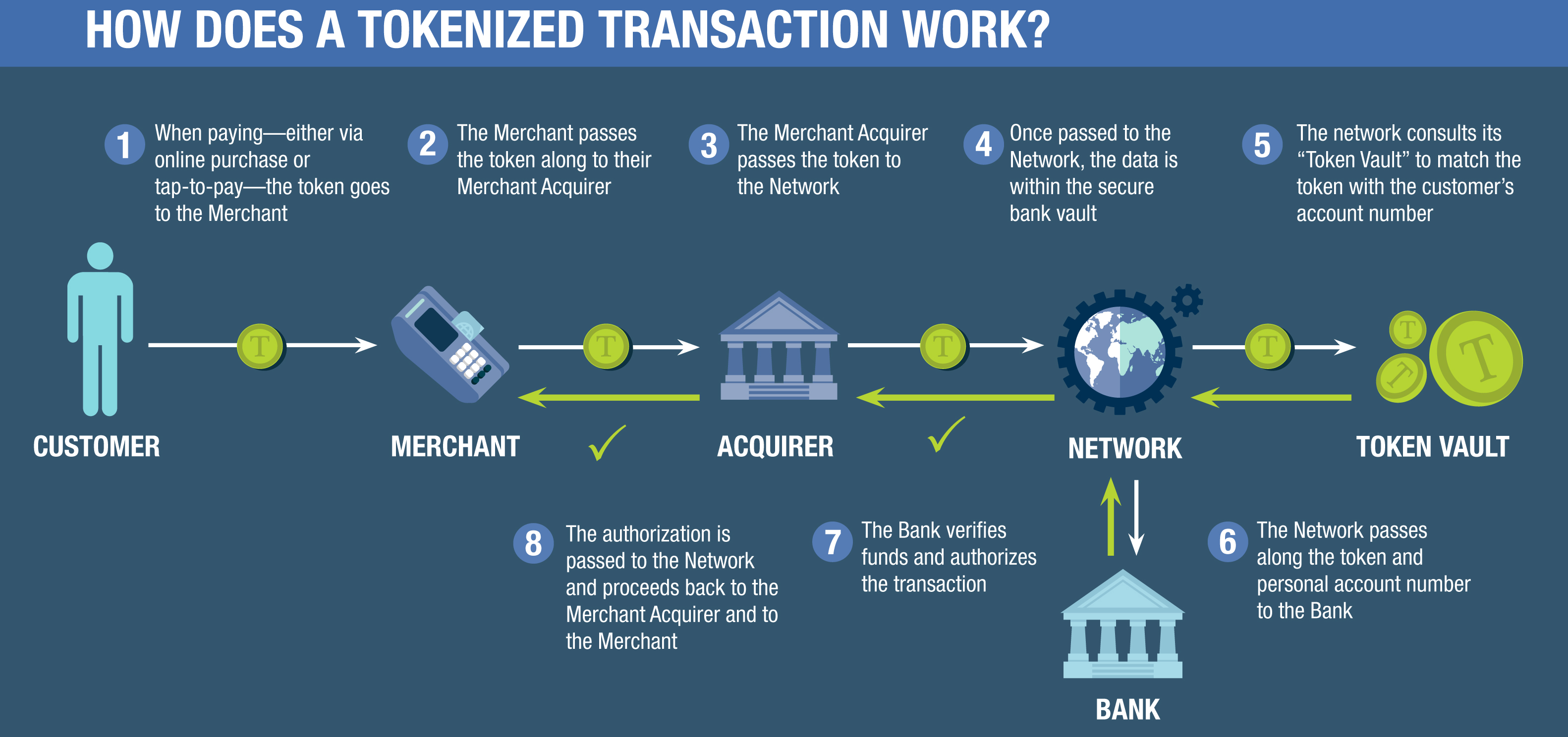
Tokenization began as a type of data security for businesses that replaces sensitive information with unique, non-sensitive data. Tokens don’t contain the original data, but they usually share similar characters or formatting.
A user would need access to the tokens that are connected to the separately-stored originals in order to restore the tokens and view the secured data. Otherwise, a user would not be able to decipher the token to view the data. Therefore, they can be useful for securing personal information, financial transaction data and other sensitive data.
***
***
There are multiple types of blockchain tokenization and non-blockchain tokenization.
Blockchain Tokenization
Types of blockchain tokenization include:
- Fungible tokenization. These are standard blockchain tokens. They have identical values, so they can easily replace one another — think of swapping one dollar for another dollar.
- Non-fungible tokenization. These are less common blockchain tokens that do not have a set value. Instead, they represent ownership of an asset, such as digital art or real estate, that determines the value of the token.
- Governance tokenization. These tokens represent voting rights and can be used to vote and collaborate on a blockchain system.
- Utility tokenization. These tokens are used to give access to certain products and services on a specific blockchain, so they can be used to complete actions like paying transaction fees or operating a decentralized market system.
Non-blockchain Tokenization
Types of non-blockchain tokenization include:
- Vault tokenization. This is the standard type of tokenization to protect payment information, where the token is used to process payments without providing card numbers or other data.
- Vaultless tokenization. This is a type of tokenization used for payment processing that doesn’t require a token vault for storage. Instead, it uses cryptographic devices and algorithms to convert data to a token.
- Natural language processing tokenization. This type of tokenization breaks information down into simpler terms to make it more easily understood by computers. It includes word, sub word and character tokenization.
While tokenization began with the idea of protecting data assets using non-blockchain tokenization, it has developed into a way to protect the ownership of many other types of assets by using blockchain technology.
MORE: https://www.blockchain-council.org/blockchain/what-is-tokenization/
***
***
COMMENTS APPRECIATED
Thank You
***
Share this:

Filed under: "Ask-an-Advisor", Financial Planning, Information Technology, Investing, Research & Development | Tagged: Bitcoin, blockchain, BTC, cryptocurrency, fungible, fungible tokens, governance tokens, tokenization, tokins, utility tokens, vault tokenization, vaultness tokenization | Leave a comment »
 The Leading Business Education Network for Doctors, Financial Advisors and Health Industry Consultants