





 Support our online development, and advance our onground research initiatives in free market economics, as we seek to showcase the brightest Next-Gen minds.
THE ME-P DISCLAIMER: Posts, comments and opinions do not necessarily represent iMBA, Inc., but become our property after submission. Copyright © 2006 to-date. iMBA, Inc allows colleges, universities, medical and financial professionals and related clinics, hospitals and non-profit healthcare organizations to distribute our proprietary essays, photos, videos, audios and other documents; etc. However, please review copyright and usage information for each individual asset before submission to us, and/or placement on your publication or web site. Attestation references, citations and/or back-links are required. All other assets are property of the individual copyright holder.
Support our online development, and advance our onground research initiatives in free market economics, as we seek to showcase the brightest Next-Gen minds.
THE ME-P DISCLAIMER: Posts, comments and opinions do not necessarily represent iMBA, Inc., but become our property after submission. Copyright © 2006 to-date. iMBA, Inc allows colleges, universities, medical and financial professionals and related clinics, hospitals and non-profit healthcare organizations to distribute our proprietary essays, photos, videos, audios and other documents; etc. However, please review copyright and usage information for each individual asset before submission to us, and/or placement on your publication or web site. Attestation references, citations and/or back-links are required. All other assets are property of the individual copyright holder.


What doctors need to know before their next service
[By Dr. David Edward Marcinko MBA and Nalley Lexus-Roswell]
 Chances are you might have heard a thing or two about oil prices and all the work it takes to get it out of the ground. You may have even walked into an auto parts store and seen a wall filled with a plethora of different types, viscosities, and brands of oil. Luckily, there are choices to be had, and we’re here to walk you through them.
To Lubricate – Not Burn
Right off the bat, the point should be made clear that motor oil is not meant to be burnt. Sure, oils are used to make the gasoline and diesel fuels that power our vehicles, but motor oil is purely there to lubricate the internals of your engine, not to be burnt as an energy source. It’s that type of burning that causes some of the environmental issues. If you notice a blue smoke emitting from the tailpipe of your vehicle, and the need to add oil every so often, your engine might have a serious problem.
But, for normal motor oil usage, the lubrication of engine internals to keep metal from touching metal while the various bits and pieces move a couple thousand times a minute, there are basically two types – conventional and synthetic.
Conventional Oil
Conventional motor oil has done a great job for the past hundred years or so, and is still largely the norm when it comes to servicing your vehicle. Why is this? For the vast majority of drivers in normal vehicles, conventional motor oil meets the vehicle’s needs while being lower cost. In fact, a quart of conventional motor oil will only set you back half of what a quart of synthetic oil costs.
What are some of the benefits of conventional motor oil? First of all, there’s the cost proposition. And if you drive a normal vehicle, conventional oil might actually be a better choice, as it’s a thicker substance. Also, for that same reason, conventional oil is often the lubricant of choice in higher-mileage engines, where some worn components might not have the ability to seal that they once had.
Synthetic Oil
Synthetic motor oil, however, is the new wave of engine lubrication. First designed for aircraft applications in the 1970s, it has also found a home in the engines of many high-performance vehicles. With the requirement of maintaining lubricating abilities at high altitudes and temperatures in aircraft, it was a natural fit. Because of the higher tolerances of aircraft and high-performance engines, the thinner nature of synthetic oil is meant to squeeze into every nook and cranny available, exactly what is needed in these finely-crafted engines.
While synthetic oil might cost twice as much as conventional, it’s thermal properties that keep it from breaking down over time mean that oil changes can occur less often at higher mileage intervals, saving you headaches and recouping some of those costs. Also, due to its thinner nature, it flows easier in cold weather, meaning less warm-up time for your engine, decreasing, once again, headaches and harmful exhaust fumes.
My Kitty Oil
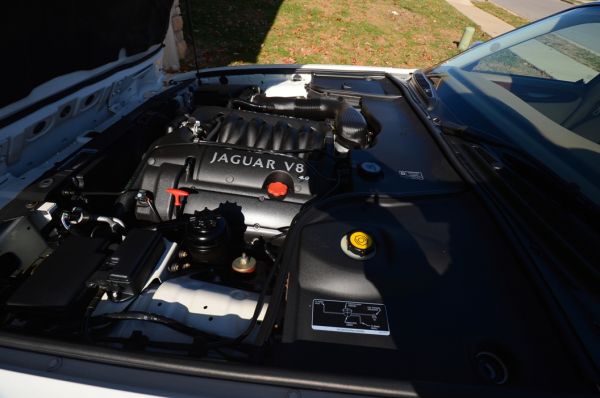
I’ve got a near showroom and mint conditioned 2000 Jaguar XJ-V8-LWB. It is a full-size luxury sedan, offering sporting drive characteristics, mixed with a classic style and interior comfort. It was available in multiple trims which all came very well equipped with upscale amenities. And, this extended wheelbase version offers much more rear seat leg room for long and winding Georgia road trips. The standard steel engine [not nikasil] in this XJ is a 4.0L V8 which produces 290 hp. The upper and lower timing chain tensioners are original, second generation metal, not plastic.
There is also a supercharged version of this vehicle which bumps output to an impressive 370 hp. Even with all of its power and weight, my XJ-8-L is still rated at over 20 mpg on the highway. Ammenities and upgrades include a mobile phone, Magellan GPS, LoJack theft recovery system, CD and MP-3 players, with internal and external cable antenna for satellite radio.
As for oil, my owners manual calls for 10w30 as preferred, but 10w40 is acceptable for hotter climates like Atlanta. Since my XJ-8 has 90,000 miles on it, I tend to use something a little thicker 15w40 and might used 20-50 come summer if it starts consuming in the high heat.
What a Cat!She is my third favorite female after my intelligent and beautiful wife, and smart and lovely daughter.
Assessment
Now that we know the key differences in the available types of motor oil, which should you choose at your next service? For that, your mechanic will take into account your driving style, vehicle mileage, and other factors, and help you decide what is best for your vehicle.

Conclusion
Your thoughts and comments on this ME-P are appreciated. Feel free to review our top-left column, and top-right sidebar materials, links, URLs and related websites, too. Then, subscribe to the ME-P. It is fast, free and secure.
Speaker: If you need a moderator or speaker for an upcoming event, Dr. David E. Marcinko; MBA – Publisher-in-Chief of the Medical Executive-Post – is available for seminar or speaking engagements. Contact: MarcinkoAdvisors@msn.com
OUR OTHER PRINT BOOKS AND RELATED INFORMATION SOURCES:
- DICTIONARIES: http://www.springerpub.com/Search/marcinko
- PHYSICIANS: www.MedicalBusinessAdvisors.com
- PRACTICES: www.BusinessofMedicalPractice.com
- HOSPITALS: http://www.crcpress.com/product/isbn/9781466558731
- CLINICS: http://www.crcpress.com/product/isbn/9781439879900
- ADVISORS: www.CertifiedMedicalPlanner.org
- BLOG: www.MedicalExecutivePost.com
- FINANCE:Financial Planning for Physicians and Advisors
- INSURANCE:Risk Management and Insurance Strategies for Physicians and Advisors




Share this:

Filed under: LifeStyle | Tagged: All About Automobile Oil Changes, conventional motor oil, david marcinko, Jaguar, LoJack, Magellan GPS, Motor Oil Changes, nikasi, synthetic motor oil | 6 Comments »
 The Leading Business Education Network for Doctors, Financial Advisors and Health Industry Consultants