Understanding the Next Generation of “Symptom-Checkers”?

Will SCs  become one of the killer applications in digital health?
***
By Ralf Jahns [Berlin, Germany]
***
Dear David and ME-P Readers,
***
Next generation of symptom checkers are entering the healthcare market with the intention to disrupt the way health services are provided. Symptoms checkers have a chance to belong to the set of killer applications within digital health market next to telehealth, e-prescription and chronic health management solutions. Market potential differs significantly country per country and could go up as high as 8 Bn EUR p.a. Payer and pharma companies must hurry up to close partnership deals as prices go up quickly.
***
Symptom Checkers
***
There are hundreds of symptom checker solutions available in the market for long. Quite a few have gone out of business or changed their business model (e.g. Medlanes) due to having started too early in a market either using B2B or B2C business models. Over the last few years a new generation of symptom checkers have been launched. These tools are building on AI for data management and a chat bot functionality for user communication. They also expanded into other service areas not only concentrating on offering expertise medical diagnostic advice, but also allowing to search for a doctor, remote HCP consultations, or shopping features for over-the-counter medicines.

Symptoms checkers have the potential to belong to the solution suite that will open up the traditional healthcare system for digital health solutions, similar to telehealth or chronic patient’s self-management services. They not only allow patients to remotely 24/7 access advice on their symptoms but are more and more used also by HCPs to support their diagnosing process.

The following list of next generation of symptom checkers shows current ranges of services, reach and business models.

  • Ada Health – a free symptom checker exclusively available as a mobile app. The app provides symptom advice for more than 6,000 diseases. The ADA app has 6 million users and 10 million assessments completed, it’s available in 5 languages and ranked as #1 medical app in over 130 countries. The Berlin-based company employs 130 workers and over 40 doctors and medical editors.
  • Your.MD – symptom checker and health tracker. The app for diagnosis, partners with online medical service providers and refers its apps users to pharmacies, test centers, doctors’ offices or recommends other medical apps which are suitable for them.
  • Sensely – an app for pre-diagnosis, video doctor consultation, allows remote monitoring, links user with local medical services and self-care resources. Currently Sensely app is available by an access code from an employer/health plan.
  • Infermedica – Symptomate is a suite of web, mobile and voice apps that help patients assess their symptom when they feel sick. The solution covers 13 languages and is available in three major voice platforms: Amazon Alexa, Microsoft Cortana and Google Assistant. According to the company the audience includes mainly young adults and more than 55% of the users are aged 18 – 30. Some of the most commonly reported symptoms include headaches, back pains, mild abdominal pains and overall fatigue.
  • Ask NHS – Virtual Assistant” app (powered by Sensely). A virtual assistant named Olivia asks questions about the symptoms and suggests what the problem is. If needed, Olivia arranges a call back from a “111 nurse” to discuss the symptoms further. Patients can also search NHS approved healthcare advice, and schedule GP appointments.
  • Isabel is a similar solution to Ada or Symptomate. The end users are patients, but the company – Isabel Healthcare – also makes the APIs available to others to integrate the symptom checker into their own systems.
In general, market readiness seems to be more advanced in terms of payer and user willingness to use and pay compared to few years back. Also, symptoms checkers are now seen as tools which not only substitute or shorten HCP visits by remote, anonymous and free-of-charge health assessments, but which also enable patient activation tools for pharma companies and enhance products by tech-companies.
***
Research2Guidance Cost Savings Potential Opportunity For Sympoms Checkers Vary Between 0,5 BN and 8 BN Euros

***

Market potential is big. 400 million people especially in developing economies lack access to essential health services. The situation in developed economies is different. Shortage of doctors, especially in rural areas also exists but the problem that symptoms checkers could address is the large amount of doctor visits. In the USA alone there are around 1.3 Bn visits to GPs in a year. Japan has an even higher GP visit numbers as people tend to go 3 times more often to a doctor compared to their US counterparts.By reducing the number of HCP visits (here only GP visits are shown), symptom checkers promise to have a significant impact on healthcare costs within each country. Regardless whether 5% or 10% of GP visits will be made obsolete, the cost saving potential is enormous. In the US alone a 5% reduction would lead to annual cost savings of 8 Bn EUR! Second biggest market opportunities are in Japan with potential cost savings of 6 Bn EUR, followed by Germany and Canada (1 Bn EUR).

Not surprisingly payer organizations in western countries have started to offer symptoms checker solutions to their member base but also to HCPs. For example, Ada and German health insurer Techniker Krankenkasse(TK) are offering the symptoms checker in emergency rooms. Patients insured by TK might be asked to complete in a waiting room an assessment on Ada. Depending on the results, the patient may be redirected to a nurse or a doctor. In another trial run with a large NHS GP clinic, 14% of patients that completed an Ada assessment in the waiting room said that if they had used Ada at home, they would not have felt the need to come to see the doctor that day.”

Babylon a telehealth service also using symptoms checkers is now embedded into Samsung Health, which is available on millions of Samsung mobile devices in the UK and US, and has recently signed major partnership agreements with Tencent, Bupa and Prudential.

Companies wanting to enter the market should hurry up as development times of symptoms checkers are long and existing players are closing deals with payers and tech companies at high speed. Ada, for example, claims to have spent seven years to build up their database of symptoms and recommendations, while integrating more than 6.000 diseases linked to symptoms including 1,100 rare diseases curated by HCPs.

On the other side, payerspharmahospitals and tech companies that want to enrich their service offering with next generation of symptoms checkers are urged to start selection and further on integration process of next generation symptoms checkers as prices go up quickly and flexibility to incorporate specific change requests will go down with increasing success of symptoms checkers.

P.S. If you need any insights or quotes about the digital health, digital diabetes and / or the digital respiratory markets, please do not hesitate to contact me. I will be happy to provide you with reliable data and latest market insights.

[HOSPITAL OPERATIONS, ORGANIZATIONAL BEHAVIOR AND FINANCIAL MANAGEMENT COMPANION TEXTBOOK SET]

Product Details

Product Details

***

Electronic Medical Data Exchange in Denmark

Join Our Mailing List

Used by 91% of doctors according to research2guidance

By Ralf Jahns

ralf

Denmark emerges as the number one country to start an mHealth business according to a survey conducted by research2guidance in partnership with HIMSS Europe. Over 5000 app developers, healthcare professionals and mHealth practitioners took part in the “European mHealth App Market Ranking” survey, where participants were asked to rank the mHealth App market readiness of the 28 EU member states. The results were recently revealed by Ralf Jahns, Managing Director at research2guidance, during the HIMSS Europe event in Riga, the mHealth Summit, on 12th May 2015.

The results, which establish Denmark as having the best market pre-requisites needed for an mHealth business, are based on the average of the scores in five categories: eHealth adoption, level of digitalisation, market potential, ease of starting an mHealth business and mHealth regulatory framework. Hans Erik Henriksen, CEO of Healthcare Denmark commented on the survey findings: “Denmark has a very digitalised society and is familiar with using technology in healthcare, supported by a regulatory framework. The research2gudiance and HIMSS Europe survey confirms the progress we are making. I sincerely hope that this will inspire the European countries and mHealth community in their efforts to progress mobile solutions, which will make a big difference for our citizens”. Denmark ranked top country for eHealth adoption being the only country where exchanging patients’ medical data electronically is used amongst 91% of doctors, whereas the average of other covered countries is only 34%

In terms of market attractiveness and healthcare investments, Denmark is at the top in the mHealth market potential category, together with Austria which also has one of the highest expenditures for health. The ease of starting mHealth business category describes how easy it is to start and maintain a new business based on the number of days needed to start business, the number of necessary start-up procedures to register a business and the level of tax and, in this case, Denmark also ranked extremely high, as the smaller countries – Ireland was also top in this category – tend to support new businesses better compared to larger countries. Rainer Herzog, General Manager at HIMSS Europe, added: “This year’s survey has revealed that the market conditions for mHealth which Denmark offers are truly remarkable. This has been the largest global mHealth research study to date and there are different learnings that could be drawn from the EU countries’ mHealth App Market Ranking. Ultimately though, although mHealth is still it is an emerging market, and a number of countries in Europe are currently in the process of defining their mHealth roadmaps, Denmark leads the way in all aspects”.

eHRs

Download the full mHealth study report here.

Channel Surfing

Have you visited our other topic channels? Established to facilitate idea exchange and link our community together, the value of these topics is dependent upon your input. Please take a minute to visit. And, to prevent that annoying spam, we ask that you register.

Link: http://feeds.feedburner.com/HealthcareFinancialsthePostForcxos

Conclusion

Your thoughts and comments on this ME-P are appreciated. Feel free to review our top-left column, and top-right sidebar materials, links, URLs and related websites, too. Then, subscribe to the ME-P. It is fast, free and secure.

Speaker: If you need a moderator or speaker for an upcoming event, Dr. David E. Marcinko; MBA – Publisher-in-Chief of the Medical Executive-Post – is available for seminar or speaking engagements. Contact: MarcinkoAdvisors@msn.com

OUR OTHER PRINT BOOKS AND RELATED INFORMATION SOURCES:

Product DetailsProduct Details

Product DetailsProduct DetailsProduct Details

Largest global m-Health research study reveals top five m-Health countries in Europe

Join Our Mailing List

More than 5,000 participate in landmark study for m-health app companies

[By Ralf Jahns]ralph

RIGA, Latvia, 12 May 2015:

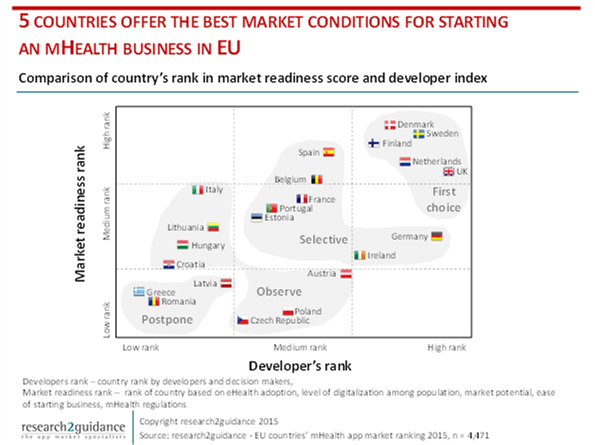
Denmark, Finland, The Netherlands, Sweden and the UK are the top five countries offering the best market conditions for mobile health app companies in Europe, according to a survey conducted by research2guidance in collaboration with HIMSS Europe. As part of the largest global mHealth research programme, research2guidance and HIMSS Europe have come together to analyse the market readiness of the 28 EU member states through “The EU Countries’ mHealth App Market Ranking” survey.

Over 5,000 app developers, healthcare professionals and mHealth practitioners were asked to rank European countries based on their experience and provide reasons for their ranking. The practitioners view is combined with facts based evaluation for each country, based on five dimensions and 26 market condition criteria such as eHealth adoption, level of digitalization, market size and health expenditure, ease of starting a business and the mHealth regulatory framework.

Denmark, Finland, The Netherlands, Sweden and UK proved to have the highest market readiness and most mature market conditions, providing the best starting points for mHealth companies to succeed. Out of these five countries though, the UK emerged as the leader according to 55% of mHealth practitioners. The study revealed that this is primarily due to the openness and positive attitude many doctors in the UK have when it comes to new technology and integrating mHealth solutions into patient treatments.

***

EU-segments

[Click to enlarge]

***

Ralf Jahns, Managing Director at research2guidance, who announced the survey findings at the mHealth Summit Europe, said: “The survey is now in its sixth year and the response this time has been overwhelming becoming increasingly evident that the momentum around mHealth is growing at a rapid pace. The report is extremely valuable for anyone thinking about starting an mHealth company, as well as for government organisations in European countries that want to benefit from a flourishing mHealth ecosystem through creating highly qualified jobs, reducing national healthcare costs and ensuring high levels of quality of care.” Germany and France emerged with mixed results: on the one hand these two markets have enormous potential when it comes to the amount which has been invested in patients, doctors, hospitals and healthcare on a whole.

However, rankings for eHealth and mHealth adoption in Germany and France were extremely low, showing these countries are more reluctant to embrace the digitalisation of healthcare, thus classifying themselves as “average” countries to invest in mHealth. Rainer Herzog, General Manager at HIMSS Europe added: “The timing of the report is particularly important as it coincides with the mHealth Summit Europe which will bring together the most important stakeholders in the mHealth industry in Europe. The survey results will provide a great platform for discussion and give us an insight into how ready European countries really are to adopt mHealth and the challenges that some countries are yet to overcome, meanwhile giving entrepreneurs a head-start when deciding which country would be best to start an mHealth business.”

To view the full report please click here: About research2guidance:

ABOUT

Research2guidance is a strategy advisory and market research company. Research2guidance concentrates on the mobile app eco-system and are convinced that mobile health solutions will make a difference to people’s lives and that the impact on the healthcare industry will be significant. The organisation provides insights to make it happen and to successfully lead a business.

Link to full report Link to blog post Link to image

Conclusion

Your thoughts and comments on this ME-P are appreciated. Feel free to review our top-left column, and top-right sidebar materials, links, URLs and related websites, too. Then, subscribe to the ME-P. It is fast, free and secure.

Speaker: If you need a moderator or speaker for an upcoming event, Dr. David E. Marcinko; MBA – Publisher-in-Chief of the Medical Executive-Post – is available for seminar or speaking engagements. Contact: MarcinkoAdvisors@msn.com

OUR OTHER PRINT BOOKS AND RELATED INFORMATION SOURCES:

Product Details

Product DetailsProduct Details