







 Support our online development, and advance our onground research initiatives in free market economics, as we seek to showcase the brightest Next-Gen minds.
THE ME-P DISCLAIMER: Posts, comments and opinions do not necessarily represent iMBA, Inc., but become our property after submission. Copyright © 2006 to-date. iMBA, Inc allows colleges, universities, medical and financial professionals and related clinics, hospitals and non-profit healthcare organizations to distribute our proprietary essays, photos, videos, audios and other documents; etc. However, please review copyright and usage information for each individual asset before submission to us, and/or placement on your publication or web site. Attestation references, citations and/or back-links are required. All other assets are property of the individual copyright holder.
Support our online development, and advance our onground research initiatives in free market economics, as we seek to showcase the brightest Next-Gen minds.
THE ME-P DISCLAIMER: Posts, comments and opinions do not necessarily represent iMBA, Inc., but become our property after submission. Copyright © 2006 to-date. iMBA, Inc allows colleges, universities, medical and financial professionals and related clinics, hospitals and non-profit healthcare organizations to distribute our proprietary essays, photos, videos, audios and other documents; etc. However, please review copyright and usage information for each individual asset before submission to us, and/or placement on your publication or web site. Attestation references, citations and/or back-links are required. All other assets are property of the individual copyright holder.


GUEST VIEW POINTS
By Vitaliy Katsenelson; CFA
***

***
The future feels less predictable because the range of possible outcomes has expanded. Here is my best attempt to think through that reality with humility, and why you should let me do the worrying for both of us.
***
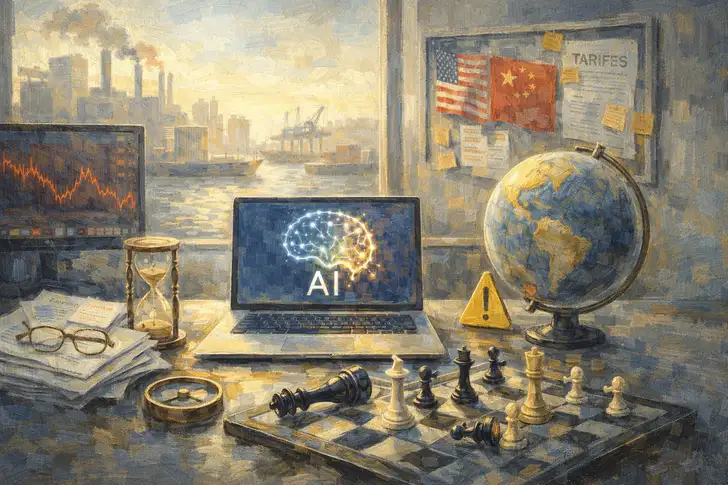
Humility Clients have been asking about AI, our portfolio, and the world. The honest answer to all three starts in an uncomfortable place.
Not with conviction. With humility.
We are living through a period where change is happening faster than our ability to understand it. The future feels less predictable, not because we know less, but because the range of possible outcomes has expanded.
When that happens, confidence becomes dangerous. Assumptions that once felt stable begin to crack. And the way we think about risk, opportunity, and even our own decision-making has to evolve.
What follows is an excerpt from a recent client letter, and my best attempt to think through that reality.
AI
AI requires an enormous dose of humility. It is changing much faster than our ability to understand the change. AI creating AI makes its growth exponential – something our minds have difficulty processing.
AI is a great benefit, but it is also a threat.
Until recently, the market focused on the benefit part, but there will be losers. Software stocks are a great recent example. Many are down 50–70% from their highs, erasing gains for some of them over the last five years or even a decade.
A lot of them traded at nosebleed valuations, priced for out-of-this-world perfection, and most of these declines are just normalization – bringing some clouds into a multidecade cloudless forecast of uninterrupted growth. But as we spent time researching them, we couldn’t say how this story will play out on an industry-wide basis. What we do know is that the range of outcomes – both positive and negative – has widened substantially.
AI definitely lowers barriers to entry and in some cases switching costs. It reduces boundaries of expansion of existing and new players – you’ll have companies encroaching on each other’s space, benefiting consumers of software but impacting profit margins of the industry. However, the productivity of software engineers will go up a lot. This is a deflationary force – and one that will displace a lot of jobs.
The software industry is the one likely to be impacted first, for several reasons: first, it is the most adept at change; and second, it has been the focus of AI companies, as they are using AI to program AI. Finally, software is at the tip of the spear of AI because it speaks the same language – computer languages. Software engineers get paid a lot of money in part because they have learned to think like a computer. Now they are competing with a brilliant one.
But it is also important to understand that though these companies are in the “software” business, creating software is not everything. They also need to provide support and continuity of updates, have industry knowledge, provide uptime, integrations, security, “throat to choke” – someone reputable to redirect blame to when there are problems – and more. The best products, at least judged on the single dimension of software excellence, don’t always win. Just look at Microsoft. It is a collection of a lot of average products that work well together.
From a broader perspective, a lot will depend not just on individual companies’ competitive positioning, which is paramount, but also on management and culture. Those who embrace change and execute well will create a lot of value. The ones who dismiss it may look fine for a while, until their businesses turn into Kodak camera film. The further we are from tasks that can be put into an algorithm and the closer we are to human connection, the further we are from the spear of AI.
As my friend Saurabh Madan put it, “Knowing what to do and having tools at hand doesn’t mean that companies will do it. It is like everyone knows that we should eat healthy and exercise. Not all of us do it.”
Embracing AI
IMA is embracing AI. It’s easier for us; we are a small company. We can turn on a dime. We intentionally stayed away from complexity, choosing to do a few things but do them better. We can test and experiment with different models. We can hire consultants to help us adapt.
But at IMA change comes from the top, mainly yours truly. If you are worried about what is going on in the world today, I am worried even more: I am worried for you and for me, as my family’s net worth is invested in the same stocks as you are. So my advice: since I am going to worry anyway, maybe you need to worry a little bit less. Let me worry for both of us.
***
Your comments are appreciated.
Like, Refer and Subscribe
***
Share this:

Filed under: iMBA, Inc. | Tagged: AI, artificial intelligence, Katsenelson, Technology |
 The Leading Business Education Network for Doctors, Financial Advisors and Health Industry Consultants
Leave a comment