ME-P SYNDICATIONS:
WSJ.com,
CNN.com,
Forbes.com,
WashingtonPost.com,
BusinessWeek.com,
USNews.com, Reuters.com,
TimeWarnerCable.com,
e-How.com,
News Alloy.com,
and Congress.org



BOARD CERTIFICATION EXAM STUDY GUIDES
Lower Extremity Trauma
[Click on Image to Enlarge]
The “Medical Executive-Post” is about connecting doctors, health care executives and modern consulting advisors. It’s about free-enterprise, business, practice, policy, personal financial planning and wealth building capitalism. We have an attitude that’s independent, outspoken, intelligent and so Next-Gen; often edgy, usually controversial. And, our consultants “got fly”, just like U. Read it! Write it! Post it! “Medical Executive-Post”. Call or email us for your FREE advertising and sales consultation TODAY [678.779.8597] Email: MarcinkoAdvisors@outlook.com



ePodiatryConsentForms.com
Suite #5901 Wilbanks Drive, Norcross, Georgia, 30092 USA [1.678.779.8597]. Our location is real and we are now virtually enabled to assist new long distance clients and out-of-town colleagues.
If you want the opportunity to work with leading health care industry insiders, innovators and watchers, the “ME-P” may be right for you? We are unbiased and operate at the nexus of theoretical and applied R&D. Collaborate with us and you’ll put your brand in front of a smart & tightly focused demographic; one at the forefront of our emerging healthcare free marketplace of informed and professional “movers and shakers.” Our Ad Rate Card is available upon request [678-779-8597].

“Providing Management, Financial and Business Solutions for Modernity”
Whether you’re a mature CXO, physician or start-up entrepreneur in need of management, financial, HR or business planning information on free markets and competition, the "Medical Executive-Post” is the online place to meet for Capitalism 2.0 collaboration.

Support our online development, and advance our onground research initiatives in free market economics, as we seek to showcase the brightest Next-Gen minds.
THE ME-P DISCLAIMER: Posts, comments and opinions do not necessarily represent iMBA, Inc., but become our property after submission. Copyright © 2006 to-date. iMBA, Inc allows colleges, universities, medical and financial professionals and related clinics, hospitals and non-profit healthcare organizations to distribute our proprietary essays, photos, videos, audios and other documents; etc. However, please review copyright and usage information for each individual asset before submission to us, and/or placement on your publication or web site. Attestation references, citations and/or back-links are required. All other assets are property of the individual copyright holder.







 The Leading Business Education Network for Doctors, Financial Advisors and Health Industry Consultants
Value Based Rx Contracting Tactics and Techniques: Navigating Legal and Regulatory Complexities
Value-based pharmaceutical contracts, sometimes referred to as risk sharing agreements between pharmaceutical manufacturers and health plans or other purchasers are critical in today’s very complex and costly healthcare marketplace. These agreements allow placement of high-risk, high-cost and often times specialty pharmaceutical products onto purchaser formularies through basing payment on outcomes as opposed to volume metrics. The concept has become popular in single payor systems, and is beginning to take flight in the U.S. as evidenced by several high profile value based contracts between pharmaceutical manufacturers and health plans. However, as with every new concept in the U.S. health care arena, there are growing pains, fear and uncertainty.
In order to establish a value-based contract, pharmaceutical manufacturers as well as purchasers must understand the complexity of these agreements and the legal implications associated with it. Manufacturers will need to ensure safe harbor protection under the Anti-Kickback Statute to enter qualified value based contracts. As there is a greater exchange of more data between stakeholders, manufacturers must mitigate HIPAA risks including reporting of adverse events and sharing of patient data. They must also understand the legal regulations necessary to take into account within value based contracts.
Special concerns must be addressed in pharmaceutical value based agreements with non-traditional purchasers such as hospitals, hospital systems, integrated delivery networks (IDNs) and ACOs. These challenges include rebates and government programs, and incorporating provisions in regard to these agreements to compliantly address best price calculations.
Sidley Austin
William A. Sarraille
via Ann Miller RN MHA
LikeLike
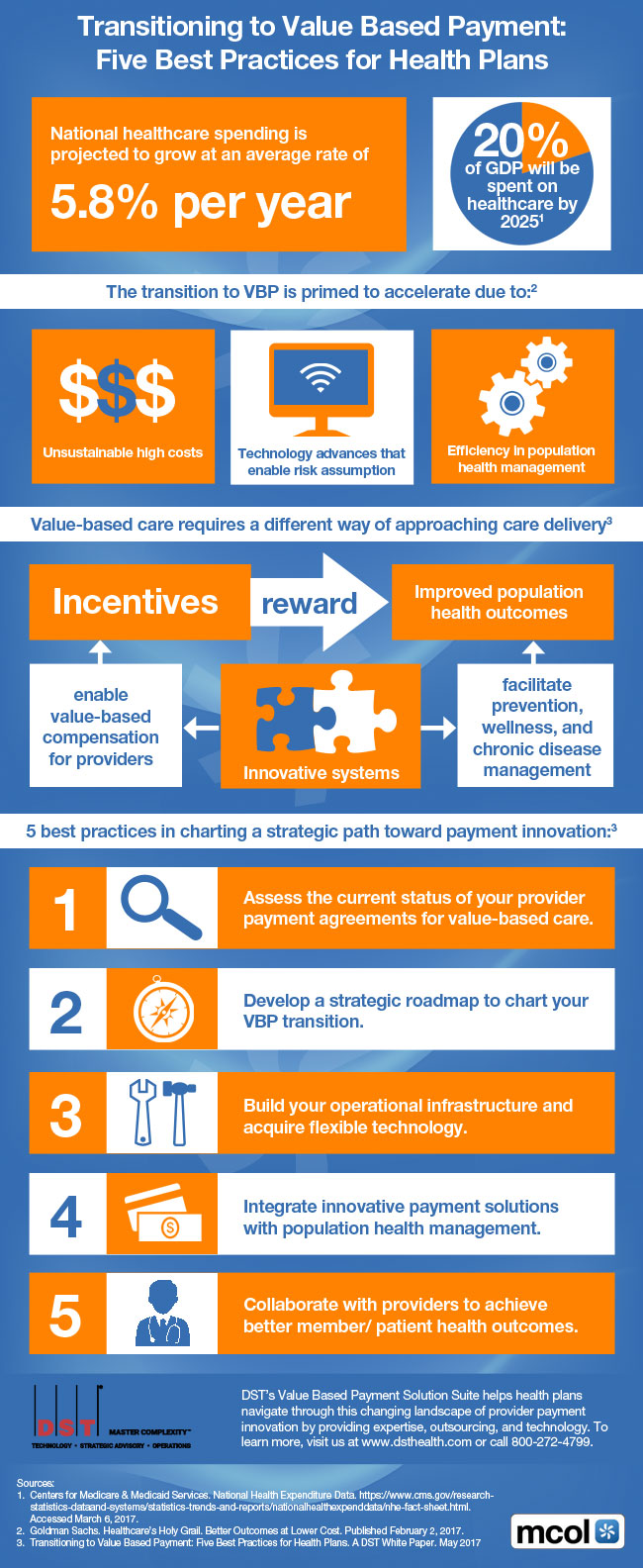
Value-Based Care Generates Medical Cost Savings of 5.6%
Change Healthcare recently released a study on the healthcare industry’s transition to value-based care. Here are some key findings from the report:
• Value-based care strategies generated medical cost savings of 5.6% on average.
• Nearly 80% of payers reported improvements in care quality after the transition.
• Pure fee-for-service currently accounts for only 37.2% of reimbursement.
• 21% of payers are capable of rolling out a new episode of care program in 3-6 months.
Source: Change Healthcare, June 18, 2018
LikeLike
VBC Start-Ups
https://www.nanalyze.com/2019/12/value-based-care-startups/
Dr. David E. Marcinko MBA
LikeLike