







 Support our online development, and advance our onground research initiatives in free market economics, as we seek to showcase the brightest Next-Gen minds.
THE ME-P DISCLAIMER: Posts, comments and opinions do not necessarily represent iMBA, Inc., but become our property after submission. Copyright © 2006 to-date. iMBA, Inc allows colleges, universities, medical and financial professionals and related clinics, hospitals and non-profit healthcare organizations to distribute our proprietary essays, photos, videos, audios and other documents; etc. However, please review copyright and usage information for each individual asset before submission to us, and/or placement on your publication or web site. Attestation references, citations and/or back-links are required. All other assets are property of the individual copyright holder.
Support our online development, and advance our onground research initiatives in free market economics, as we seek to showcase the brightest Next-Gen minds.
THE ME-P DISCLAIMER: Posts, comments and opinions do not necessarily represent iMBA, Inc., but become our property after submission. Copyright © 2006 to-date. iMBA, Inc allows colleges, universities, medical and financial professionals and related clinics, hospitals and non-profit healthcare organizations to distribute our proprietary essays, photos, videos, audios and other documents; etc. However, please review copyright and usage information for each individual asset before submission to us, and/or placement on your publication or web site. Attestation references, citations and/or back-links are required. All other assets are property of the individual copyright holder.


By Samantha Wanner [VITAS Healthcare]
Watch this short animation to learn why advance directives are so important.
***
What Do You Want?
It’s not easy, but the medical treatments you would want near the end of life need to be discussed with others. If you never bring up the topic and you were unexpectedly incapacitated and unable to speak for yourself, your medical wishes would never be known.
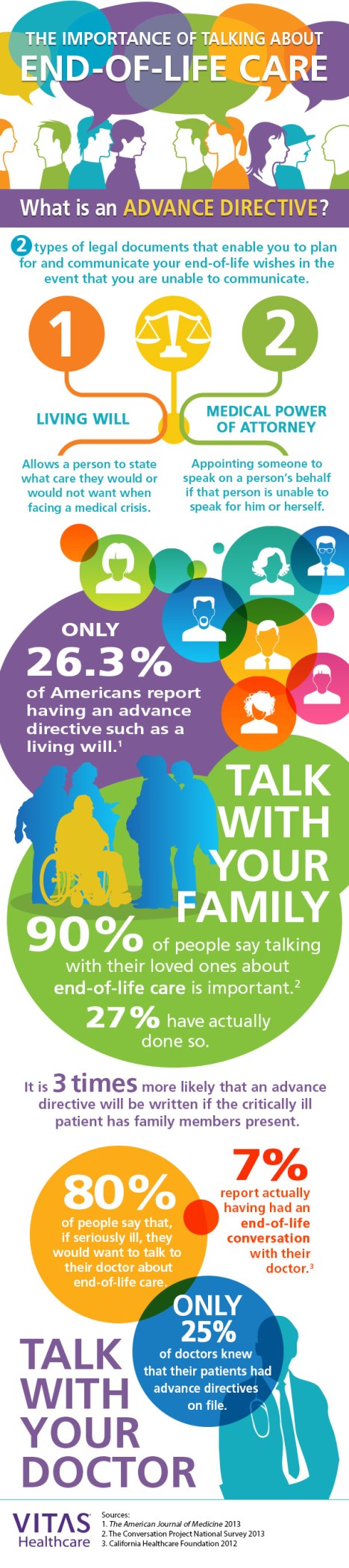
Despite the topic’s importance, only 27% of Americans report having talked with their families about end-of-life care. The best way to make your medical wishes known is to create an advance directive and share it with your family and your doctor.
Advance Directives
An advance directive is actually two legal documents that enable you to plan and communicate your end-of-life wishes. When you create your advance directive, you are being proactive about your medical care and sparing your loved ones from having to make difficult medical decisions in a time of crisis.
***
***
Assessment
Don’t wait for a crisis. Create your advance directive, share copies with your loved ones and doctor and keep your copy in an accessible location others can find.
Conclusion
Your thoughts and comments on this ME-P are appreciated. Feel free to review our top-left column, and top-right sidebar materials, links, URLs and related websites, too. Then, subscribe to the ME-P. It is fast, free and secure.
Speaker: If you need a moderator or speaker for an upcoming event, Dr. David E. Marcinko; MBA – Publisher-in-Chief of the Medical Executive-Post – is available for seminar or speaking engagements. Contact: MarcinkoAdvisors@msn.com
OUR OTHER PRINT BOOKS AND RELATED INFORMATION SOURCES:
- PRACTICES: www.BusinessofMedicalPractice.com
- HOSPITALS: http://www.crcpress.com/product/isbn/9781466558731
- CLINICS: http://www.crcpress.com/product/isbn/9781439879900
- ADVISORS: www.CertifiedMedicalPlanner.org
- FINANCE: Financial Planning for Physicians and Advisors
- INSURANCE: Risk Management and Insurance Strategies for Physicians and Advisors
- Dictionary of Health Economics and Finance
- Dictionary of Health Information Technology and Security
- Dictionary of Health Insurance and Managed Care
Harvard Medical School
Yale University
***
Share this:

Filed under: Health Insurance, iMBA, Inc., Insurance Matters, Risk Management, Videos | Tagged: End of Life Care |


Medicare Spent $11,393 per Hospice Beneficiary in 2014
CMS recently released an analysis on hospice spending. Here are some key findings from the report:
• In 2014, Medicare spent an average of $11,393 per hospice beneficiary.
• There were 1.3 million hospice beneficiaries in 2014.
• 11% had a live discharge from hospice care in 2014.
• In 2014, 1 in 3 beneficiaries had more than 60 days of hospice care.
• 13% had more than 180 days of hospice care in 2014.
• South Carolina had the highest spending ($14,778) per hospice beneficiary.
Source: CMS, October 6, 2016
LikeLike
Healthcare Without Intensive Services in Patient’s Final Month Cost $7,660
JAMA recently published an analysis of costs associated with intensive end-of-life medical services among veterans. Here are some key findings from the report:
• Beneficiary costs in the last month of life were $133 for patients with no intensive service.
• For patients with at least 1 intensive service, beneficiary costs in the last month were $1257.
• Those receiving no intensive service in the last month had a health system cost of $7,660.
• 59% of patients receiving 1 or more intensive services in the last month had a cost of $23,612.
Source: JAMA, September 27, 2019
LikeLike