





 Support our online development, and advance our onground research initiatives in free market economics, as we seek to showcase the brightest Next-Gen minds.
THE ME-P DISCLAIMER: Posts, comments and opinions do not necessarily represent iMBA, Inc., but become our property after submission. Copyright © 2006 to-date. iMBA, Inc allows colleges, universities, medical and financial professionals and related clinics, hospitals and non-profit healthcare organizations to distribute our proprietary essays, photos, videos, audios and other documents; etc. However, please review copyright and usage information for each individual asset before submission to us, and/or placement on your publication or web site. Attestation references, citations and/or back-links are required. All other assets are property of the individual copyright holder.
Support our online development, and advance our onground research initiatives in free market economics, as we seek to showcase the brightest Next-Gen minds.
THE ME-P DISCLAIMER: Posts, comments and opinions do not necessarily represent iMBA, Inc., but become our property after submission. Copyright © 2006 to-date. iMBA, Inc allows colleges, universities, medical and financial professionals and related clinics, hospitals and non-profit healthcare organizations to distribute our proprietary essays, photos, videos, audios and other documents; etc. However, please review copyright and usage information for each individual asset before submission to us, and/or placement on your publication or web site. Attestation references, citations and/or back-links are required. All other assets are property of the individual copyright holder.


Future Care 2014 e-Poll Findings
By www.MCOL.com
MCOL recently conducted its twelfth annual Future Care e-Poll, asking stakeholders their perspective of trends, winners and losers for the coming year and beyond. The corresponding white paper with complete findings from the e-poll is now available for MCOL members, including comparisons to previous year’s results.
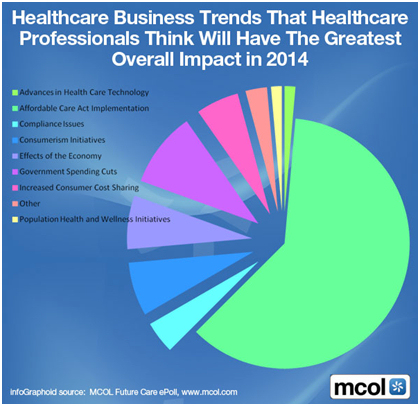
Participants were asked to respond to four items:
1. Please categorize your organization: (a) Payor (Health Plan, Employer, TPA, Agent, PBM); (b) Provider (Hospital, Physician, Pharmaceutical, Other Providers); (c) Vendor or Other
2. Which of the following health care business trends do you think will have the greatest overall impact in 2014? (a) Advances in Health Care Technology; (b) Consumerism Initiatives (c) Compliance Issues; (d) Effects of the Economy (e) Affordable Care Act Implementation (f) Increased Consumer Cost Sharing (g) Population Health and Wellness Initiatives (h) Government Spending Cuts (i) Other
3. Rate the ultimate anticipated impact in the marketplace of these selected health reform provisions including those already implemented: (a) Accountable Care Organization Development; (b) Health Plan Medical Loss Ratio Regulation; (c) State Health Insurance Exchanges (d) Extension of Dependent Care Coverage; (e) EHR Development – Meaningful Use; (f) Health Insurance Guaranteed Issue/ Elimination of Pre-Existing Conditions; (g) Expansion of Medicaid Coverage; (h) Mandated Coverage Provisions for Business and Individuals
4. Please project who you think the economic winners and losers for 2014 will be: Who do you think will be economically better off, the same or worse off by this time next year: (a) Consumers; (b) Employers; (c.) Health Plans; (d) Hospitals; (e) Physicians; (f) Pharmaceutical
Assessment
Link: http://www.mcol.com/futurecareepoll.pdf
Conclusion
Your thoughts and comments on this ME-P are appreciated. Feel free to review our top-left column, and top-right sidebar materials, links, URLs and related websites, too. Then, subscribe to the ME-P. It is fast, free and secure.
Link: http://feeds.feedburner.com/HealthcareFinancialsthePostForcxos
Speaker: If you need a moderator or speaker for an upcoming event, Dr. David E. Marcinko; MBA – Publisher-in-Chief of the Medical Executive-Post – is available for seminar or speaking engagements. Contact: MarcinkoAdvisors@msn.com
OUR OTHER PRINT BOOKS AND RELATED INFORMATION SOURCES:
DICTIONARIES: http://www.springerpub.com/Search/marcinko
PHYSICIANS: www.MedicalBusinessAdvisors.com
PRACTICES: www.BusinessofMedicalPractice.com
HOSPITALS: http://www.crcpress.com/product/isbn/9781466558731
CLINICS: http://www.crcpress.com/product/isbn/9781439879900
BLOG: www.MedicalExecutivePost.com
FINANCE: Financial Planning for Physicians and Advisors
INSURANCE: Risk Management and Insurance Strategies for Physicians and Advisors





Share this:

Filed under: Practice Management, Risk Management, Voting Polls | Tagged: Healthcare Business Trends |
 The Leading Business Education Network for Doctors, Financial Advisors and Health Industry Consultants
Driving Forces – An Environment Ripe for Change
We won’t get to all the drivers or trends defining the future of health care but want this section to give a big-picture perspective of what’s behind the massive and growing problem, and the need for solutions.
http://www.mhealthtalk.com/2014/08/101-minitrends-in-health-care/
Dr. Hellering
LikeLike
Healthcare Innovations
A year ago I had ten trends on my watch-list: Obamacare 2.0, Risk Management, Quality Outcomes, Chronic America, Behaving Healthy, Big Good Data, Retailization, Mobile Health, Socialnomics, and Customer Centricity. Many of these remain in the forefront of healthcare companies’ 2015 strategic agendas. However, there’s one I believe will begin to dominate in the months to come: “The Internet of Medical Things”.
In 2005, there were 2.5 billion connected devices, mostly PCs followed by smartphones and tablets. By 2020 there will be over 30 billion wirelessly connected devices most will not be PCs, smartphones and tablets. “The Internet of Things” is changing everyday lives by using the interconnection of embedded computing devices and the Internet’s infrastructure to bring advanced connectivity of systems, products and services at home and at work.
“The Internet of Medical Things” means enhanced connectivity will change every aspect of the healthcare landscape: care delivery, care management, care plan compliance, wellness and prevention, patient-doctor relationships, and benefit shopping and financing. Connected healthcare delivery platforms will allow organizations to leverage wireless, social and cloud technologies to connect today’s fragmented health systems and bring actionable intelligence to how health information is accessed, shared and used. There are now more than 100,000 healthcare apps in iOS and Android app stores. Over the next five years it’s expected that 13 million wearable connected devices will be integrated into wellness plans.
Prepare for mind-blowing advances in connected medical devices as they evolve from simple activity trackers used to count steps to smart contact lens’ that monitor blood sugar levels for diabetics, and throw-away patches or digital tattoos able to transmit real-time electrocardiogram readings displayed on your smartphone. Patients and their providers will connect, not just through Electronic Medical Records, mHealth and eVisits, but ePCMH mobile apps (electronic Patient Centered Medical Home) uniting an individuals complete caregiver community. We will see even more spectacular applications allowing doctors to view a patient’s genome on a secure phone during an office visit so it gets built-in to care plans.
Expect to see rapid growth in “The Internet of Medical Things” as consumer healthcare communities get structured around connection, collaboration and communication. Patient connectivity means they move from intimidated listen-only mode to having a dialogue where consumers can step-up as informed, connected decision-makers.
Lindsay Resnick
Chief Marketing Officer
[KBM Group: Health Services]
LikeLike
Here are my top 10 impact trends shaping healthcare’s strategic business agenda in 2016
1. Looming economic events create market turmoil. The combination of 2016 elections, DC gridlock, SCOTUS decisions, and Fed rate hike all reek havoc on the healthcare sector at varying times throughout the year with the crescendo coming as a new President gets set to determine the fate of ACA…Hillarycare? Trumpcare?
2. Activist consumerism continues to gain momentum. Call it gig, on-demand, or sharing economy, companies looking to jump on the bandwagon will pursue “uberization of healthcare” and we’ll see some big winners (and big losers) as healthcare consumerism dominates new models of financing and delivering care.
3. Shifting demographics change customer acquisition landscape. Those companies deploying predictive insights, micro-segmentation, multi-cultural communication, and omni-channel selling will grow and retain customers at a much faster rate than competitors stuck in “one size fits all” status quo marketing.
4. Digtalization of everything challenges companies to deliver value. Whether the Internet of Things (IoT), eCommerce, mobile pay, telemedicine, or online price and quality transparency tools, companies must be able to create a value exchange with their customers through meaningful, patient-first digital health experiences.
5. Consolidation threatens competition and blurs the lines. As health insurers go oligopolistic, hospital systems employ doctors to become insurers, and pharmaceutical companies play the tax inversion game, the trust gap with consumers widens and undifferentiated competitors lacking critical mass face obsolescence.
6. Managing government as a business partner trumps all. With over 100 million Americans in a government health care program, enterprises able to grow profitability under rules and regulations of ACA, FDA, CMS and DOI will not only succeed but be called out as the industry’s most admired for beating the bureaucrats.
7. “Value over volume” mantra goes to the next level. With outcomes-based reimbursement, bundled payments, patient money-back guarantees, and high deductible health plans all taking hold, we’ll see companies’ step-up development of decision support tools allowing consumers to take ownership of their health.
8. Movement from sickness‒ illness to wellness‒ prevention. Help is on its way for chronic patients to be proactive and adhere to therapies designed to improve quality of life. For other consumers, engageability takes center stage to influence “good health” behaviors and attitudes, from quantified-self to lifestyle connections.
9. Silo-busting becomes the new Six Sigma. At a macro level health care isn’t a system, it’s a network of fragmented delivery and payment models and, at a micro level, functional fiefdoms create a disjointed, uninspired customer experience. Winners will organize people and processes around their customers (patients).
10. Personalization drives the next generation of healthcare. Convenience-driven, always addressable consumers demanding access to health care services at their moment of need will be served by a combination of big data’s ability to target content, cognitive computing’s focused insights, and precision medicine’s ability to customize treatment plans to an individual’s genetic make-up…welcome healthcare 2016!
Lindsay Resnick
[Chief Marketing Officer-Wunderman Health]
LikeLike