





 Support our online development, and advance our onground research initiatives in free market economics, as we seek to showcase the brightest Next-Gen minds.
THE ME-P DISCLAIMER: Posts, comments and opinions do not necessarily represent iMBA, Inc., but become our property after submission. Copyright © 2006 to-date. iMBA, Inc allows colleges, universities, medical and financial professionals and related clinics, hospitals and non-profit healthcare organizations to distribute our proprietary essays, photos, videos, audios and other documents; etc. However, please review copyright and usage information for each individual asset before submission to us, and/or placement on your publication or web site. Attestation references, citations and/or back-links are required. All other assets are property of the individual copyright holder.
Support our online development, and advance our onground research initiatives in free market economics, as we seek to showcase the brightest Next-Gen minds.
THE ME-P DISCLAIMER: Posts, comments and opinions do not necessarily represent iMBA, Inc., but become our property after submission. Copyright © 2006 to-date. iMBA, Inc allows colleges, universities, medical and financial professionals and related clinics, hospitals and non-profit healthcare organizations to distribute our proprietary essays, photos, videos, audios and other documents; etc. However, please review copyright and usage information for each individual asset before submission to us, and/or placement on your publication or web site. Attestation references, citations and/or back-links are required. All other assets are property of the individual copyright holder.


Are Doctors Typical or A-typical?

Here is what typical Americans earn in salary, spend in a month, and how they pay their bills. Now, compare this to physicians and other medical professionals.
This analysis suggests that many people [even some doctors] are most likely spending more than they earn each month. It also shows steady movement away from cash and checks toward plastic and electronic payment instruments, which can result in unfamiliar or unchecked fees and interest charges that can increase overspending and indebtedness.
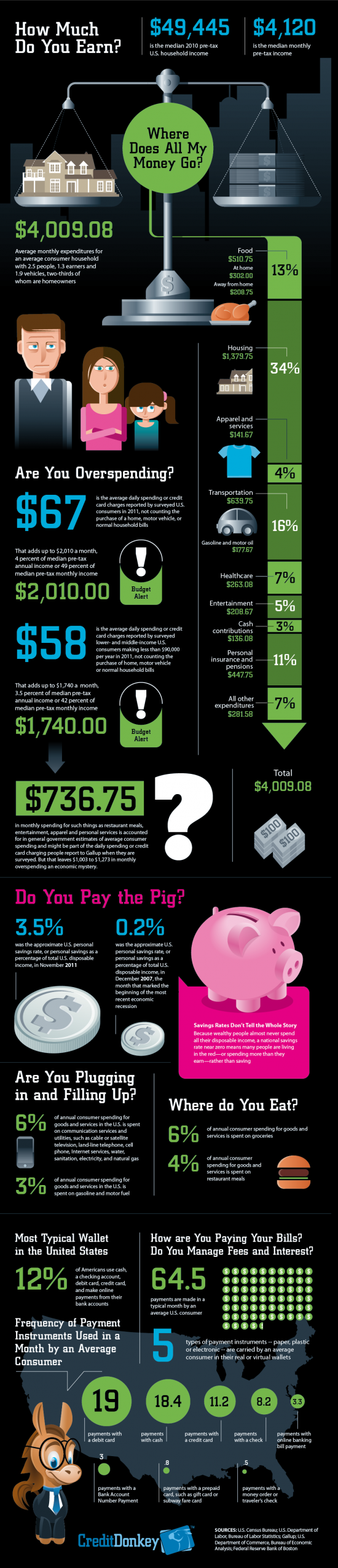
Source: creditdonkey.com
Assessment
Managing your spending and payments will help track monthly expenditures.
Conclusion
Your thoughts and comments on this ME-P are appreciated. Feel free to review our top-left column, and top-right sidebar materials, links, URLs and related websites, too. Then, subscribe to the ME-P. It is fast, free and secure.
Link: http://feeds.feedburner.com/HealthcareFinancialsthePostForcxos
Speaker: If you need a moderator or speaker for an upcoming event, Dr. David E. Marcinko; MBA – Publisher-in-Chief of the Medical Executive-Post – is available for seminar or speaking engagements. Contact: MarcinkoAdvisors@msn.com
Our Other Print Books and Related Information Sources:
Health Dictionary Series: http://www.springerpub.com/Search/marcinko
Practice Management: http://www.springerpub.com/product/9780826105752
Physician Financial Planning: http://www.jbpub.com/catalog/0763745790
Medical Risk Management: http://www.jbpub.com/catalog/9780763733421
Healthcare Organizations: www.HealthcareFinancials.com
Physician Advisors: www.CertifiedMedicalPlanner.com
Subscribe Now: Did you like this Medical Executive-Post, or find it helpful, interesting and informative? Want to get the latest ME-Ps delivered to your email box each morning? Just subscribe using the link below. You can unsubscribe at any time. Security is assured.
Link: http://feeds.feedburner.com/HealthcareFinancialsthePostForcxos
Sponsors Welcomed: And, credible sponsors and like-minded advertisers are always welcomed.
Link: https://healthcarefinancials.wordpress.com/2007/11/11/advertise



Share this:

Filed under: Financial Planning, Funding Basics, iMBA, Inc. | Tagged: doctor personal expenses, doctor salary, physician income, physician pay, Where Does our Salary Go? |
 The Leading Business Education Network for Doctors, Financial Advisors and Health Industry Consultants
Ways and Means Votes to Repeal IPAB
The House panel with jurisdiction over Medicare approved legislation to repeal the Independent Payment Advisory Board (IPAB) created in the Patient Protection and Affordable Care Act.
In a voice vote with no “nays,” the full House Ways and Means Committee approved Rep. Phil Roe’s (R-TN) Medicare Decisions Accountability Act, which would eliminate the 15-member board that is responsible for suggesting ways to restrict Medicare cost growth. The House Energy and Commerce Committee approved the measure Tuesday.
“Repealing IPAB reinforces that doctors and patients—not a board of unelected bureaucrats—should be making healthcare decisions,” Rep. Dave Camp (R-MI), chairman of the House Ways and Means Committee, said in a statement following the vote. “If left in place, IPAB would threaten seniors’ access to healthcare and would be able to do so without answering to Congress or the American people.” According to a spokeswoman for House Majority Leader Eric Cantor (R-VA), the full House is expected to vote on Roe’s bill the week of March 19th.
Source: Jessica Zigmond, Modern Healthcare [3/8/12]
LikeLike
Are Doctors Struggling to Make Ends Meet?
According to this WSJ essay, physicians frequently have to make a big financial commitment to upgrade information-technology systems and other services, leaving them fearful of getting squeezed as the US moves toward new ways of paying for health care.
http://online.wsj.com/article/SB10001424052970204603004577271340816194320.html
But, are they really struggling, and what do you think?
Hope Rachel Hetico RN MHA
[Managing Editor]
LikeLike
Struggling Doctors?
An interesting essay by Aaron Carroll over at the The Incidental Economist:
http://theincidentaleconomist.com/wordpress/doctors-struggle-to-make-ends-meet/
Sarita
LikeLike
Our “Finances in Shambles”
According to The Digerati Life:
■ The average American family has $3,800 in the bank.
■ 50% of American households don’t have a retirement account.
■ The 50% of households with retirement accounts have $35,000 per family.
■ The average family owns a house worth $160,000 but $95,000 is mortgaged.
■ Average income is $43,000 per year.
■ Average credit card debt is $2,200.
■ 40% of working Americans are not saving for retirement.
■ $117,951 is the average American household’s debt.
■ 25% of households have no savings whatsoever.
■ 24% have postponed retirement.
■ Only 18% are very confident about their retirement situation.
■ $2 trillion is the combined amount of personal debt held by Americans.
■ 7.7% don’t own a bank account!
Source: http://www.thedigeratilife.com/blog/average-american-family-finances-infographic/
Given these statistics, doctors may be curious about how their own financial situation compares with the rest of America; and be very thankful.
Sharon
LikeLike
More Doctors Work Part-Time, Flexible Schedules
A survey released March 12th 2012, by Cejka Search, a physician search firm based in St. Louis, and the American Medical Group Assn. found that in 2011, 22% of male physicians and 44% of female physicians worked less than full-time, up from 7% of men and 29% of women from Cejka’s 2005 survey. The 2011 survey covered 14,366 physicians in 80 practices, which had from three to more than 500 doctors each.
Two of the fastest-growing physician demographics — men near the end of their careers and women at the beginning or middle are the most likely to demand part-time or flexible work schedules, according to experts in physician recruitment.
Source: Victoria Stagg Elliott, AM News [3/26/12]
LikeLike
Lawmakers Urged to Consider SGR Alternatives
Lawmakers should consider patient-centered medical homes, value-based payments and incentives to coordinate patient care as Congress explores how to change the way Medicare reimburses physicians, a panel of experts testified Wednesday. As physicians face a cut of around 30% to their Medicare payments in five months, House Republicans hosted the first of two hearings in a week to learn from the private sector about effective payment strategies. On Wednesday, lawmakers and witnesses at the House Energy and Commerce Health Subcommittee hearing started with the premise that the current system—the contentious sustainable growth-rate formula—is unworkable.
Dr. David Bronson, a physician at the Cleveland Clinic and president of the American College of Physicians, said that the ACP strongly recommends that the Medicare program broadly adopt the patient-centered medical home model, and that Congress should enact payment policies to accelerate the adoption of the medical home neighborhood model. The neighborhood concept, Bronson testified, is essential to the success of the medical home because it recognizes that specialties, sub-specialties, hospitals, and other entities that provide treatment should receive incentives for engaging in patient-centered practices.
Source: Jessica Zigmond, Modern Healthcare [7/18/12]
LikeLike
Medicare Modifier Could Hit Unsuspecting Doctors with Pay Cuts
Hundreds of thousands of physicians will have their 2015 Medicare payments adjusted either up or down by a value-based modifier to account for the quality and cost-effectiveness of the care they provide in 2013. Organized medicine groups, however, say doctors will be left with too little time to make the changes that might be necessary to excel under the new payment model. The Centers for Medicare & Medicaid Services has proposed applying the value-based payment modifier to all physicians practicing in medical groups with 25 or more practitioners. The modifier will adjust 2015 Medicare rates through a scoring system that could raise pay by as much as 2% or cut it by as much as 1%.
The AMA warned that many physicians could be caught unaware of the program’s requirements when the reporting period officially begins Jan. 1, 2013. For instance, doctors in a practice could avoid the penalty by participating as a group in the Medicare physician quality reporting system, a related component to the modifier initiative. But the group first would need to register for that PQRS reporting option by Jan. 31, 2013 — just three months after the rules for the modifier are finalized.
Source: Charles Fiegl, AM News [9/17/12]
LikeLike
Podiatrists and Other Doctor Fees Under Medicare to Drop Approximately 1%
CMS unveiled its final rules for the CY 2014 Medicare Physician Fee Schedule and the CY 2014 Medicare Hospital Outpatient Prospective Payment and Ambulatory Surgical Center Payment Systems (OPPS) on November 27.
According to the final rule, podiatric physicians are likely to experience, on average, a 1-percent reduction to estimated payments. The majority of specialties, 37 out of 57, will experience a decrease or will not change—23 will see an estimated pay decrease, while 14 will see no change. Other issues addressed in the rule include revisions to the Medicare Economic Index, and changes to the Physician Quality Reporting System and Value Modifier.
If Congress does not take action before the end of the year, Medicare physician payment rates will be reduced by 20.1 percent due to the Sustainable Growth Rate (SGR) formula. When adjustments to the relative value scale are combined with the conversion factor change, the net reduction in payment rates would be about 24 percent.
Source: APMA Weekly Focus [12/3/13]
LikeLike