







 Support our online development, and advance our onground research initiatives in free market economics, as we seek to showcase the brightest Next-Gen minds.
THE ME-P DISCLAIMER: Posts, comments and opinions do not necessarily represent iMBA, Inc., but become our property after submission. Copyright © 2006 to-date. iMBA, Inc allows colleges, universities, medical and financial professionals and related clinics, hospitals and non-profit healthcare organizations to distribute our proprietary essays, photos, videos, audios and other documents; etc. However, please review copyright and usage information for each individual asset before submission to us, and/or placement on your publication or web site. Attestation references, citations and/or back-links are required. All other assets are property of the individual copyright holder.
Support our online development, and advance our onground research initiatives in free market economics, as we seek to showcase the brightest Next-Gen minds.
THE ME-P DISCLAIMER: Posts, comments and opinions do not necessarily represent iMBA, Inc., but become our property after submission. Copyright © 2006 to-date. iMBA, Inc allows colleges, universities, medical and financial professionals and related clinics, hospitals and non-profit healthcare organizations to distribute our proprietary essays, photos, videos, audios and other documents; etc. However, please review copyright and usage information for each individual asset before submission to us, and/or placement on your publication or web site. Attestation references, citations and/or back-links are required. All other assets are property of the individual copyright holder.


Then … and Now

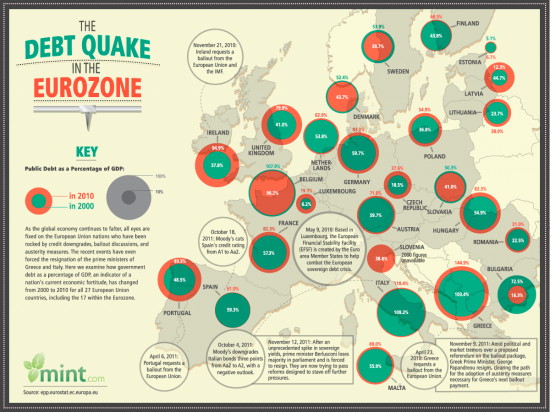
As the global economy continues to falter, all eyes are fixed on the European Union nations who have been rocked by credit downgrades, bailout discussions, and austerity measures.
Column Five Media created this infographic with Mint to examine how government debt as a percentage of GDP has changed from 2000 to 2010 for all 27 European Union countries, including the 17 within the Eurozone.
Source: Mint .
Channel Surfing the ME-P
Have you visited our other topic channels? Established to facilitate idea exchange and link our community together, the value of these topics is dependent upon your input. Please take a minute to visit. And, to prevent that annoying spam, we ask that you register. It is fast, free and secure.
Conclusion
Your thoughts and comments on this ME-P are appreciated. Feel free to review our top-left column, and top-right sidebar materials, links, URLs and related websites, too. Then, subscribe to the ME-P. It is fast, free and secure.
Speaker: If you need a moderator or speaker for an upcoming event, Dr. David E. Marcinko; MBA – Publisher-in-Chief of the Medical Executive-Post – is available for seminar or speaking engagements. Contact: MarcinkoAdvisors@msn.com
OUR OTHER PRINT BOOKS AND RELATED INFORMATION SOURCES:
- PRACTICES: www.BusinessofMedicalPractice.com
- HOSPITALS: http://www.crcpress.com/product/isbn/9781466558731
- CLINICS: http://www.crcpress.com/product/isbn/9781439879900
- ADVISORS: www.CertifiedMedicalPlanner.org
- FINANCE: Financial Planning for Physicians and Advisors
- INSURANCE: Risk Management and Insurance Strategies for Physicians and Advisors
- Dictionary of Health Economics and Finance
- Dictionary of Health Information Technology and Security
- Dictionary of Health Insurance and Managed Care


Share this:

Filed under: Investing | Tagged: Euro Zone, European Debt Crisis, European Union |
 The Leading Business Education Network for Doctors, Financial Advisors and Health Industry Consultants
‘Uncertainty and Danger’
[World Bank warns of downturn worse than 2008]
International body cuts growth forecast for US in 2012 from 2.9 percent to 2.2 percent.
http://www.msnbc.msn.com/id/46036397/ns/business-stocks_and_economy/
The World Bank just warned of a possible slump in global economic growth and urged developing countries to prepare for shocks that could be more severe than the 2008 crisis.
Hector
LikeLike
On The Euro
The eurozone is still in crisis and still in recession — maybe even a deeper recession. Greece, Portugal, Ireland, Italy and Spain have been joined in the list of crisis spots by Cyprus and, soon I expect, France.
The economies of these countries will continue to deteriorate through the summer, with the accompanying decay in national debt-to-GDP ratios. That will require either extensions of debt target set by current bailout plans or new rescue plans.
But, getting eurozone action on anything will be difficult if not impossible before September elections in Germany.
Keifer
LikeLike
How low will the Euro go?
That depends on how much, if at all, the Fed raises rates, and how long the ECB buys bonds. On one hand, there’s no sign of any inflation or bubbly behavior that would force the Fed to raise rates. But, on the other, the Fed has been pretty clear that it wants to start normalizing policy in June because unemployment is already normal-ish.
And, on top of that, New York Fed President William Dudley has even said they might have to hike rates in quick succession if long-term rates don’t go up too—which seems pretty likely with Europe’s low bond yields pushing ours down. The ECB has promised to keep buying bonds until at least September 2016, and even longer than that if inflation is still too low.
Now, Europe’s inflation numbers are already picking up a little bit, but, as Paul Krugman points out, markets seem to believe it will be a good while longer before Europe’s economy—and by extension, its monetary policy—is anywhere close to normal.
Add it all up, and Deutsche Bank expects the euro to keep falling to $0.90 by the end of 2016 and $0.85 by the end of 2017.
Farnsworth
LikeLike
They Told You So
[Economists Were Right to Doubt the Euro]
How Greece’s problems have proved economists like Milton Friedman and Martin Feldstein correct.
Mikos
LikeLike