







 Support our online development, and advance our onground research initiatives in free market economics, as we seek to showcase the brightest Next-Gen minds.
THE ME-P DISCLAIMER: Posts, comments and opinions do not necessarily represent iMBA, Inc., but become our property after submission. Copyright © 2006 to-date. iMBA, Inc allows colleges, universities, medical and financial professionals and related clinics, hospitals and non-profit healthcare organizations to distribute our proprietary essays, photos, videos, audios and other documents; etc. However, please review copyright and usage information for each individual asset before submission to us, and/or placement on your publication or web site. Attestation references, citations and/or back-links are required. All other assets are property of the individual copyright holder.
Support our online development, and advance our onground research initiatives in free market economics, as we seek to showcase the brightest Next-Gen minds.
THE ME-P DISCLAIMER: Posts, comments and opinions do not necessarily represent iMBA, Inc., but become our property after submission. Copyright © 2006 to-date. iMBA, Inc allows colleges, universities, medical and financial professionals and related clinics, hospitals and non-profit healthcare organizations to distribute our proprietary essays, photos, videos, audios and other documents; etc. However, please review copyright and usage information for each individual asset before submission to us, and/or placement on your publication or web site. Attestation references, citations and/or back-links are required. All other assets are property of the individual copyright holder.


Increase for Eight Major Drug Classes
[By Staff Reporters]
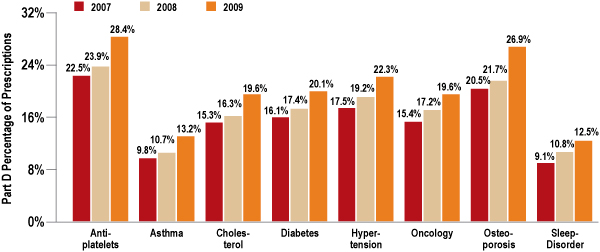
The shares of all prescriptions dispensed covered by Medicare Part D rose by at least three percentage points, between midyear 2007 and midyear 2009, in each of eight major drug classes profiled.
Assessment
The largest percentage increases over this period were in the osteoporosis (to 26.9% in 2009 from 20.5% in 2007) and anti-platelet (to 28.4% from 22.5%) markets as of September 9, 2009.
Source: Data source: SDI © 2009.
Conclusion
Your thoughts and comments on this ME-P are appreciated. Feel free to review our top-left column, and top-right sidebar materials, links, URLs and related websites, too. Then, subscribe to the ME-P. It is fast, free and secure.
Link: http://feeds.feedburner.com/HealthcareFinancialsthePostForcxos
Speaker: If you need a moderator or speaker for an upcoming event, Dr. David E. Marcinko; MBA – Publisher-in-Chief of the Medical Executive-Post – is available for seminar or speaking engagements. Contact: MarcinkoAdvisors@msn.com
OUR OTHER PRINT BOOKS AND RELATED INFORMATION SOURCES:
DICTIONARIES: http://www.springerpub.com/Search/marcinko
PHYSICIANS: www.MedicalBusinessAdvisors.com
PRACTICES: www.BusinessofMedicalPractice.com
HOSPITALS: http://www.crcpress.com/product/isbn/9781466558731
CLINICS: http://www.crcpress.com/product/isbn/9781439879900
BLOG: www.MedicalExecutivePost.com
FINANCE: Financial Planning for Physicians and Advisors
INSURANCE: Risk Management and Insurance Strategies for Physicians and Advisors


Share this:

Filed under: Drugs and Pharma, Health Economics, Managed Care | Tagged: medicare, Medicare Part D, Part D |
 The Leading Business Education Network for Doctors, Financial Advisors and Health Industry Consultants
The Wall Street Journal has found another potential bonus for big-pharma in healthcare reform: closing of the doughnut hole.
http://online.wsj.com/article/SB10001424052748704094104575143961683850340.html?mod=googlenews_wsj
Mark
LikeLike
Aetna – I’m Glad I Never Met Ya!
The Centers for Medicare & Medicaid Services has issued an intermediate sanction against the Aetna Insurance Company for what CMS officials said are violations in administering the Medicare drug benefit.
http://www.healthcarefinancenews.com/news/cms-issues-sanctions-against-aetna
Gilbert
LikeLike
More on Medicare Part D
Medicare’s drug benefit became available in 2006 through a variety of private plans. Some plan types were new (stand alone prescription drug plans (PDPs) and regional PPOs) and some were familiar (local Medicare Advantage (MA) plans).
Steve Pizer and Austin Frakt published the first peer-reviewed paper characterizing the forms the drug benefit took under the variety of plan types ”A First Look at the New Medicare Prescription Drug Plans,” Health Affairs Web Exclusive (May 23, 2006): w252-w261.
It is worth a review after healthcare reform.
http://theincidentaleconomist.com/a-first-look-at-the-new-medicare-prescription-drug-plans-frakt-pizer-2006/?utm_source=feedburner&utm_medium=email&utm_campaign=Feed%3A+TheIncidentalEconomist+%28The+Incidental+Economist+%28Posts%29%29
Shane
LikeLike
eRx Penalty Revealed in Fine Print of Medicare Remittances
Physicians who wonder whether they received a hardship exemption from Medicare’s 1% penalty in 2012 for failing to e-prescribe in 2011 will have to find out by reading the fine print on their payment remittance statements. The Centers for Medicare and Medicaid Services (CMS) had intended to inform physicians and other prescribers whether they would be subject to the penalty through a feedback report that they could access online. However, on December 29, the agency announced that “due to the high volume of significant hardship exemption requests, it is no longer technically feasible for CMS to provide a…feedback report.”
Instead, CMS encouraged prescribers to check their remittance statements for claims submitted for services rendered since January 1, 2012. If they were hit with the 1% penalty (a “payment adjustment” in CMS parlance), they would see the letters “LE” on the statement and 2 different codes. The first is Claim Adjustment Reason Code (CARC[I1]) 237, indicating a “legislated/regulatory penalty.” The second is Remittance Advice Remark Code (RARC) N545, which explains that the provider was an “unsuccessful e-prescriber” in 2010 as defined by Medicare’s e-prescribing incentive program.
Source: Robert Lowes, Medscape News [1/5/12]
LikeLike
‘Let the Crime Spree Begin’
[How Fraud Flourishes in Medicare’s Drug Plan]
The federal government does little to stop schemers from stealing from Medicare Part D, the program that provides prescription drugs to more than 36 million seniors and disabled people.
http://www.propublica.org/article/how-fraud-flourishes-in-medicares-drug-plan?utm_source=et&utm_medium=email&utm_campaign=dailynewsletter
Eray
LikeLike
CMS – Key Changes and Updates Finalized in the 2015 Rate Announcement and Final Call Letter for Medicare Advantage and Prescription Drug Benefit (Part D) Programs
1. Lower Out-of-Pocket Drug Spending: Beneficiaries in the Part D prescription drug coverage gap, or “donut hole,” will benefit from greater savings on prescription drugs
2. Greater Protection for Beneficiaries: CMS intends to again use its authority to protect Medicare Advantage enrollees from significant increases in costs or cuts in benefits
3. Increased Protections for Beneficiaries Affected by Changes in Medicare Advantage Plan Networks: Strengthens tools used to ensure compliance with established provider access requirements
4. Payments to Medicare Advantage Plans: CMS estimates that the overall net change to plan payments between 2014 and 2015 to be +0.4 percent.
Source: Centers for Medicare & Medicaid Services
LikeLike