







 Support our online development, and advance our onground research initiatives in free market economics, as we seek to showcase the brightest Next-Gen minds.
THE ME-P DISCLAIMER: Posts, comments and opinions do not necessarily represent iMBA, Inc., but become our property after submission. Copyright © 2006 to-date. iMBA, Inc allows colleges, universities, medical and financial professionals and related clinics, hospitals and non-profit healthcare organizations to distribute our proprietary essays, photos, videos, audios and other documents; etc. However, please review copyright and usage information for each individual asset before submission to us, and/or placement on your publication or web site. Attestation references, citations and/or back-links are required. All other assets are property of the individual copyright holder.
Support our online development, and advance our onground research initiatives in free market economics, as we seek to showcase the brightest Next-Gen minds.
THE ME-P DISCLAIMER: Posts, comments and opinions do not necessarily represent iMBA, Inc., but become our property after submission. Copyright © 2006 to-date. iMBA, Inc allows colleges, universities, medical and financial professionals and related clinics, hospitals and non-profit healthcare organizations to distribute our proprietary essays, photos, videos, audios and other documents; etc. However, please review copyright and usage information for each individual asset before submission to us, and/or placement on your publication or web site. Attestation references, citations and/or back-links are required. All other assets are property of the individual copyright holder.


About the Ship USNS COMFORT
By Dr. David Edward Marcinko; MBA, CMP™
[Publisher-in-Chief]
Dateline: August 4, 2009 Canton, Maryland
The official Navy ship USNS COMFORT [“Medical Treatment Facility”] has the primary mission to provide a mobile, flexible and rapidly responsive capability for acute medical and surgical care in support of amphibious task forces. These forces include the Marine Corps, Army and Air Force elements, forward deployed Navy elements of the fleet, and activities located in areas where hostilities may be imminent. Operations are governed by the principles of the “Geneva Convention for the Amelioration of the Wounded, Sick, and Shipwrecked Members of the Armed Forces at Sea”, as of August 12, 1949.
Mission
As a secondary mission of the ship COMFORT is providing a full hospital service asset for use by other government agencies involved in the support of relief and humanitarian operations worldwide. These mission statements are accountable to both the Reduced Operating Status (ROS) and Full Operating Status (FOS) military personnel staffed at National Naval Medical Center, Bethesda Maryland until the ship is activated. However, the ROS personnel’s immediate and number one priority is to fully activate the ship to a FOS Echelon III Medical Treatment Facility within a prescribed 5-day time frame.
Functions
In meeting these missions, the ROS personnel perform the following functions:
- Serve as the nucleus of the critical core required to execute activations;
- Develop, test, and maintain systems and procedures to support activation process;
- Orient and train FOS augmenting staff;
- Monitor/assess the medical treatment facility’s overall ability to fully activate/perform mission.
Leaders
The ship is commanded by CAPT James J. Ware DDS, with Executive Officer Captain Larnerd, and Master Chief Lohner. The home base is Baltimore, Maryland. Upon arrival at the dock, the ME-P and I planned to meet onboard with Master David Lieberman. But, an interview was cancelled due to a last minute scheduling conflict. However, we were placed in the competent hands of our civilian tour guide, Shaun B. of Virginia. He noted 70 civilian and 700 military personnel.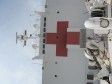
Assessment
Shaun B, informed me that despite advanced age, my application for a four month tour would be gladly reviewed. And, it is under serious future consideration as my nurse sister is a recent Bronze Star Award winner from a Combat Army Surgical Hospital [CASH] unit stationed in Iraq. I also did my trauma surgery training in Martin Army Hospital, at Fort Benning Georgia, back-in-the-day.
About Off Road with Dr. Marcinko
These sporadic off-road segments will continue through-out my 2009 summer promotional tour. Attendance at several formal and informal engagements increased since the early summer. The previously noted sales spike for our texts, handbooks and dictionaries www.HealthDictionarySeries.com continued and interest in our online www.CertifiedMedicalPlanner.com program and premier quarterly guide: Healthcare Organizations [Journal of Financial Management Strategies] www.HealthcareFinancials.com remained high.
Part IV: https://healthcarefinancials.wordpress.com/2009/08/13/off-road-touring-with-dr-marcinko-part-iv/
Conclusion
And so, your thoughts and comments on this Medical Executive-Post are appreciated. Feel free to review our top-left column, and top-right sidebar materials, links, URLs and related websites, too. Then, be sure to subscribe to the ME-P. It is fast, free and secure.
Link: http://feeds.feedburner.com/HealthcareFinancialsthePostForcxos
Speaker: If you need a moderator or speaker for an upcoming event, Dr. David E. Marcinko; MBA – Publisher-in-Chief of the Executive-Post – is available for seminar or speaking engagements. Contact: MarcinkoAdvisors@msn.com
Get our Widget: Get this widget!
Our Other Print Books and Related Information Sources:
Practice Management: http://www.springerpub.com/prod.aspx?prod_id=23759
Physician Financial Planning: http://www.jbpub.com/catalog/0763745790
Medical Risk Management: http://www.jbpub.com/catalog/9780763733421
Healthcare Organizations: www.HealthcareFinancials.com
Health Administration Terms: www.HealthDictionarySeries.com
Physician Advisors: www.CertifiedMedicalPlanner.com
Subscribe Now: Did you like this Medical Executive-Post, or find it helpful, interesting and informative? Want to get the latest ME-Ps delivered to your email box each morning? Just subscribe using the link below. You can unsubscribe at any time. Security is assured.
Link: http://feeds.feedburner.com/HealthcareFinancialsthePostForcxos
Sponsors Welcomed
And, credible sponsors and like-minded advertisers are always welcomed.
Link: https://healthcarefinancials.wordpress.com/2007/11/11/advertise

Share this:

Filed under: Career Development, iMBA, Inc., Military Medicine, Op-Editorials, Sponsors, Touring with Marcinko | Tagged: Air Force, Army, Baltimore, Bronze Star, CAPT James J. Ware, Captain Larnerd, CASH Unit, DDS, Echelon III Medical Treatment Facility, Fort Benning, Geneva Convention, Marine Corps, Martin Army Hospital, Master Chief Lohner, military dentistry, National Naval Medical Center, USNS Comfort |
 The Leading Business Education Network for Doctors, Financial Advisors and Health Industry Consultants
TRICARE data breach was targeted
[Targeted identity thefts hit data breach victims]
“Victims of TRICARE data theft report financial fraud” by Bob Brewin was posted on Nextgov yesterday. http://www.nextgov.com/nextgov/ng_20120314_6971.php?oref=topstory
I’m not even a TRICARE identity theft victim and I’m pissed at the industry-wide recklessness in HIT. So imagine how angry they feel.
Even though throughout the giddy development of EHRs no stakeholder has wanted to openly discuss the ever increasing danger of identity theft – not with billions of stimulus dollars being thrown around – we all knew it was only a matter of time before patients’ identities would be targeted. Now the public is catching on to the deception the hard way.
The complaint has been amended to acknowledge that TRICARE beneficiaries had to take extensive steps to protect their financial information:
— Virginia Gaffney of Hampton, Va., a TRICARE beneficiary and military spouse, said her USAA credit card was rejected at a restaurant; she later discovered the company had canceled her card due to suspicious activity.
— Antoinette Morelli, a disabled Air Force veteran of the Gulf War, said she and her husband, a retired Air Force colonel, discovered unauthorized charges on two credit cards and unauthorized withdrawals from two bank accounts.
— James Biggerman, a retired Army command sergeant major who lives in Shelbyville, Ind., was notified about fraudulent charges on his credit card account shortly after the tape theft and started receiving unsolicited calls from telemarketers and scam artists.
— Juan Diego Hernandez, a Frisco, Texas, Army veteran noticed unauthorized charges on the credit card account he holds with his wife and spent hours on the phone with the bank resolving the errors.
— Carol Keller, the Revere, Mass., spouse of a disabled Air Force veteran, said she discovered three separate fraudulent charges against her credit or debit cards since last October.
Imagine how angry other TRICARE clients were when they discovered that they “had to cancel credit cards and close bank accounts; open new credit cards and bank accounts; stop direct deposits to those compromised accounts and re-enroll in direct deposits for new accounts; stop recurring electronic payments from compromised accounts and re-enroll in electronic payments through new accounts; and otherwise spend time and money in mitigation responding to notifications following the wrongful disclosure that certain financial accounts have been compromised,” according to the complaint.
“Dr. Deborah Peel, founder of the Patient Privacy Rights Advocacy Group in Austin, Texas, said unwanted marketing, credit card cancellation, and identity theft are typical and expected when sensitive, richly detailed personal health data is breached. It could take years to discover the repercussions of stolen medical information, she said.”
Most ominous of all, it was a targeted theft.
“The thief or thieves stealthily broke into the employee’s Honda Civic and took the unencrypted backup tapes and records, thereby gaining information worth billions of dollars. The nature of this theft supports the logical inference that the thief or thieves were specifically targeting the confidential information contained on the backup tapes and records.”
No more fun and games, folks. You’re quickly losing Americans’ trust.
I don’t know what you are going to do about EMRs, but if electronic dental records cannot be de-identified, the logical thing for dentists to do is to return to paper – the gold standard in security.
D. Kellus Pruitt DDS
LikeLike
TRICARE identity heist details
Yesterday, Howard Anderson posted “TRICARE Breach Victims Report Fraud – 8 Class Action Lawsuits Pending; Consolidation Sought” on HealthcareInfoSecurity.com.
http://www.healthcareinfosecurity.com/articles.php?art_id=4590&rf=2012-03-16-eh&elq=e1ccf903adca416a8399afa26cea1d23&elqCampaignId=1585
Anderson says that according to the complaint, the backup tapes were left in an employee’s 2003 Honda Civic parked “‘in a parking garage of an upscale office building with 24-hour security in downtown San Antonio.” The complaint continues: “The parking garage where the security breach took place contained many cars that were far more valuable than the 2003 Honda Civic. Yet the thief or thieves, who went to great effort to avoid security, did not break into any of the luxury cars in the garage, targeting instead the relatively inexpensive car containing the confidential data.” Evidently, the thief or thieves stole a radio/CD player and a GPS unit as well. That way, if someone got caught, they might go to jail for breaking into the cheapest car in the garage. All in all, not a bad risk for $240 million. Whether you are a provider or not, as a healthcare consumer, don’t you find that scary?
According to the Ponemon Institute, the street value of the 4.9 million financial identities at $5 each is $24.5 million. The medical identities bring ten times that much.
Do you think the successful TRICARE heist will increase or decrease the demand for stolen medical records?
D. Kellus Pruitt DDS
LikeLike