 The average cost of processing a single, clean, paper-based or electronic claim can range from 85 cents to $1.58.
However, according to AHIP, nearly half of all claims (48 percent) were pended due to the submission of duplicate claims (35 percent), lack of complete information or other information needed to justify the claim (12 percent), or invalid codes (1 percent).
The manual adjudication of these duplicate or incorrect claim submissions increases the cost of administration to $2.05. The $2.05 scenario is a best case calculation. In our actual field experience the cost can be as high as $10.00 per claim.
Payment Delays
In addition to the increased administrative cost, one must not forget about the delayed payment to the provider. As stated by AHIP, a duplicate claim can take 9 days to remediate and missing information on a claim can take up to 11 days. This kind of delay damages the relationship between the provider and the health plan, which in terms of costs is priceless.
Enter ID Management
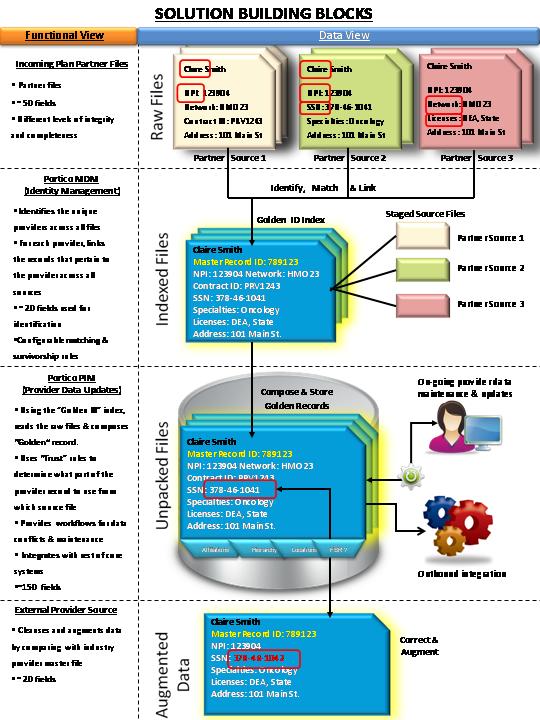
To solve this problem, some healthcare organizations are implementing Master Identity Management (IDM)—a valuable approach to creating an enterprise “source of truth” for provider identity information. But when it comes to payment integrity and claims processing, IDM without a Provider Information Management (PIM) system doesn’t work. Provider relationship and contract data are far too complex, and both types of data are needed to supplement provider identity data in support of claims administration.

Provider Information Management
When IDM is fully integrated with PIM, payers can successfully establish a single, accurate and effective source of truth. An integrated approach also:
- Ensures quality – by standardizing, cleansing, cross-referencing and consolidating relevant data, while removing duplicate entries.
- Mitigates risk – reducing the downstream impact of inaccurate data on all claims processing, contracting, credentialing, provider directory and connected systems.
- Saves millions of dollars – by reducing duplicate entries by even a fraction of a percent, thus ensuring that claims are being processed in an efficient and effective manner.
Assessment
IDM plays a pivotal role in the future of healthcare. As new, collaborative and accountable care delivery models evolve, reliable provider identity management is absolutely critical. Combining IDM with PIM gives payers the most powerful solution for assuring payment integrity while improving provider identity and duplication management.
Conclusion
Your thoughts and comments on this ME-P are appreciated. Feel free to review our top-left column, and top-right sidebar materials, links, URLs and related websites, too. Then, subscribe to the ME-P. It is fast, free and secure.
Conclusion
Your thoughts and comments on this ME-P are appreciated. Feel free to review our top-left column, and top-right sidebar materials, links, URLs and related websites, too. Then, subscribe to the ME-P. It is fast, free and secure.
Speaker: If you need a moderator or speaker for an upcoming event, Dr. David E. Marcinko; MBA – Publisher-in-Chief of the Medical Executive-Post – is available for seminar or speaking engagements. Contact: MarcinkoAdvisors@msn.com
OUR OTHER PRINT BOOKS AND RELATED INFORMATION SOURCES:
Our Newest Textbook Release

Learn How to Profit and Thrive in the PP-ACA Era
BOOK FOREWORD / TESTIMONIAL
Filed under: Health Insurance, Information Technology | Tagged: AHIP, ARs, electronic health care claims, Health Insurance Claims Processing Costs, Hospital Revenue Cycle Management, Integrated Provider Management, Master Identity Management, Matias Klein, medical accounts receivable, paper-based health insurance claims, Portico Systems, Provider Information Management | 5 Comments »





 Support our online development, and advance our onground research initiatives in free market economics, as we seek to showcase the brightest Next-Gen minds.
THE ME-P DISCLAIMER: Posts, comments and opinions do not necessarily represent iMBA, Inc., but become our property after submission. Copyright © 2006 to-date. iMBA, Inc allows colleges, universities, medical and financial professionals and related clinics, hospitals and non-profit healthcare organizations to distribute our proprietary essays, photos, videos, audios and other documents; etc. However, please review copyright and usage information for each individual asset before submission to us, and/or placement on your publication or web site. Attestation references, citations and/or back-links are required. All other assets are property of the individual copyright holder.
Support our online development, and advance our onground research initiatives in free market economics, as we seek to showcase the brightest Next-Gen minds.
THE ME-P DISCLAIMER: Posts, comments and opinions do not necessarily represent iMBA, Inc., but become our property after submission. Copyright © 2006 to-date. iMBA, Inc allows colleges, universities, medical and financial professionals and related clinics, hospitals and non-profit healthcare organizations to distribute our proprietary essays, photos, videos, audios and other documents; etc. However, please review copyright and usage information for each individual asset before submission to us, and/or placement on your publication or web site. Attestation references, citations and/or back-links are required. All other assets are property of the individual copyright holder.








 The Leading Business Education Network for Doctors, Financial Advisors and Health Industry Consultants