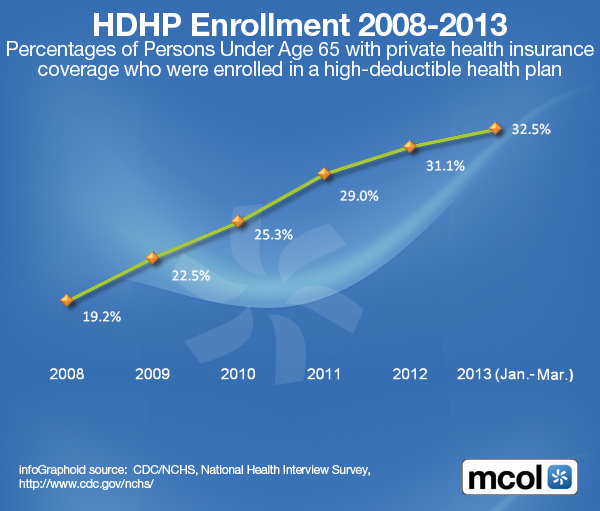
HDHP Enrollment Stats for 2008-2013

Join Our Mailing List

Enrollment Stats for those Under Age 65

By www.MCOL.com

### HDHCP

###

Conclusion

Your thoughts and comments on this ME-P are appreciated. Feel free to review our top-left column, and top-right sidebar materials, links, URLs and related websites, too. Then, subscribe to the ME-P. It is fast, free and secure.

Link: http://feeds.feedburner.com/HealthcareFinancialsthePostForcxos

Speaker: If you need a moderator or speaker for an upcoming event, Dr. David E. Marcinko; MBA – Publisher-in-Chief of the Medical Executive-Post – is available for seminar or speaking engagements. Contact: MarcinkoAdvisors@msn.com

OUR OTHER PRINT BOOKS AND RELATED INFORMATION SOURCES:

Health Dictionary Series: http://www.springerpub.com/Search/marcinko

Practice Management: http://www.springerpub.com/product/9780826105752

Physician Financial Planning: http://www.jbpub.com/catalog/0763745790

Medical Risk Management: http://www.jbpub.com/catalog/9780763733421

Hospitals: http://www.crcpress.com/product/isbn/9781439879900

Physician Advisors: www.CertifiedMedicalPlanner.org

Product DetailsProduct Details

HD-HCPs Gaining Ground


Popularity of Consumer Driven Plans Increasing

Staff Writers 

Join Our Mailing List 


Product DetailsProduct DetailsProduct Details

Product Details  Product Details

   Product Details 

CD-HCPs and Pharmacy Benefits

Join Our Mailing List

Safety and Compliance Needed

[By Staff Writers]

A new report suggests that Consumer Directed-Health Care Plans and Pharmacy Benefits Plans [PBPs] must focus on safety and compliance.

The survey, done by the Employee Benefit Research Institute [EBRI], found that nearly 70% of those enrolled in consumer-directed health care plans (CD-HCPs) said that they considered costs when deciding to see a doctor or filling a prescription. This compared with fewer than 40% of those in a more traditional comprehensive health insurance plan.

Assessment

However, the survey also found that CD-HP enrollees were twice as likely to avoid, skip or delay healthcare services. Is anyone surprised; please opine? 

Note: CD-HCPs: aka High-Deductible-Health Care Plans [HD-HCPs]

Conclusion

Your thoughts and comments on this ME-P are appreciated. Feel free to review our top-left column, and top-right sidebar materials, links, URLs and related websites, too. Then, subscribe to the ME-P. It is fast, free and secure.

Speaker: If you need a moderator or speaker for an upcoming event, Dr. David E. Marcinko; MBA – Publisher-in-Chief of the Medical Executive-Post – is available for seminar or speaking engagements. Contact: MarcinkoAdvisors@msn.com

OUR OTHER PRINT BOOKS AND RELATED INFORMATION SOURCES:

Product DetailsProduct DetailsProduct Details

2008 CMS Updates for HDHCPs

 Join Our Mailing List 

HDHCP Minimum Deductibles

[By Staff Writers]

For 2008, the minimum annual deductible amounts are unchanged from 2007:

  • Single Minimum Deductible: $1,100
  • Family Minimum Deductible: $2,200 

HDHP Maximum Out of Pocket Expense:

The 2008 maximum out of pocket amounts are:

  • Single Annual Maximum: $5,600
  • Family Annual Maximum: $11,200 

Maximum Annual HSA Contributions:

The 2008 maximum for HSA contributions are:

  • Single Annual Contribution: $2,900
  • Family Annual Contributions: $5,800

Conclusion

Your thoughts and comments on this ME-P are appreciated. Feel free to review our top-left column, and top-right sidebar materials, links, URLs and related websites, too. Then, subscribe to the ME-P. It is fast, free and secure.

Link: http://feeds.feedburner.com/HealthcareFinancialsthePostForcxos

Speaker: If you need a moderator or speaker for an upcoming event, Dr. David E. Marcinko; MBA – Publisher-in-Chief of the Medical Executive-Post – is available for seminar or speaking engagements. Contact: MarcinkoAdvisors@msn.com

OUR OTHER PRINT BOOKS AND RELATED INFORMATION SOURCES:

LEXICONS: http://www.springerpub.com/Search/marcinko
PHYSICIANS: www.MedicalBusinessAdvisors.com
PRACTICES: www.BusinessofMedicalPractice.com
HOSPITALS: http://www.crcpress.com/product/isbn/9781466558731
CLINICS: http://www.crcpress.com/product/isbn/9781439879900
ADVISORS: www.CertifiedMedicalPlanner.org
BLOG: www.MedicalExecutivePost.com


Product Details  Product Details

One Health Insurance Policy Solution

A Real Insurance Solution 

By Dr. David Edward Marcinko; MBA, CMP™

Publisher-in-Chief

Market Driven Health Insurance Alternatives


According to Michael K. Evans, former chief economist for the American Economics Group, Washington, DC, a real market driven insurance model may be a solution to the current health insurance coverage crisis.

It would work like a Medical Savings Account [MSA], or Health Savings Account [HSA] or any other insurance plan; by self-payment for routine visits and medications and using the insurance only for catastrophic illness.

Ironically, this was the plan in the original Medicare legislation and the reason prescription drug costs were not covered until the adoption of Medicare Part D, a few years ago.  

However, many older or sickly patients claim that the cost of doctors, hospitals and medications has risen so much that they are often forced to choose between food and medical care, since the CPI grossly understates the cost of living for the elderly. And, some experts therefore believe a one-time adjustment is needed to put those payments back where they actually cover the average market basket of goods and services they buy. 

But, with adjustments must come an ironclad agreement that government aid for medical care should be used only for major costs associated with catastrophic illness, not routine care.

Furthermore, we believe that when drug companies, hospitals and physicians find that consumers are spending their own money, they will then work out more reasonable price schedules — or they won’t get paid.  

Just, as not everyone can live in the most expensive neighborhood, not everyone can afford to see the most expensive doctor.  As lower prices work their way through the system, employers who offer health-care benefits will find their financial situation also will benefit because costs incurred by employees will rise less rapidly.  

In the long run, even though the initial effect will be to boost government spending, the net result will be lower medical-care costs, more covered recipients, less bureaucracy, more competent physicians, smaller government outlays and a greater chance that some medical manufacturing firms, or big pharma companies, will remain in the U.S. instead of outsourcing to countries where labor costs are much lower. 

Your thoughts are appreciated – but it sure sounds like a HDHCP to me?  

High Deductible Health Care Plans

Providing Health Care in a High-Deductible World

By Steven Podnos MD, CFP®

With the increasingly common use of  High Deductible Health Care Plans (HDHCP) (often combined with a Health Savings Account), health care providers are seeing a growing population of health care consumers that are paying “out of pocket” in some fashion for the first several thousand dollars of health care expenses each year.

Q: What is the impact of this for health care providers and hospitals? 

Consider that historical pricing for health care services are much higher than providers expect to receive. Many “fee schedules” hark back to a day in which reimbursement bore some relationship to charged fees-almost unheard of now. 

Let’s illustrate

Enter the consumer with a high deductible plan.  Last year, with his old more traditional health insurance, he sees a physician for an initial visit.  With ancillaries, the office bill might be $300, but the patient pays his $20 co-pay and leaves.  The physician is contracted with the insurer to provide that level of service for a total of $110, and collect the remaining $90 from the carrier.  Everybody is happy. 

This year however, no one is happy.  The consumer with the HDHCP gets a $300 bill for the same service that cost him $20 last year.  He doesn’t know or doesn’t remember that his health care insurance premiums are lower than last year (as he may not pay them). 

The result is one very unhappy patient. Clearly, health care providers need to adapt to the new world of HDHC plans. Hospitals and physician offices should have a list of charges for patients paying cash or having these plans.  The charges would fairly approximate what they expect to receive from patients with Medicare and/or managed care plans for the same services. 

Conversely, patients with these HDHC plans must learn to ask up front for a “cash” price on health care services.  

Dr. Podnos is a fee-only financial planner in Brevard County, Florida.

Product Details  Product Details