







 Support our online development, and advance our onground research initiatives in free market economics, as we seek to showcase the brightest Next-Gen minds.
THE ME-P DISCLAIMER: Posts, comments and opinions do not necessarily represent iMBA, Inc., but become our property after submission. Copyright © 2006 to-date. iMBA, Inc allows colleges, universities, medical and financial professionals and related clinics, hospitals and non-profit healthcare organizations to distribute our proprietary essays, photos, videos, audios and other documents; etc. However, please review copyright and usage information for each individual asset before submission to us, and/or placement on your publication or web site. Attestation references, citations and/or back-links are required. All other assets are property of the individual copyright holder.
Support our online development, and advance our onground research initiatives in free market economics, as we seek to showcase the brightest Next-Gen minds.
THE ME-P DISCLAIMER: Posts, comments and opinions do not necessarily represent iMBA, Inc., but become our property after submission. Copyright © 2006 to-date. iMBA, Inc allows colleges, universities, medical and financial professionals and related clinics, hospitals and non-profit healthcare organizations to distribute our proprietary essays, photos, videos, audios and other documents; etc. However, please review copyright and usage information for each individual asset before submission to us, and/or placement on your publication or web site. Attestation references, citations and/or back-links are required. All other assets are property of the individual copyright holder.


EVIDENCE BASED DENTISTRY
By Staff Reporters
***
***
Evidence Based Dentistry?
Despite the high praise for evidence-based dentistry, there are a number of limitation and criticism that has been given to the process. Chambers DW provides quite a bit of criticism, as well as a number of limitations that evidence-based dentistry provides. In no particular order of importance, a number of mentioned objections towards this format are:
- Evidence-based dentistry is too clumsy due to the concept being poorly defined
- The implementation of evidence-based dentistry has been distorted by too heavy of an emphasis of computerized searches for research findings that meet the standards of academics
- Although EBD advocates enjoy sharing anecdotal accounts of mistakes others have made, faulting others is not proof that one’s own position is correct
- There is no systematic, high-quality evidence that EBD is effective
- Patient and practitioner values are the shortest leg of the stool. As they are so little recognized, their integration in EBD is problematic and ethical tensions exist where paternalism privileges science over patient’s self-determined best interests.
- MORE: https://pmc.ncbi.nlm.nih.gov/articles/PMC6375114/
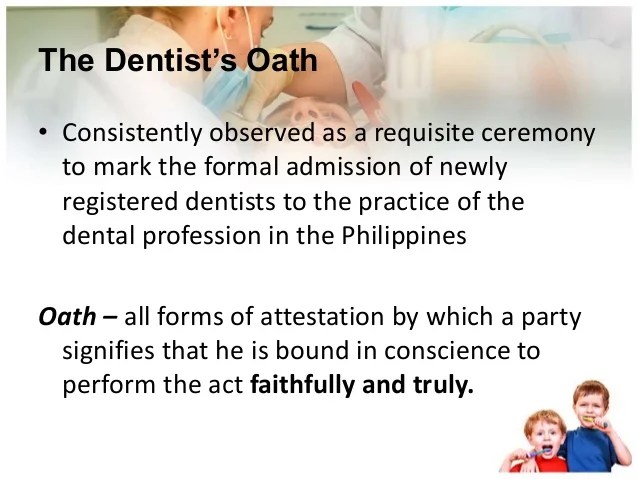
Dental Oath
Although dentists, dental hygienists, and dental assistants may not formally recite the Hippocratic Oath, its principles undeniably apply in their practice, particularly in the high-stakes context of emergency medical care.
By embodying these principles, dental professionals not only fulfill their commitment to ethical patient care but also ensure the safety and well-being of those they serve.
More: https://www.ada.org/about/principles/code-of-ethics
COMMENTS APPRECIATED
Refer and Subscribe
***
***
Share this:

Filed under: "Doctors Only", Career Development, Drugs and Pharma, Ethics, Glossary Terms, Health Economics, Health Insurance | Tagged: DDS, dental assistants, dental ethics, dental hygienists, dental oath, dental patient care, dentist, dentists, DMD, EBD, evidence based dentistry, Hippocrates | Leave a comment »
 The Leading Business Education Network for Doctors, Financial Advisors and Health Industry Consultants