







 Support our online development, and advance our onground research initiatives in free market economics, as we seek to showcase the brightest Next-Gen minds.
THE ME-P DISCLAIMER: Posts, comments and opinions do not necessarily represent iMBA, Inc., but become our property after submission. Copyright © 2006 to-date. iMBA, Inc allows colleges, universities, medical and financial professionals and related clinics, hospitals and non-profit healthcare organizations to distribute our proprietary essays, photos, videos, audios and other documents; etc. However, please review copyright and usage information for each individual asset before submission to us, and/or placement on your publication or web site. Attestation references, citations and/or back-links are required. All other assets are property of the individual copyright holder.
Support our online development, and advance our onground research initiatives in free market economics, as we seek to showcase the brightest Next-Gen minds.
THE ME-P DISCLAIMER: Posts, comments and opinions do not necessarily represent iMBA, Inc., but become our property after submission. Copyright © 2006 to-date. iMBA, Inc allows colleges, universities, medical and financial professionals and related clinics, hospitals and non-profit healthcare organizations to distribute our proprietary essays, photos, videos, audios and other documents; etc. However, please review copyright and usage information for each individual asset before submission to us, and/or placement on your publication or web site. Attestation references, citations and/or back-links are required. All other assets are property of the individual copyright holder.


SPONSOR: http://www.CertifiedMedicalPlanner.org
Dr. David Edward Marcinko; MBA MEd
***

***
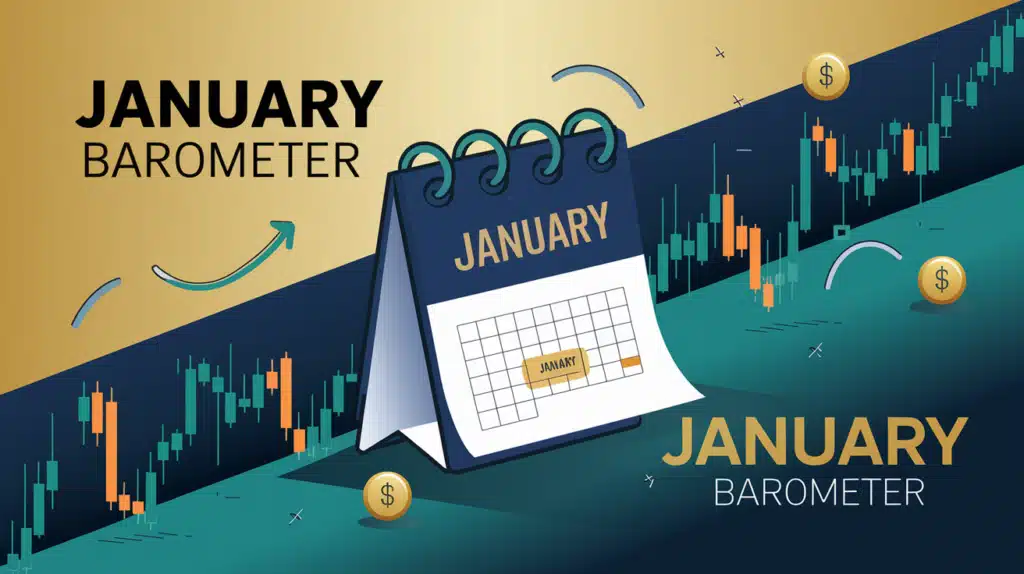
The January Barometer is a long‑standing market adage suggesting that the performance of the U.S. stock market during the month of January predicts how the market will behave for the remainder of the year. Popularized in the early 1970s, the idea is built around a simple rule: as goes January, so goes the year. In other words, if the S&P 500 posts gains in January, the full year is expected to end positively; if January is negative, the year may follow the same direction.
The reasoning behind the January Barometer is partly psychological and partly structural. January marks the beginning of a new financial year, when investors reposition portfolios after year‑end tax strategies, holiday spending cycles, and institutional rebalancing. Because of this, the month is often viewed as a clean slate that reflects genuine investor sentiment. A strong January may signal optimism, confidence in economic conditions, and a willingness to take on risk. Conversely, a weak January may indicate caution, uncertainty, or concerns about the broader economic environment.
Historically, the January Barometer has shown periods of impressive accuracy. Over several decades, it appeared to correctly predict the direction of the market in a large majority of years, which helped cement its reputation among traders and analysts. Many investors found the pattern compelling, especially during periods when January’s performance aligned closely with the eventual outcome of the year. These long‑term correlations contributed to the Barometer’s status as one of the most widely discussed seasonal indicators in finance.
However, the January Barometer is far from perfect. In more recent years, its predictive power has weakened, particularly during times of unusual economic disruption. Events such as global health crises, geopolitical tensions, and rapid shifts in monetary policy have created market environments where January’s performance did not reliably forecast the rest of the year. In some periods, the Barometer’s accuracy has hovered only slightly above chance, raising questions about whether the pattern reflects genuine market behavior or simply historical coincidence.
***
***
Critics argue that the January Barometer may be an example of data‑mining rather than a meaningful financial principle. Markets are influenced by countless variables, including interest rates, corporate earnings, inflation, and global events. No single month can capture all of these forces. Additionally, the Barometer does not account for unexpected shocks or policy changes that can dramatically alter market trajectories later in the year. Even supporters acknowledge that the indicator should be used as a supplementary tool rather than a standalone forecasting method.
Despite its limitations, the January Barometer remains influential because it reflects broader themes in investor psychology. Markets are not purely mechanical systems; they are shaped by expectations, sentiment, and collective behavior. January, as the symbolic start of the financial year, often amplifies these forces. When investors begin the year with confidence, that momentum can carry forward. When they begin with caution, the tone may remain subdued.
In conclusion, the January Barometer occupies a unique place in financial analysis: part historical curiosity, part behavioral insight, and part predictive tool. While its accuracy has varied over time, it continues to offer a lens through which investors interpret early‑year market movements. Used thoughtfully—alongside economic data, corporate fundamentals, and global trends—it can contribute to a broader understanding of market sentiment. But like all market adages, it should be approached with skepticism and an appreciation for the complexity of modern financial markets.
COMMENTS APPRECIATED
SPEAKING: Dr. Marcinko will be speaking and lecturing, signing and opining, teaching and preaching, storming and performing at many locations throughout the USA this year! His tour of witty and serious pontifications may be scheduled on a planned or ad-hoc basis; for public or private meetings and gatherings; formally, informally, or over lunch or dinner. All medical societies, financial advisory firms or Broker-Dealers are encouraged to submit an RFP for speaking engagements: CONTACT: Ann Miller RN MHA at MarcinkoAdvisors@outlook.com -OR- http://www.MarcinkoAssociates.com
Like, Refer and Subscribe
***
***
Share this:

Filed under: iMBA, Inc. | Tagged: david marcinko |
 The Leading Business Education Network for Doctors, Financial Advisors and Health Industry Consultants
Leave a comment