







 Support our online development, and advance our onground research initiatives in free market economics, as we seek to showcase the brightest Next-Gen minds.
THE ME-P DISCLAIMER: Posts, comments and opinions do not necessarily represent iMBA, Inc., but become our property after submission. Copyright © 2006 to-date. iMBA, Inc allows colleges, universities, medical and financial professionals and related clinics, hospitals and non-profit healthcare organizations to distribute our proprietary essays, photos, videos, audios and other documents; etc. However, please review copyright and usage information for each individual asset before submission to us, and/or placement on your publication or web site. Attestation references, citations and/or back-links are required. All other assets are property of the individual copyright holder.
Support our online development, and advance our onground research initiatives in free market economics, as we seek to showcase the brightest Next-Gen minds.
THE ME-P DISCLAIMER: Posts, comments and opinions do not necessarily represent iMBA, Inc., but become our property after submission. Copyright © 2006 to-date. iMBA, Inc allows colleges, universities, medical and financial professionals and related clinics, hospitals and non-profit healthcare organizations to distribute our proprietary essays, photos, videos, audios and other documents; etc. However, please review copyright and usage information for each individual asset before submission to us, and/or placement on your publication or web site. Attestation references, citations and/or back-links are required. All other assets are property of the individual copyright holder.


ON “PRIME”, “COMPOSITE” AND “TWIN” NUMBERS
Courtesy: https://lnkd.in/eBf-4vY
[By staff reporters]
***
A “PRIME” number is greater than 1 and has no positive divisors other than 1; and itself.
A natural number greater than 1, that is not a prime number, is a “COMPOSITE” number. For example, 5 is prime because 1 and 5 are its only positive integer factors, whereas 6 is composite because it has the divisors 2 and 3 in addition to 1 and 6. ESSAY: https://lnkd.in/gJNcgad
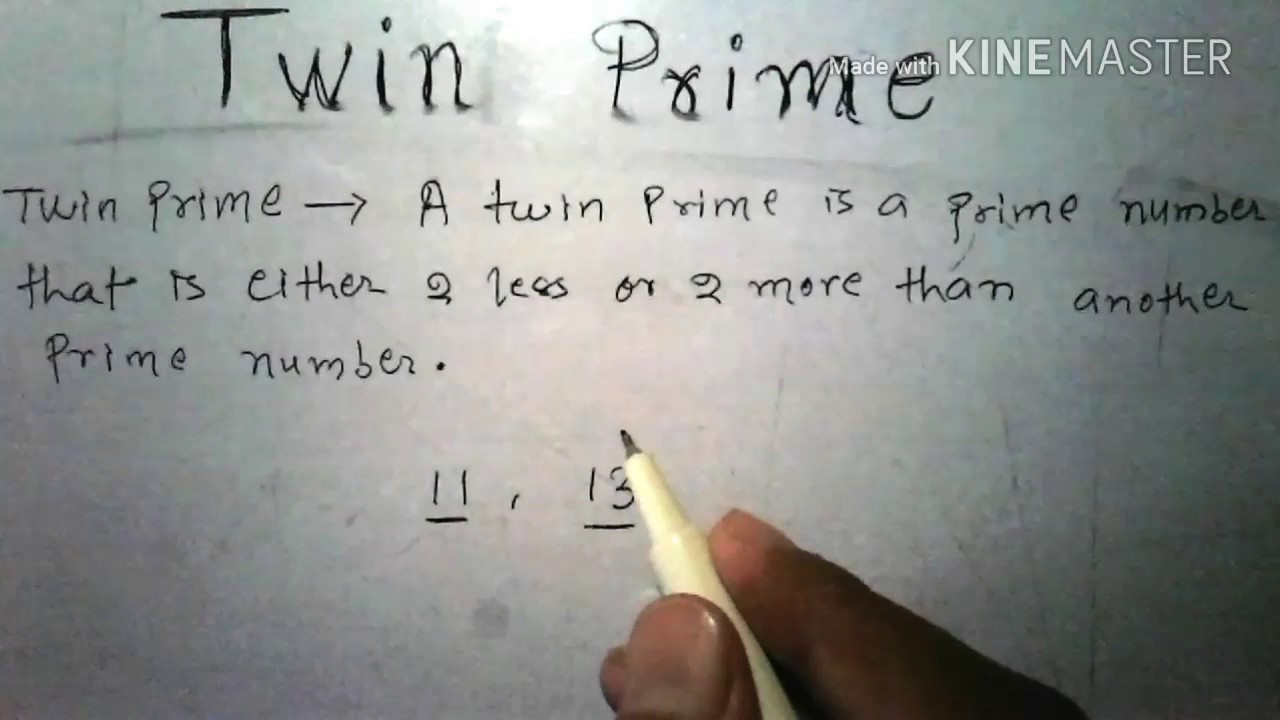
Now, a “TWIN PRIME” is a prime that is either 2 less or 2 more than another prime number [either member of the twin prime pair [41, 43]. In other words, a twin prime is a prime that has a prime gap of two.
***
***
LINK: https://lnkd.in/eJNz355
UTILITY: Prime numbers are used in cyphers and codes – including credit card numbers because prime factorization is unique.
An example is Gödel’s theorem which is used to argue that a computer can never be as smart as a human being because the extent of its knowledge is limited by a fixed set of axioms, whereas people can discover unexpected truths.
LINK: https://www.scientificamerican.com/article/what-is-godels-theorem/
It also plays a part in modern linguistic theories which emphasize the power of language to find new ways to express ideas. Your thoughts are appreciated.
Assessment: Your thoughts are appreciated.
***
 8
8
***
Share this:

Filed under: Health Economics | Tagged: composite numbers, Gödel's theorem, prime numbers, twin prime numbers |
 The Leading Business Education Network for Doctors, Financial Advisors and Health Industry Consultants
Leave a comment