ME-P SYNDICATIONS:
WSJ.com,
CNN.com,
Forbes.com,
WashingtonPost.com,
BusinessWeek.com,
USNews.com, Reuters.com,
TimeWarnerCable.com,
e-How.com,
News Alloy.com,
and Congress.org


BOARD CERTIFICATION EXAM STUDY GUIDES
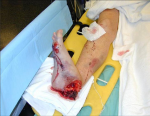
Lower Extremity Trauma
[Click on Image to Enlarge]
The “Medical Executive-Post” is about connecting doctors, health care executives and modern consulting advisors. It’s about free-enterprise, business, practice, policy, personal financial planning and wealth building capitalism. We have an attitude that’s independent, outspoken, intelligent and so Next-Gen; often edgy, usually controversial. And, our consultants “got fly”, just like U. Read it! Write it! Post it! “Medical Executive-Post”. Call or email us for your FREE advertising and sales consultation TODAY [678.779.8597] E-mail: MarcinkoAdvisors1738@outlook.com



ePodiatryConsentForms.com
Suite #5901 Wilbanks Drive, Norcross, Georgia, 30092 USA [1.678.779.8597]. Our location is real and we are now virtually enabled to assist new long distance clients and out-of-town colleagues.
If you want the opportunity to work with leading health care industry insiders, innovators and watchers, the “ME-P” may be right for you? We are unbiased and operate at the nexus of theoretical and applied R&D. Collaborate with us and you’ll put your brand in front of a smart & tightly focused demographic; one at the forefront of our emerging healthcare free marketplace of informed and professional “movers and shakers.” Our Ad Rate Card is available upon request [678-779-8597].

“Providing Management, Financial and Business Solutions for Modernity”
Whether you’re a mature CXO, physician or start-up entrepreneur in need of management, financial, HR or business planning information on free markets and competition, the "Medical Executive-Post” is the online place to meet for Capitalism 2.0 collaboration.

Support our online development, and advance our onground research initiatives in free market economics, as we seek to showcase the brightest Next-Gen minds.
THE ME-P DISCLAIMER: Posts, comments and opinions do not necessarily represent iMBA, Inc., but become our property after submission. Copyright © 2006 to-date. iMBA, Inc allows colleges, universities, medical and financial professionals and related clinics, hospitals and non-profit healthcare organizations to distribute our proprietary essays, photos, videos, audios and other documents; etc. However, please review copyright and usage information for each individual asset before submission to us, and/or placement on your publication or web site. Attestation references, citations and/or back-links are required. All other assets are property of the individual copyright holder.







Annual Growth in Medicaid Enrollment, By Enrolled Population, 2007-2012
Aged & Disabled Families Total:
2007-08 2.7% 3.3% 3.1%
2008-09 3.5% 9.5% 7.8%
2009-10 3.6% 8.5% 7.2%
2010-11 4.0% 5.0% 4.7%
2011-12 3.1% 2.3% 2.5%
Source: Kaiser Family Foundation
LikeLike
As Medicaid Rolls Swell, Cuts in Payments to Doctors Threaten Access to Care
Just as millions of people are gaining insurance through Medicaid, the program is poised to make deep cuts in payments to many doctors, prompting some physicians and consumer advocates to warn that the reductions could make it more difficult for Medicaid patients to obtain care. The Affordable Care Act provided a big increase in Medicaid payments for primary care in 2013 and 2014.
But, the increase expires on Thursday — just weeks after the Obama administration told the Supreme Court that doctors and other providers had no legal right to challenge the adequacy of payments they received from Medicaid.
The impact will vary by state, but a study by the Urban Institute, a non-partisan research organization, estimates that doctors who have been receiving the enhanced payments will see their fees for primary care cut by 43 percent, on average.
Source: Robert Pear
New York Times [12/17/14]
LikeLike
KFF Survey: Median Medicaid / CHIP Income Eligibility Limits
According to a January 2015 survey of eligibility, enrollment, renewal and cost-sharing policies by the Kaiser Family Foundation:
Adopting Medicaid Expansion (28 states) Income Thresholds:
– 305% FPL $60K (Children)
– 138% $27K (Parents)
– 138% $16K (Childless Adults)
Not adopting Medicaid expansion (23 states) Income Thresholds:
– 215% $43K (Children)
– 45% $9K (Parents)
– 0% $0 (Childless Adults)
Source: Kaiser Family Foundation
LikeLike
Medicaid Acceptance by Healthcare Providers Drops in 2015
HealthPocket examined government records on Medicaid acceptance for a broad cross-section of healthcare providers. Below are some findings:
• 34% of the healthcare providers examined were listed as accepting Medicaid insurance.
• 2015 results represent a 21% decrease compared to 2013 data for the same provider categories.
• Medicaid typically pays 61% of what Medicare pays for the same outpatient physician services.
• Medicare itself typically pays 80% of what commercial health insurers pay.
Source: Insurance News Net
LikeLike
On Medicaid
A friend of Sherlock Company suggested that plans with a heavy focus on Medicaid, all other factors being equal, tends to operate at lower administrative costs in their commercial business. He believes that states are very sensitive to costs and also favor benefit designs that are simple and remain relatively stable over time. This creates a corporate culture that emphasizes low cost administrative processes in health plans.
Using the Sherlock Benchmarks, we’ve tested his theory. While we can’t confirm the causation, a focus on Medicaid does in fact seem associated with low administrative costs in commercial products. So, our friend may have a point. The P-Value is 11.5%, which is often interpreted as the chance of there being no relationship between the variables.
Douglas B. Sherlock CFA
[Senior Health Care Analyst]
Sherlock Company
LikeLike