


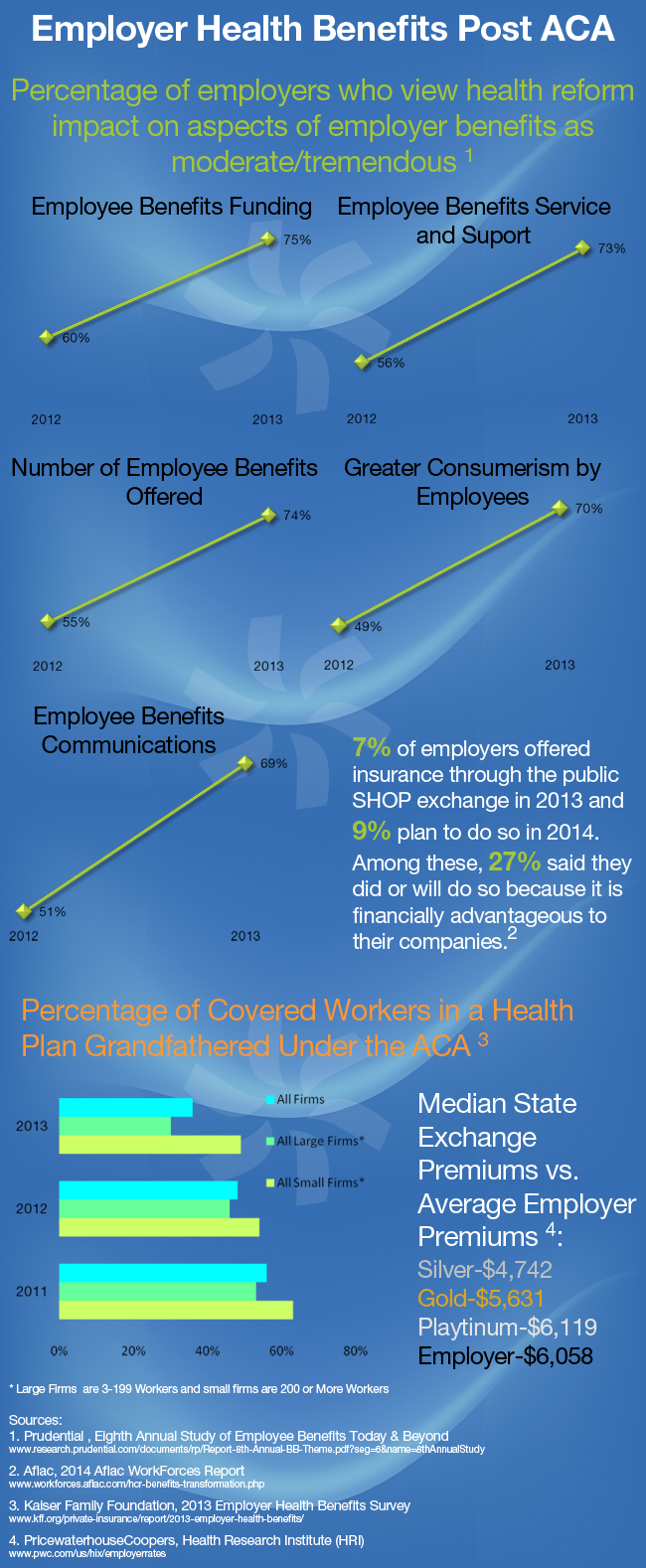
Percentage of Employers who View Health Reform Impact on Aspects of Employer Benefits as Moderate / Tremendous

Share this:

Filed under: Health Economics, Health Law & Policy | Tagged: ACA, health benefits, Health Benefits Post PP-ACA |
ME-P SYNDICATIONS:
WSJ.com,
CNN.com,
Forbes.com,
WashingtonPost.com,
BusinessWeek.com,
USNews.com, Reuters.com,
TimeWarnerCable.com,
e-How.com,
News Alloy.com,
and Congress.org


BOARD CERTIFICATION EXAM STUDY GUIDES
Lower Extremity Trauma
[Click on Image to Enlarge]
The “Medical Executive-Post” is about connecting doctors, health care executives and modern consulting advisors. It’s about free-enterprise, business, practice, policy, personal financial planning and wealth building capitalism. We have an attitude that’s independent, outspoken, intelligent and so Next-Gen; often edgy, usually controversial. And, our consultants “got fly”, just like U. Read it! Write it! Post it! “Medical Executive-Post”. Call or email us for your FREE advertising and sales consultation TODAY [678.779.8597] E-mail: MarcinkoAdvisors1738@outlook.com



 ePodiatryConsentForms.com
 “Providing Management, Financial and Business Solutions for Modernity”
 Support our online development, and advance our onground research initiatives in free market economics, as we seek to showcase the brightest Next-Gen minds.
THE ME-P DISCLAIMER: Posts, comments and opinions do not necessarily represent iMBA, Inc., but become our property after submission. Copyright © 2006 to-date. iMBA, Inc allows colleges, universities, medical and financial professionals and related clinics, hospitals and non-profit healthcare organizations to distribute our proprietary essays, photos, videos, audios and other documents; etc. However, please review copyright and usage information for each individual asset before submission to us, and/or placement on your publication or web site. Attestation references, citations and/or back-links are required. All other assets are property of the individual copyright holder.
Support our online development, and advance our onground research initiatives in free market economics, as we seek to showcase the brightest Next-Gen minds.
THE ME-P DISCLAIMER: Posts, comments and opinions do not necessarily represent iMBA, Inc., but become our property after submission. Copyright © 2006 to-date. iMBA, Inc allows colleges, universities, medical and financial professionals and related clinics, hospitals and non-profit healthcare organizations to distribute our proprietary essays, photos, videos, audios and other documents; etc. However, please review copyright and usage information for each individual asset before submission to us, and/or placement on your publication or web site. Attestation references, citations and/or back-links are required. All other assets are property of the individual copyright holder.


Percentage of Employers who View Health Reform Impact on Aspects of Employer Benefits as Moderate / Tremendous
Filed under: Health Economics, Health Law & Policy | Tagged: ACA, health benefits, Health Benefits Post PP-ACA |


Why Not Just Eliminate the Employer Mandate?
Employees offered coverage deemed affordable and adequate are prohibited from obtaining subsidies, as are their family members, and employers can avoid penalties by offering coverage to at least 95 percent of workers.
However, the Administration has delayed the requirements until 2016 for employers of 50-99, for larger employers until 2015, and softened requirements for that first year. Yet there are anecdotal reports of employers changing labor practices even though penalties have yet to be implemented.
Source: Urban Institute
LikeLike
The Affordable Care Actand America’s Cities
According to a report by the Robert Wood Johnson Foundation that estimated the effect of the Affordable Care Act (ACA) on 14 large and diverse cities: Los Angeles, Chicago, Houston, Philadelphia, Phoenix, Indianapolis, Columbus, Charlotte, Detroit, Memphis, Seattle, Denver, Atlanta, and Miami, among the seven cities in states that have expanded Medicaid, the ACA will likely decrease the number of uninsured by an average of 57 percent.
City by city, the reduction is projected to vary between 49 percent in Denver and 66 percent in Detroit by 2016. New federal spending on health care from 2014 to 2023 would range from $4.1 billion in Seattle to $27 billion in Los Angeles.
Among the seven cities in states not expanding Medicaid, the ACA will likely decrease the number of uninsured by an average of 30 percent. The decrease would range from 25 percent in Atlanta to 36 percent in Charlotte by 2016. New federal spending due to the ACA from 2014 to 2023 would increase by between $1.9 billion in Atlanta and $9.9 billion in Houston.
If Medicaid eligibility were expanded in these cities, the number of uninsured would fall by an average of 52 percent, ranging from 45 percent in Houston to 59 percent in Memphis. New federal spending would increase by between $4.8 billion in Atlanta and $16.4 billion in Houston from 2014 to 2023.
Source: Robert Wood Johnson Foundation
LikeLike
Affordable Care Act’s 1st Open Enrollment Period
A survey was taken regarding the decline for the % of adults who are uninsured (after the end of open enrollment). This was done on a monthly basis and this is what they found:
• July-Sept. 2013 (Ages 19-34) – 28%
• April-June 2014 (Ages 19-34) – 18%
• July-Sept. 2013 (Ages 35-49) – 18%
• April-June 2014 (Ages 35-49) – 15%
• July-Sept. 2013 (Ages 50-64) – 14%
• April-June 2014 (Ages 50-64) – 11%
• July-Sept. 2013 (Total) – 20%
• April-June 2014 (Total) – 15%
Source: The Commonwealth Fund
LikeLike
D.C. Appeals Court Strikes Down ACA Insurance Subsidies for Federal Exchanges
A federal appeals court has ruled the Obama administration cannot subsidize insurance premiums for nearly 7 million Americans, dealing a serious blow to the Affordable Care Act. The administration plans to appeal the ruling to a full panel of the left-leaning D.C. Circuit Court.
On Tuesday, a three-judge panel of the D.C. Circuit Court of Appeals in Washington ruled Tuesday that the text of the reform law clearly forbids income-tax subsidies to go to low- and middle-income Americans who use one of the federally run insurance exchanges. The tax subsidies have been flowing since the beginning of the year, based on a 2012 interpretation of the law by the IRS. The ruling, if upheld, could end insurance subsidies in as many as 36 states.
Source: Joe Carlson, Modern Healthcare [7/22/14]
LikeLike
Obamacare fines look less likely as exemptions swell
Almost 90% of uninsured Americans won’t pay a penalty under the Affordable Care Act in 2016.
http://money.msn.com/health-and-life-insurance/article.aspx?post=94d6ed99-9454-490a-9970-4d5e225f3c9d
Claire
LikeLike
Employers Should Prepare Now for 2015 to Avoid Penalties
Starting next year, the health law requires employers with at least 100 full-time workers to offer health coverage benefits to at least 70 percent of them or face penalties that start at $2,000 per employee.
Although the requirement, also called “the employer mandate” is new, the vast majority of large businesses have been offering health benefits for years.
Source: PPACA
LikeLike
Reaching Minorities
[Health Care Enrollment and Engagement]
As we approach the ACA’s third open enrollment, health insurance is still far from universal for some minority groups.
One in five Hispanics were uninsured last year. And although coverage rates among African Americans have surged nationally, success has varied from state to state based on Medicaid expansion decisions and other factors.
Nancy Chockley MBA
[President and CEO]
http://www.nihcm.org
LikeLike
ACA
Under the Affordable Care Act, tax-free health insurance is slated to change. The so-called Cadillac Tax would impose a levy on generous employer health plans in 2018.
That’s already causing some employers to consider reducing benefits or blocking workers from putting money into tax-free health-savings accounts.
Thoughts?
Luke
LikeLike