





 Support our online development, and advance our onground research initiatives in free market economics, as we seek to showcase the brightest Next-Gen minds.
THE ME-P DISCLAIMER: Posts, comments and opinions do not necessarily represent iMBA, Inc., but become our property after submission. Copyright © 2006 to-date. iMBA, Inc allows colleges, universities, medical and financial professionals and related clinics, hospitals and non-profit healthcare organizations to distribute our proprietary essays, photos, videos, audios and other documents; etc. However, please review copyright and usage information for each individual asset before submission to us, and/or placement on your publication or web site. Attestation references, citations and/or back-links are required. All other assets are property of the individual copyright holder.
Support our online development, and advance our onground research initiatives in free market economics, as we seek to showcase the brightest Next-Gen minds.
THE ME-P DISCLAIMER: Posts, comments and opinions do not necessarily represent iMBA, Inc., but become our property after submission. Copyright © 2006 to-date. iMBA, Inc allows colleges, universities, medical and financial professionals and related clinics, hospitals and non-profit healthcare organizations to distribute our proprietary essays, photos, videos, audios and other documents; etc. However, please review copyright and usage information for each individual asset before submission to us, and/or placement on your publication or web site. Attestation references, citations and/or back-links are required. All other assets are property of the individual copyright holder.


Fortunate Medical Professionals
www.CertifiedMedicalPlanner.org
The income gap between the 95th percentile and 80th percentile grew by $1,424 from 2010 to 2011. Indeed, income distribution appears to be widening, and fast, according to the graphic below.
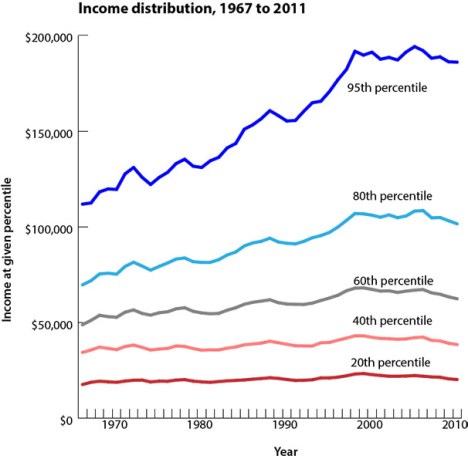
Inequality Grows
Okay, we don’t have inequality figures for 2012 yet. But, we do have income data for 2011, and it suggests that the post-war trend of widening income gaps show little sign of abating.
Assessment
And so, the gap between the top 5 percent and the rest of the country just kept growing. But, what about doctors and related medical professionals?
- Physician Income Maximization
- PHYSICIAN CLIENTS
- Doctor Salary v. Others [Present Value of Career Wealth]
- The US Income Gap as a New Reality Check for Doctors NOT Going Broke
Conclusion
Your thoughts and comments on this ME-P are appreciated. Feel free to review our top-left column, and top-right sidebar materials, links, URLs and related websites, too. Then, subscribe to the ME-P. It is fast, free and secure.
Speaker: If you need a moderator or speaker for an upcoming event, Dr. David E. Marcinko; MBA – Publisher-in-Chief of the Medical Executive-Post – is available for seminar or speaking engagements. Contact: MarcinkoAdvisors@msn.com
OUR OTHER PRINT BOOKS AND RELATED INFORMATION SOURCES:
- DICTIONARIES: http://www.springerpub.com/Search/marcinko
- PHYSICIANS: www.MedicalBusinessAdvisors.com
- PRACTICES: www.BusinessofMedicalPractice.com
- HOSPITALS: http://www.crcpress.com/product/isbn/9781466558731
- CLINICS: http://www.crcpress.com/product/isbn/9781439879900
- ADVISORS: www.CertifiedMedicalPlanner.org
- BLOG: www.MedicalExecutivePost.com
- FINANCE: Financial Planning for Physicians and Advisors
- INSURANCE: Risk Management and Insurance Strategies for Physicians and Advisors



Share this:

Filed under: "Doctors Only", Career Development, CMP Program | Tagged: certified medical planner, doctor income, physician income, rich doctors, US Income Distribution |
 The Leading Business Education Network for Doctors, Financial Advisors and Health Industry Consultants
Investing in Healthcare
The Patient Protection and Affordable Care Act, the President’s health care initiative, set out new mandates, subsidies and credits to employers and individuals to increase Americans’ access to health care.
Upon its passage in March 2010, investors began boosting the shares of drug makers, insurance providers and hospitals because they all suddenly had a lot more paying customers, courtesy of the government and taxpayers. And, much has been written about it here, and elsewhere. But, what about investing in the healthcare sector, following the PP-ACA?
Examples:
Shares of Pfizer (US:PFE) fell 50% during the eight years of the Bush Administration, January 2001 to January 2009. In contrast, its shares are up 70% during the Obama Administration, almost in a straight line. Sixty-four percent of the gains in the maker of Viagra, Zoloft and Lipitor have come since ACA passed.
Insurance provider Unitedhealth Group (US:UNH) is up 73% since Obamacare passed. Smaller biotechs have gained a lot more, led by Alexion Pharmaceuticals (US:ALXN), up 252%.
Overall, SPDR Health Care (US:XLV), which includes all the health care stocks in the S&P 500, is up 31% since the President’s health-care law passed, vs. 27% for the broad market. It’s still a good bet going forward, as most of the benefits lie ahead.
Any thoughts?
Dr. David Edward Marcinko MBA
http://www.CertifiedMedicalPlanner.org
LikeLike
Can’t get by on $60K, $80K, even $100K?
Hundreds of readers have shared how they live well while spending less than $5,000 a month.
http://money.msn.com/saving-money-tips/post–cant-get-by-on-dollar60k-dollar80k-even-dollar100k
Now it’s time to hear from those who feel they’re falling behind despite having a much larger income.
Ike
LikeLike
Shrinking PATIENT Incomes
[Why health-care income and wages are the exception to the rule?]
One answer is that health care is, generally speaking, the exception to many rules.
Demand for medical services is dominated by the government (i.e. Medicare, Medicaid, and the employer insurance tax break), which doesn’t face the same vertiginous up-and-downs as the rest of the economy. So as the Great Recession steamrolled many industries, health care, propped up by sturdy government spending, kept adding workers.
What’s more, computerization and information technology have yet to work their magical price-cutting power in health care as they have in other industries, for a variety of reasons.
Americans are spending four percent less on food away from home than in 2007; but we’re spending 42 percent more on health insurance. As prices have increased, so have wages for younger workers in the medical field.
(Update: Some ME-P readers have made the smart suggestion that money which might have gone to higher salaries has instead gone to paying higher health insurance costs.)
Fred
LikeLike