





 Support our online development, and advance our onground research initiatives in free market economics, as we seek to showcase the brightest Next-Gen minds.
THE ME-P DISCLAIMER: Posts, comments and opinions do not necessarily represent iMBA, Inc., but become our property after submission. Copyright © 2006 to-date. iMBA, Inc allows colleges, universities, medical and financial professionals and related clinics, hospitals and non-profit healthcare organizations to distribute our proprietary essays, photos, videos, audios and other documents; etc. However, please review copyright and usage information for each individual asset before submission to us, and/or placement on your publication or web site. Attestation references, citations and/or back-links are required. All other assets are property of the individual copyright holder.
Support our online development, and advance our onground research initiatives in free market economics, as we seek to showcase the brightest Next-Gen minds.
THE ME-P DISCLAIMER: Posts, comments and opinions do not necessarily represent iMBA, Inc., but become our property after submission. Copyright © 2006 to-date. iMBA, Inc allows colleges, universities, medical and financial professionals and related clinics, hospitals and non-profit healthcare organizations to distribute our proprietary essays, photos, videos, audios and other documents; etc. However, please review copyright and usage information for each individual asset before submission to us, and/or placement on your publication or web site. Attestation references, citations and/or back-links are required. All other assets are property of the individual copyright holder.


Will that be Paper or Electrons?
[By Staff Reporters]
Paper medical records continue to be a serious waste and posses potential HIPAA violations as paper charts are vulnerable to being lost, stolen, or destroyed.
According to some reports, managing paper charts, from transcriptions to labor needed to pull and re-file charts, costs medical practices $116,375 a year on average.
Taking a Look
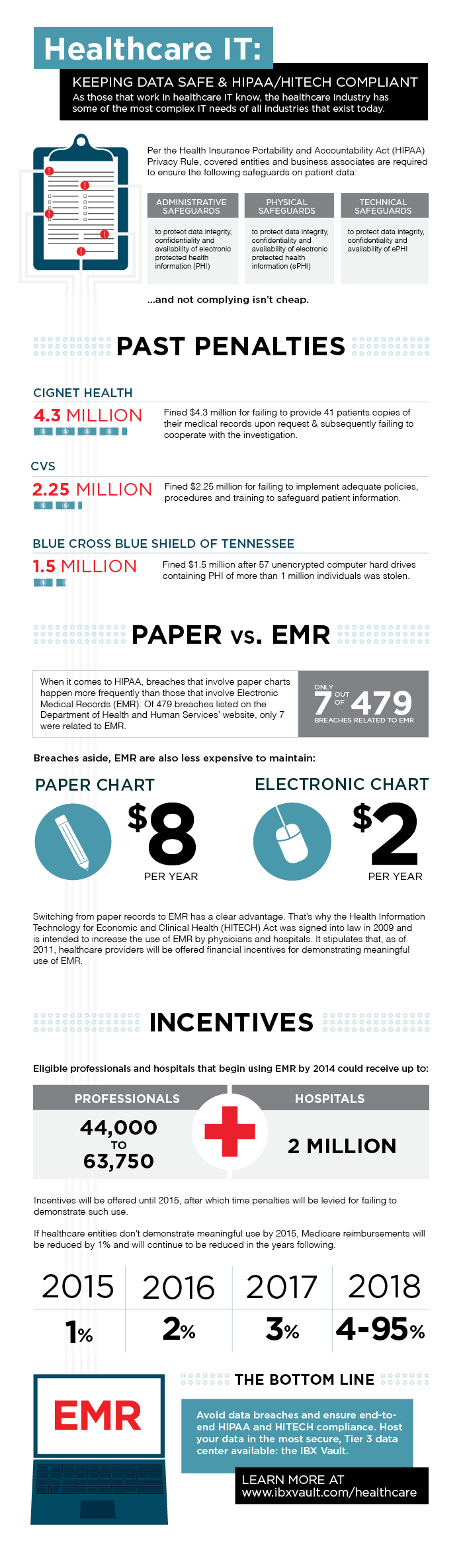
The waste & dangers of paper medical records infographic shown below created by IBX Vault takes deep look into the administrative, physical, and technical safeguards required by covered entities and business associates per the HIPAA privacy rule to secure patient data. The visualization also compares the potential security risks of paper medical records vs. EMRs stating that only 7 out of 479 breaches were related to EMRs.
[See also: The High Cost of HIPAA Violations Infographic]
Privacy and Treatments
While it is important to note that the adoption of EMRs present some security risks of its own as many critics have cited potential privacy concerns that may lead to expensive medical treatments.
Assessment
Additionally, it is imperative to note the tremendous financial harm that implementing an EMR does to a hospital’s bottom-line.
Conclusion
Your thoughts and comments on this ME-P are appreciated. Feel free to review our top-left column, and top-right sidebar materials, links, URLs and related websites, too. Then, subscribe to the ME-P. It is fast, free and secure.
Speaker: If you need a moderator or speaker for an upcoming event, Dr. David E. Marcinko; MBA – Publisher-in-Chief of the Medical Executive-Post – is available for seminar or speaking engagements. Contact: MarcinkoAdvisors@msn.com
OUR OTHER PRINT BOOKS AND RELATED INFORMATION SOURCES:
- DICTIONARIES: http://www.springerpub.com/Search/marcinko
- PHYSICIANS: www.MedicalBusinessAdvisors.com
- PRACTICES: www.BusinessofMedicalPractice.com
- HOSPITALS: http://www.crcpress.com/product/isbn/9781466558731
- CLINICS: http://www.crcpress.com/product/isbn/9781439879900
- ADVISORS: www.CertifiedMedicalPlanner.org
- BLOG: www.MedicalExecutivePost.com
- FINANCE: Financial Planning for Physicians and Advisors
- INSURANCE: Risk Management and Insurance Strategies for Physicians and Advisors

Share this:

Filed under: Information Technology | Tagged: EHRs, eMTs, HIPAA, paper medical records |
 The Leading Business Education Network for Doctors, Financial Advisors and Health Industry Consultants
Is paperless worth it?
How badly do you really want a paperless practice, Doc?
“Medical Billing Company Says Employee Leaked Data to Identity Theft Ring.”
http://www.securitymanagement.com/news/medical-billing-company-says-employee-leaked-data-identity-theft-ring-0011129
If such an employee working for a dental billing company steals dental patients’ identities, every individual affected has to be notified of the breach – causing 20% of them to immediately look for new dentists.
Even if a HIPAA-covered Business Associate is responsible for a breach and not the HIPAA-covered dentist, if it involves 500 or more of a dentist’s patients, details of the breach must be published as a local press release, harming the dentist’s reputation in his or her community forever.
Is paperless really worth it?
Darrell
LikeLike
Don’t Over Pay for MRs
Do you want to see a copy of your hospital medical record? Many people do in order to check for errors, to better understand their care, to provide information to a new doctor, or for any number of other reasons.
http://www.philly.com/philly/blogs/fieldclinic/Dont-Pay-Too-Much-for-Your-Medical-Records.html#t8xFH6fyejyxcrX0.99
So, copying PAPER records is a revenue generator; go figure!
Race
LikeLike
HIPAA compliance favors paper medical records
Electronic dental records’ inferior security compared to paper is just one of the obstacles to adoption of EHRs in dentistry… except in Minnesota, where EDRs have been mandated – regardless of who gets hurt.
HIPAA/HITECH Compliance consultants like Rich Szymanski, President of CMIT Solutions, unintentionally remind us through scary advertisements that paper dental records will continue to become increasingly cheaper and safer than electronic.
“Eight dangers of HIPAA noncompliance,” by Rich Szymanski for Postcrescent.com, August 24, 2014
http://www.postcrescent.com/story/money/2014/08/24/eight-dangers-hipaa-noncompliance/14456869/
1. The HITECH Act and HIPAA Omnibus Rule have substantially increased civil penalties for noncompliance. The penalty cap for HIPAA violations was increased from $25,000/year to $1,500,000/year per violation. Any complaint, breach or discovered violation can initiate mandatory investigations.
2. New breach notification rules will increase the number of HIPAA violations determined to be breaches. The HIPAA Omnibus Rule expands the definition of a breach and the consequences of failure to address it properly. The breach and failure to report it can trigger federal investigations and eventual fines and penalties, which can in turn financially cripple a business from running to its best ability.
3. All covered entities must have documented policies and procedures regarding HIPAA compliance. Recently, a dermatology practice in Concord, Mass., learned this lesson the hard way, getting slapped with a $150,000 fine for allowing the health information of just 2,200 individuals to be compromised via a stolen thumb drive. The company also had to incur the cost of implementing a corrective action plan to address privacy, security, and breach notification rules.
4. Business associates are now required to be compliant with HIPAA privacy and security rules. Covered entities (health care provider, health care plan or health care clearinghouse) are responsible of holding this standard toward their business associates (a person or entity that performs certain functions that involve the use or disclosure of protected health information on behalf of, or provides services to, a covered entity) through a business associate agreement, which lays out the permitted and required uses of protected health information.
5. While meaningful use incentives for electronic health records (EHR) are optional, HIPAA compliance is not. If you manage protected health information (PHI), you must comply with federal regulations or face substantial civil and criminal penalties. If a covered entity accepts meaningful use funding, a security risk analysis is required — and any funding may have to be returned if adequate documentation is not provided upon request.
6.The Department of Human & Health Services’ (HHS) Office of Civil Rights (OCR) is expanding its Division of Health Information Privacy enforcement team. The federal bureau is stepping up hiring for HIPAA compliance activities, calling for professionals with experience in privacy and security compliance and enforcement.
7. HIPAA compliance requires staff privacy and security training on a regular basis. All clinicians and medical staff that access PHI must be trained and retrained on proper HIPAA procedures. Documentation of provided training is required to be kept for six years.
8. Protecting your practice means protecting your reputation. The list of health care organizations reporting major breaches and receiving substantial penalties is growing at an alarming rate. It has reached a point where there is a large risk in losing so many clients that a business is unable to bounce back.
In order to avoid the violations above, it is important to sign a business associate agreement with all partners, as well as implement regular internal training for every employee that comes into contact with health care documents. This agreement lays out the business associate’s obligations and activities, as well as the permitted uses and disclosures.
If this step is not taken, the consequences of a health care-related data breach can include not just civil and criminal penalties but also damage to your company’s reputation.
—————
We’ve been had, Doc. Especially if you practice in Minnesota.
D. Kellus Pruitt DDS
LikeLike
Paper MRs
A physician in Portland, Maine returns to paper health records to protect the welfare of his patients. Since dentists need EHRs even less than physicians, and since dental patients see no value in electronic dental records anyway, will they do the same?
Dr. Michael Ciampi, owner of Ciampi Family Practice in Portland, Maine says cyber security inspired him to move from EHRs to paper medical records. “We no longer file claims electronically and we no longer use electronic health records,” Ciampi says. He adds, “We take patient privacy very seriously, in that we do not ask patients for Social Security numbers and I think that sets us apart from most other offices.” (See: “Experts say medical identity theft poses threat to healthcare systems.” WGME Channel 13, Portland, Maine, November 12, 2014).
http://www.wgme.com/news/features/top-stories/stories/experts-say-medical-identity-theft-poses-threat-healthcare-systems-24800.shtml#.VGS9mfnF9yR
WGME reports that according to a Ponemon Institute study, in 2013, the healthcare industry accounted for 44% of all data breaches – the most by far of any sector of the economy. The study also found that in the last two years, 90% of the healthcare organizations polled suffered a reportable data breach. Kate Healy, an attorney and Partner at Verrill Dana, LLP tells WGME, “It is a marked increase and I think because medical information is, I think, garnering a higher price on the black market, it’s a trend that we may see continue.”
EHR vendors, the American Dental Association, the ONC (US Dept. of HHS) and other ambitious stakeholders have never been transparent with dentists and patients about the cost and danger of digital records. Remember the secrecy surrounding the voluntary but permanent National Provider Identifiers which stakeholders pushed clueless dentists to adopt? Recognize a pattern?:
“Obamacare Architect: Lack of Transparency Was Key Because ‘Stupidity Of The American Voter’ Would Have Killed Obamacare said that lack of transparency was a major part of getting Obamacare passed because ‘the stupidity of the American voter’ would have killed the law if more people knew what was in it.” By Patrick Howley, Political Reporter, Dailycaller.com, November 9, 2014.
http://dailycaller.com/2014/11/09/obamacare-architect-lack-of-transparency-was-key-because-stupidity-of-the-american-voter-would-have-killed-obamacare/
Obamacare architect Jonathan Gruber proudly tells Dailycaller.com that the Obama administration’s lack of transparency creates a huge political advantage. Similarly, this summer, the American Dental Association’s Fort Worth District Dental Society anonymously censored from its Facebook a link to news report of a data breach from a local dental office – not to hide the bad news about EHRs from patients, but to hide the information from dues-paying members.
In spite of stakeholders’ successful efforts to temporarily hide the liabilities of EHRs, we are arguably witnessing a growing, ethical concern among providers for patients’ privacy. As dental patients learn the truth, and begin to seek out paper-based dentists, will you go back to pegboard and carbon paper – or just retire, Doc?
We’ve been had, and intentional lack of transparency due to conflicts of interest is to blame.
Don’t you wish there was a way to use computerized practice management tools without putting patients’ identities on computers? De-identification just might be the answer.
Still too early?
D. Kellus Pruitt DDS
LikeLike
Survey: 23% of ACOs Use Paper Charts
The Pharmacy Benefit Management Institute recently conducted a study of health IT challenges for accountable care organizations (ACOs). Here are some key findings from the report:
• Fewer than 1 in 3 ACO providers use a single electronic health record system.
• 59% of ACOs use multiple EHR systems.
• Almost one quarter (23%) of ACOs still use paper charts.
• 90% utilize quality reporting tools and 60% use point-of-care decision tools.
• One third (34%) of respondents found these support tools easy to use.
• Most ACOs (93%) say managing population health is very or extremely important.
Source: Pharmacy Benefit Management Institute, January 27, 2016
LikeLike