






 Support our online development, and advance our onground research initiatives in free market economics, as we seek to showcase the brightest Next-Gen minds.
THE ME-P DISCLAIMER: Posts, comments and opinions do not necessarily represent iMBA, Inc., but become our property after submission. Copyright © 2006 to-date. iMBA, Inc allows colleges, universities, medical and financial professionals and related clinics, hospitals and non-profit healthcare organizations to distribute our proprietary essays, photos, videos, audios and other documents; etc. However, please review copyright and usage information for each individual asset before submission to us, and/or placement on your publication or web site. Attestation references, citations and/or back-links are required. All other assets are property of the individual copyright holder.
Support our online development, and advance our onground research initiatives in free market economics, as we seek to showcase the brightest Next-Gen minds.
THE ME-P DISCLAIMER: Posts, comments and opinions do not necessarily represent iMBA, Inc., but become our property after submission. Copyright © 2006 to-date. iMBA, Inc allows colleges, universities, medical and financial professionals and related clinics, hospitals and non-profit healthcare organizations to distribute our proprietary essays, photos, videos, audios and other documents; etc. However, please review copyright and usage information for each individual asset before submission to us, and/or placement on your publication or web site. Attestation references, citations and/or back-links are required. All other assets are property of the individual copyright holder.


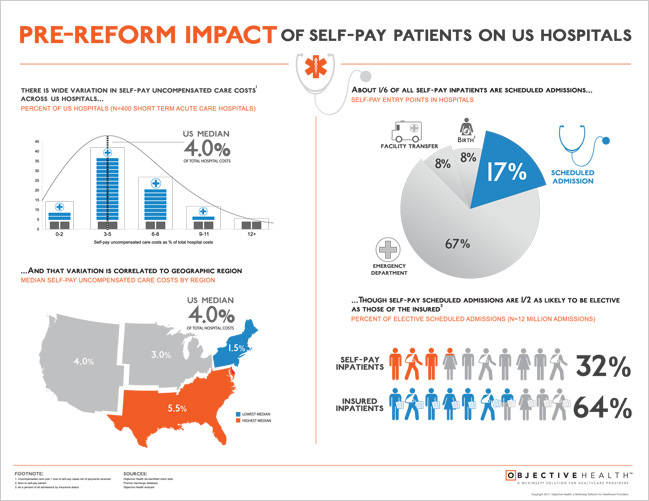
Pre-healthcare reform, and full PP-ACA implementation, many hospitals experience significant uncompensated care costs from self-pay patients. This infographic illustrates the variation in self-pay uncompensated care costs across US hospitals and regions.
Despite the uncompensated care risk, 1/6th of self-pay inpatients are scheduled admissions, though their procedures are much less elective than the procedures of the insured.
Conclusion
Your thoughts and comments on this ME-P are appreciated. Feel free to review our top-left column, and top-right sidebar materials, links, URLs and related websites, too. Then, subscribe to the ME-P. It is fast, free and secure.
Link: http://feeds.feedburner.com/HealthcareFinancialsthePostForcxos
Speaker: If you need a moderator or speaker for an upcoming event, Dr. David E. Marcinko; MBA – Publisher-in-Chief of the Medical Executive-Post – is available for seminar or speaking engagements. Contact: MarcinkoAdvisors@msn.com
Our Other Print Books and Related Information Sources:
Health Dictionary Series: http://www.springerpub.com/Search/marcinko
Practice Management: http://www.springerpub.com/product/9780826105752
Physician Financial Planning: http://www.jbpub.com/catalog/0763745790
Medical Risk Management: http://www.jbpub.com/catalog/9780763733421
Hospitals: http://www.crcpress.com/product/isbn/9781439879900
Physician Advisors: www.CertifiedMedicalPlanner.org

Share this:

Filed under: Health Economics, Health Law & Policy | Tagged: ACA, concierge medicine, direct pay medical care, PP-ACA, Pre-Reform Impact of Self-Pay Patients on US Hospitals, self pay medical care, self-pay patients, uncompensated healthcare |
 The Leading Business Education Network for Doctors, Financial Advisors and Health Industry Consultants
Lower Mortality Rates At Cardiac Specialty Hospitals Traceable To Healthier Patients And To Doctors’ Performing More Procedures
Physician-owned cardiac specialty hospitals advertise that they have outstanding physicians and results.
To test this assertion, the authors examined who gets referred to these hospitals, as well as whether different results occur when specialty physicians split their caseloads among specialty and general hospitals in the same markets.
Using data on 210,135 patients who underwent percutaneous coronary interventions in Texas during 2004–07, they found that the risk-adjusted in-hospital mortality rate for patients treated at specialty hospitals was significantly below the rate for all hospitals in the state (0.68 percent versus 1.50 percent). However, the rate was significantly higher when physicians who owned cardiac specialty hospitals treated patients in general hospitals (2.27 percent versus 1.50 percent).
In addition, several patient characteristics were associated with a lower likelihood of being admitted to a cardiac hospital for cardiac care, such as being African American or Hispanic and having Medicaid or no health insurance. After adjustment for patient severity and number of procedures performed, the overall outcomes for cardiologists who owned specialty hospitals were not significantly different from the “average outcomes” obtained at noncardiac hospitals.
In contrast to previous studies, patient outcomes were found to be highly dependent on the type of hospital where the procedure was performed. To remove a potential source of bias and achieve a more balanced comparison, the quality statistics reported by physician-owned cardiac hospitals should be adjusted to incorporate the high rates of poor outcomes for the many procedures done by their cardiologists at nearby noncardiac hospitals.
Source: Liam O’Neill and Arthur J. Hartz (Health Affairs)
LikeLike