







 Support our online development, and advance our onground research initiatives in free market economics, as we seek to showcase the brightest Next-Gen minds.
THE ME-P DISCLAIMER: Posts, comments and opinions do not necessarily represent iMBA, Inc., but become our property after submission. Copyright © 2006 to-date. iMBA, Inc allows colleges, universities, medical and financial professionals and related clinics, hospitals and non-profit healthcare organizations to distribute our proprietary essays, photos, videos, audios and other documents; etc. However, please review copyright and usage information for each individual asset before submission to us, and/or placement on your publication or web site. Attestation references, citations and/or back-links are required. All other assets are property of the individual copyright holder.
Support our online development, and advance our onground research initiatives in free market economics, as we seek to showcase the brightest Next-Gen minds.
THE ME-P DISCLAIMER: Posts, comments and opinions do not necessarily represent iMBA, Inc., but become our property after submission. Copyright © 2006 to-date. iMBA, Inc allows colleges, universities, medical and financial professionals and related clinics, hospitals and non-profit healthcare organizations to distribute our proprietary essays, photos, videos, audios and other documents; etc. However, please review copyright and usage information for each individual asset before submission to us, and/or placement on your publication or web site. Attestation references, citations and/or back-links are required. All other assets are property of the individual copyright holder.


Some Cost of Living and Expense Benchmarks for Us All
 By Dr. David Edward Marcinko MBA
[Editor-in-Chief]
There are many types of budgets. Fixed and variable budgets; semi-variable, cost plus/minus, managerial and even zero-based budgets! And, we’ve written about some of them on this ME-P.
Nevertheless, I’ve never been a big fan of personal budgeting. For clients, they seem to be a neurotic crutch, and for me a pointless exercise as I make sure I live on less than I make. Yet, this philosophy is most unusual in the financial advisory world.
But, like minds to the contrary do exist. Just ask my colleague, and financial planner, Rick Kahler CFP® MS ChFC CCIM.
Still, this visual will give you a rough idea of the average cost-of-living as a percentage of income for laymen. We all love benchmarks; don’t we?
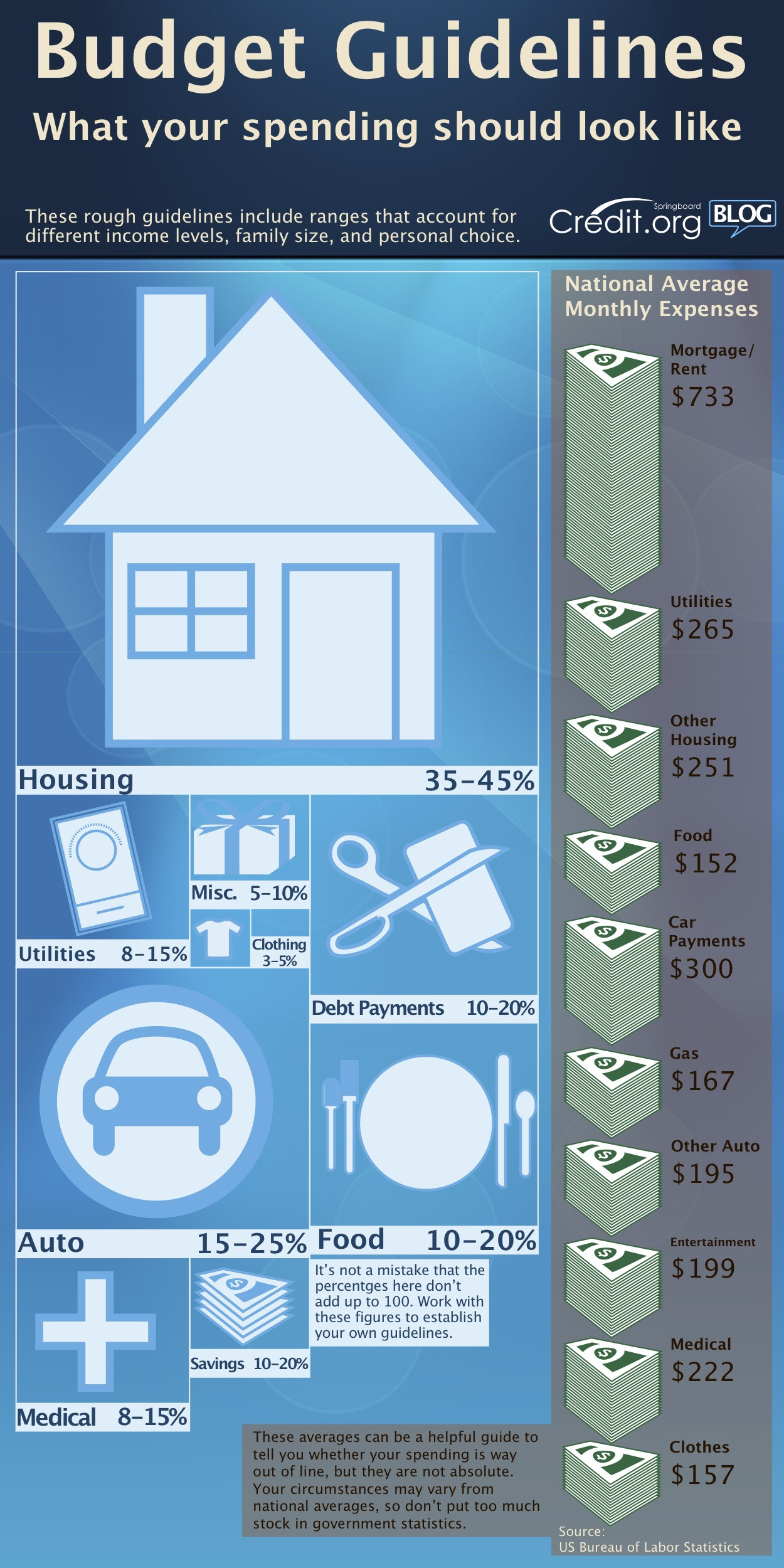
Assessment
But, does the above infographic relate to medical and financial services professionals; why or why not, and if so, how?
Conclusion
Your thoughts and comments on this ME-P are appreciated. Feel free to review our top-left column, and top-right sidebar materials, links, URLs and related websites, too. Then, subscribe to the ME-P. It is fast, free and secure.
Speaker: If you need a moderator or speaker for an upcoming event, Dr. David E. Marcinko; MBA – Publisher-in-Chief of the Medical Executive-Post – is available for seminar or speaking engagements. Contact: MarcinkoAdvisors@msn.com
OUR OTHER PRINT BOOKS AND RELATED INFORMATION SOURCES:
- PHYSICIANS: www.MedicalBusinessAdvisors.com
- PRACTICES: www.BusinessofMedicalPractice.com
- HOSPITALS: http://www.crcpress.com/product/isbn/9781466558731
- CLINICS: http://www.crcpress.com/product/isbn/9781439879900
- ADVISORS: www.CertifiedMedicalPlanner.org
- BLOG: www.MedicalExecutivePost.com
- FINANCE: Financial Planning for Physicians and Advisors
- INSURANCE: Risk Management and Insurance Strategies for Physicians and Advisors


Share this:

Filed under: Financial Planning, Risk Management | Tagged: Cost of Living and Expense Benchmarks, Dr. David Marcinko, Personal Budgetings Guidelines |
 The Leading Business Education Network for Doctors, Financial Advisors and Health Industry Consultants
More on Budgets and Financial Calculators
Dr. Marcinko, thanks for this post. A bit too broad perhaps, but helpful nevertheless.
And so, to continue the budgeting thought, here is a link to every possible financial calculator your readers could ever think of, all for free.
http://credit.org/blog/calculators/
Claude
LikeLike
On Cash Emergency Funds for Physicians – Update
Today, in these tumultuous times – as financial advisors – we are suggesting a generous 3-5 year cash emergency fund for mature practicing doctors.
Sure this seems extreme to some MDs and FAs, but since the “flash crash” of 2008-09; it seems more prudent with considerably less criticism, especially of late with our current low interest rate environment.
Look – Cash is power, choice, swagger, potency, freedom and represents options. And, the emergency fund determination is now more complicated than ever, for any budget.
Read this related post to learn how to do it:
Cash is king! So, acquire it!
Dr. David Edward Marcinko MBA CMP™
Certified Medical Planner™
http://www.CertifiedMedicalPlanner.com
LikeLike
Doctors and Budgets
Having an Emergency Fund (EF) is a needed part of a functioning financial plan and a critical part of budgeting. Like mentioned here, even if your budget is simply spending less than you make, you need an EF, as unexpected financial changes are just that … unexpected. How much is a matter of much debate. I recommend 6 months of annual income for physicians, and know the advice by financial advisors can be 3 months to 5 years of annual income. The problem with this advice is that most Doctors cringe when they see a six-digit portion of their portfolio earning virtually nothing. After taxes and inflation, the Emergency Fund has a negative real return.
Of course, making lots of money on your EF is not the point. Having cash when you need it is the point of an EF.
I am surprised at how many physicians will simply park a large amount of funds in their local checking account at their bank at an almost negligible yield (0.05% or less). I have found physicians can park a good portion of their EF in an FDIC insured money market such as ING Direct, Emigrant Direct, Ally Bank, Discover Bank (with an EFT link to their regular checking account) or other competitive source and still maintain liquidity with some return (currently .80% or more).
Also, a portion as much as half can be invested using a shorter 3 -5 year Muni Bond ladder (highest investment quality) which will create at least a tax equivalent yield (consider the Doc is in the upper bracket) slightly better than the insured money market yields. The Muni Bond ladder does not have the immediate liquidity or ultimate safety of the FDIC insured money market funds and a physician may justifiably not feel that the added risk/liquidity issues are not worth the extra yield.
David K. Luke, MIM
Physician Financial Planner
Certified Medical Planner™ Candidate
http://www.CertifiedMedicalPlanner.org
LikeLike