





 Support our online development, and advance our onground research initiatives in free market economics, as we seek to showcase the brightest Next-Gen minds.
THE ME-P DISCLAIMER: Posts, comments and opinions do not necessarily represent iMBA, Inc., but become our property after submission. Copyright © 2006 to-date. iMBA, Inc allows colleges, universities, medical and financial professionals and related clinics, hospitals and non-profit healthcare organizations to distribute our proprietary essays, photos, videos, audios and other documents; etc. However, please review copyright and usage information for each individual asset before submission to us, and/or placement on your publication or web site. Attestation references, citations and/or back-links are required. All other assets are property of the individual copyright holder.
Support our online development, and advance our onground research initiatives in free market economics, as we seek to showcase the brightest Next-Gen minds.
THE ME-P DISCLAIMER: Posts, comments and opinions do not necessarily represent iMBA, Inc., but become our property after submission. Copyright © 2006 to-date. iMBA, Inc allows colleges, universities, medical and financial professionals and related clinics, hospitals and non-profit healthcare organizations to distribute our proprietary essays, photos, videos, audios and other documents; etc. However, please review copyright and usage information for each individual asset before submission to us, and/or placement on your publication or web site. Attestation references, citations and/or back-links are required. All other assets are property of the individual copyright holder.


More on Healthcare Network Design and Automation

[Part 5 in a 6 part series]
By Sam Muppalla – Vice President, McKesson Health Solutions Network Performance Management
 Previously, on this ME-P, I wrote about the barriers to alignment across product, network, care and reimbursement innovations. And, yes, I teased you with the three-word preview of what was to come this week: Integrated Building Blocks. The idea of building blocks lies at the heart of an approach to achieving alignment and scaling innovation, so let’s dive in.
Unlocking potential administrative, IT and medical savings — while also creating sustainable alignment of the innovation engines — requires various building blocks be in place as a sound foundation for network design and implementation. These building blocks deliver the required functionality in the most efficient manner. When these building blocks are utilized in an integrated fashion, the current barriers are removed and innovation alignment is achieved.
Four Essential Building Blocks
There are four essential network design automation building blocks that comprise the foundation for innovation: networks, contracting, reimbursement and engagement.
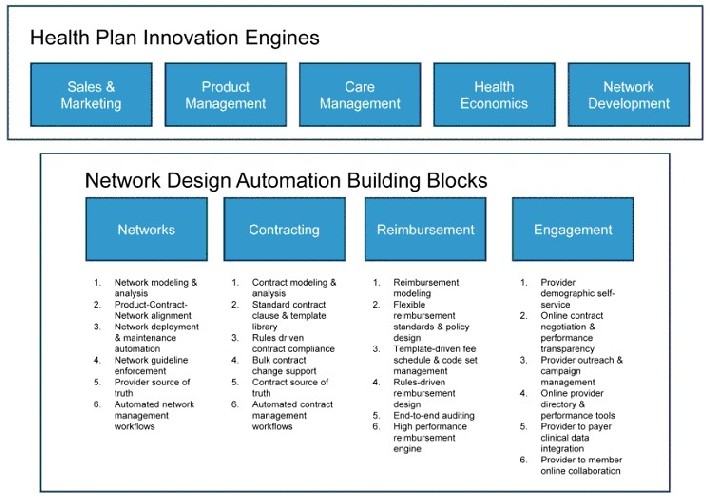
Each of these building blocks enables capabilities by delivering necessary functionality within and across the spectrum of network design. Reaching levels of maturity with this capability unlocks additional value and alignment.
Networks
The network building block enables health plans to differentiate and compete. The purpose is to differentiate their value for each customer segment by aligning the product and care model designs with the underlying network designs. It ensures network performance by facilitating the selection of appropriate providers into networks and the alignment of provider reimbursement with network design objectives. It enables networks to be mapped to member-facing and provider-facing products. The provider-facing products can be used for contracting and provider rate differentiation. The member-facing products can be aligned with benefits and serve as steerage targets for benefit designers.
These constructs, in conjunction with each other, enable productization of care model and payment innovation. For example, a health plan could define a “Medical Home Network” that consists of medical homes and supporting providers in a given geography. It could then enable PCMH-specific reimbursement (e.g., PMPM capitation + Fee For Services (FFS) for preventive services + P4P for EBM) by defining a provider-facing product and associating specific reimbursement policies with that provider product. Additionally, it could also define a member-facing product (e.g., PPO Value) which combines the medical home network with the general market PPO network. This in turn will allow the health plan to define a benefit extension which gives a 10 percent premium reduction to members who use Medical Home Network providers for their primary care. In short, a health plan is now able to monetize its care innovation (PCMH), align benefit design to network design for steerage, and align its provider payment with member incentives (around preventive services), while incenting higher quality care (P4P).
The network building block also achieves administrative cost leadership through comprehensive provider data governance and automation of core provider processes.
Contracting
The contracting building block is designed to enable health plans to reduce contract administrative costs while increasing provider payment accuracy. It optimizes the management of the provider contracting lifecycle through the automation of contract authoring, offering negotiating and acceptance while ensuring the standardization of terms and policies. This building block achieves reduced medical expenditure driven by contract standards adherence, reduced claims mis-payments, and increased speed to market for new payment innovations. It also can support rules-based enforcement of network level reimbursement guidelines to ensure consistent network performance.
Reimbursement
The reimbursement building block enables health plans to maximize the effectiveness of their medical expenditures by paying for value versus volume and by incenting team-based performance. It is the single source of truth for all forms of reimbursement including traditional claims pricing, episodes of care, shared savings, capitation and P4P. This building block enables the mixing and matching of reimbursement methodologies to incent optimal provider performance. It supports a modeling engine to analyze the financial impact of reimbursement and contract changes. It incorporates network-aware provider/contract selection for claims pricing intake. This is a rules driven, high performance service that leverages provider relationship information to select the right provider, the right governing contract and the right reimbursement model for each incoming claim. Additionally, it includes provider transparency services that enable health plan provider portals to support online pricing lookups and reimbursement status/detail inquiries for providers. These services can be extended to support provider performance scorecards and benchmarks.
Engagement
The engagement building block is designed to increase collaboration and participation. It enables meaningful engagement among health plans, providers and members in order to improve health outcomes and reduce costs. This building block achieves reduced administrative and service costs, increased member participation and adherence, increased provider satisfaction and adoption of care/payment initiatives, and the enablement of collaborative/integrated care delivery models such as PCMH and ACO.
Utilizing flexible, automated and integrated building block capabilities is the key to sustainable success that not only unlocks the promise of affordable care to customer segments but also delivers on reduced administrative, medical and IT costs. Incorporating information technologies that can facilitate, if not altogether replace, the manual interactions will be an important part of every organization’s evolution.
Assessment
Next week, in our final part 6 of this series, we’ll wrap up this discussion with a look at some of the potential savings health plans could achieve through alignment and an integrated approach to network design. The potential savings are not slight, so stay tuned. As always, if you just don’t want to wait for next week, visit our website and download the entire Unlocking Affordable Care by Aligning Products white paper; it’s available now.
Conclusion
Your thoughts and comments on this ME-P are appreciated. Feel free to review our top-left column, and top-right sidebar materials, links, URLs and related websites, too. Then, subscribe to the ME-P. It is fast, free and secure.
Speaker: If you need a moderator or speaker for an upcoming event, Dr. David E. Marcinko; MBA – Publisher-in-Chief of the Medical Executive-Post – is available for seminar or speaking engagements. Contact: MarcinkoAdvisors@msn.com
OUR OTHER PRINT BOOKS AND RELATED INFORMATION SOURCES:
- PHYSICIANS: www.MedicalBusinessAdvisors.com
- PRACTICES: www.BusinessofMedicalPractice.com
- HOSPITALS: http://www.crcpress.com/product/isbn/9781466558731
- CLINICS: http://www.crcpress.com/product/isbn/9781439879900
- ADVISORS: www.CertifiedMedicalPlanner.org
- BLOG: www.MedicalExecutivePost.com
- FINANCE: Financial Planning for Physicians and Advisors
- INSURANCE: Risk Management and Insurance Strategies for Physicians and Advisors

Share this:

Filed under: Experts Invited, Information Technology, Practice Management | Tagged: ACO, FFS, Integrated Approach to Healthcare Networks, McKesson Health Solutions, Medical Home Network, medical reimbursement, P4P, PCHM, pho, PMPM capitation, PPO, Sam Muppalla |
 The Leading Business Education Network for Doctors, Financial Advisors and Health Industry Consultants
More Venture Capital Dollars Flow To Health IT for Innovation
Venture capitalists invested $633 million in medical software and services in 2011, a 22% increase from 2010.
http://www.informationweek.com/news/healthcare/leadership/232500575
Alan
LikeLike
Standards Group to Hold Off on 6020
As the U.S. healthcare industry struggles with implementing the federally mandated upgrade to the ASC X12 Version 5010 standard for electronic claims and other administrative communications, the Accredited Standards Committee has announced it’s putting a hold on work on a successor standard.
“After meeting with healthcare industry stakeholders and assessing the current and planned healthcare industry initiatives, ASC X12 will not recommend its 6020 Type 3 Technical Reports (TR3s) to the Designated Standards Maintenance Organizations (DSMO) for consideration of adoption under the Health Insurance Portability and Accountability Act (HIPAA),” the committee stated in a news release. “ASC X12 doesn’t typically make decisions such as this until after final publication; however, it believes the healthcare industry is better served at this time by a reassurance that the 5010 implementations will have time to mature before another version is recommended for adoption.”
Source: Joseph Conn, Modern Healthcare [2/7/12]
LikeLike
5 ways to break into the business of health care
Every year, ambitious students from around the world flock to America’s leading business schools, hoping to learn how to create new ventures that can change the world.
On the West Coast, situated in the heart of Silicon Valley, Stanford University’s Graduate School of Business attracts budding entrepreneurs with challenging and practical programs. Courses like “Entrepreneurship: Formation of New Ventures” and “Managing Growing Enterprises” encourage students to develop innovative business models that solve real problems and fill unmet needs.
Many students in these courses want to strike it rich by launching the next Google, Facebook or Apple.
http://www.kevinmd.com/blog/2014/10/5-ways-break-business-health-care.html
But, more and more B-school students are expressing a new and unexpected interest: transforming the American health care system.
Nolan
LikeLike
Innovation
“When physicians, policymakers, vendors and technology innovators work together, the power of technology can enhance patient care, improve productivity and efficiency and slow the rise in health care costs.”
Robert M. Wah MD
[President – American Medical Association]
via Ann Miller RN MHA
LikeLike