





 Support our online development, and advance our onground research initiatives in free market economics, as we seek to showcase the brightest Next-Gen minds.
THE ME-P DISCLAIMER: Posts, comments and opinions do not necessarily represent iMBA, Inc., but become our property after submission. Copyright © 2006 to-date. iMBA, Inc allows colleges, universities, medical and financial professionals and related clinics, hospitals and non-profit healthcare organizations to distribute our proprietary essays, photos, videos, audios and other documents; etc. However, please review copyright and usage information for each individual asset before submission to us, and/or placement on your publication or web site. Attestation references, citations and/or back-links are required. All other assets are property of the individual copyright holder.
Support our online development, and advance our onground research initiatives in free market economics, as we seek to showcase the brightest Next-Gen minds.
THE ME-P DISCLAIMER: Posts, comments and opinions do not necessarily represent iMBA, Inc., but become our property after submission. Copyright © 2006 to-date. iMBA, Inc allows colleges, universities, medical and financial professionals and related clinics, hospitals and non-profit healthcare organizations to distribute our proprietary essays, photos, videos, audios and other documents; etc. However, please review copyright and usage information for each individual asset before submission to us, and/or placement on your publication or web site. Attestation references, citations and/or back-links are required. All other assets are property of the individual copyright holder.


Management Strategies, Operational Techniques, Tools, Templates and Case Studies

ADVERTISEMENT
Book Review and Summary
Drawing on the expertise of decision-making professionals, leaders, and managers in hospitals and healthcare organizations, this book addresses their ubiquitous struggles with decreasing revenues, increasing costs, and high consumer expectations in a competitive market.
Offering practical experience and applied operating vision, the authors integrate 5-S and six-sigma managerial applications and regulatory perspectives, with real-world case studies, models, and reports, as well as charts, tables, diagrams, and sample contracts.
The result is an integration of lean management and operational strategies vital to hospitals, clinics and healthcare administrators; CXOs, COOs and CEOs; comptrollers, nurse-leaders and physician-executives.
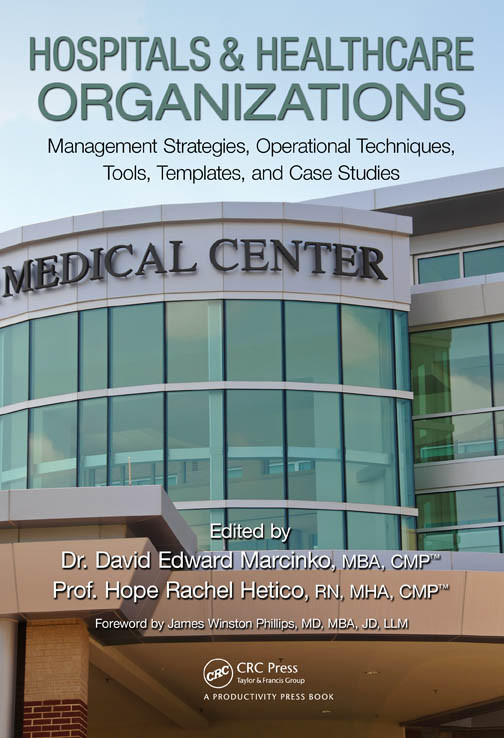
Pre-Order here: http://www.crcpress.com/product/isbn/9781439879900
Conclusion
As always, your thoughts and comments on this ME-P are appreciated. Feel free to review our top-left column, and top-right sidebar materials, links, URLs and related websites, too. Then, subscribe to the ME-P. It is fast, free and secure.
Link: http://feeds.feedburner.com/HealthcareFinancialsthePostForcxos
Speaker: If you need a moderator or speaker for an upcoming event, Dr. David E. Marcinko; MBA – Publisher-in-Chief of the Medical Executive-Post – is available for seminar or speaking engagements. Contact: MarcinkoAdvisors@msn.com
Our Other Print Books and Related Information Sources:
Health Dictionary Series: http://www.springerpub.com/Search/marcinko
Practice Management: http://www.springerpub.com/product/9780826105752
Physician Financial Planning: http://www.jbpub.com/catalog/0763745790
Medical Risk Management: http://www.jbpub.com/catalog/9780763733421
Healthcare Organizations: www.HealthcareFinancials.com
Physician Advisors: www.CertifiedMedicalPlanner.com
Subscribe Now: Did you like this Medical Executive-Post, or find it helpful, interesting and informative? Want to get the latest ME-Ps delivered to your email box each morning? Just subscribe using the link below. You can unsubscribe at any time. Security is assured.
Link: http://feeds.feedburner.com/HealthcareFinancialsthePostForcxos
Sponsors Welcomed: And, credible sponsors and like-minded advertisers are always welcomed.
Link: https://healthcarefinancials.wordpress.com/2007/11/11/advertise



Share this:

Filed under: Book Reviews, Practice Management | Tagged: Dr. David Edward Marcinko MBA, Hope Rachel Hetico, hospital administration, Hospitals and Healthcare Organizations, Management Strategies, Operational Techniques, Templates and Case Studies], Tools |
 The Leading Business Education Network for Doctors, Financial Advisors and Health Industry Consultants
Hospitals and Healthcare Organizations
[Management Strategies, Operational Techniques, Tools, Templates and Case Studies]
FOREWORD
Dr. James Winston Phillips
In the business of medicine, there are three ways to increase revenue 1) charge more, 2) do more, and/or 3) do the work more efficiently. In the current health care market where reimbursements are decreasing in the face of increasing expenses, a systemized approach is needed to maximize revenue to remain viable in the current health care arena.
Dr. David Edward Marcinko and Professor Hope Rachel Hetico in their new book, Hospitals and Healthcare Organizations [Management Strategies, Operational Techniques, Tools, Templates and Case Studies] bring their vast healthcare experience along with additional national experts to provide a healthcare model-based framework to allow health care professionals to utilize the checklists and templates to evaluate their own systems, recognize where the weak links in the system are and, applying the well illustrated principles, improve the efficiency of the system without sacrificing quality patient care.
I first became aware of Dr. Marcinko while doing research for the master’s thesis in my post graduate LL.M. program following graduation from law school. The topic of my thesis was The Anatomy and Psychology of Physician Investments. There was no shortage of literature about the psychology of investing. However, health care professionals in general and physician in particular are more unique in the psychological forces that guide their investing. Dr. Marcinko’s previous book, Financial Planning Handbook for Physicians and Advisors, provided the foundation of physician investing allowing me to add to the discussion by bringing the academic ivory tower discussion into the everyday clinical environment of the physician. Since that time I have benefited from his websites, our correspondences and telephone conversations.
As nothing in a health care system is isolated unto itself and is co-dependent upon a number of other departments in the system, maximizing efficiency across departments and among different types of health care workers may prove to be a task many are called upon to undertake but few have succeeded. If the number of assets such as hospital beds, operating rooms, ICU suites are fixed then these units must be maximized by working more efficiently to allow these fixed assets to be utilized more within calendar period thus resulting in increase revenue generation.
My wife and I recently experienced a health care delivery system that could have been detailed as a case history in this book. She had a total knee arthroplasty done by the doctor’s doctor in joint replacement in Florida. This physician does 1,000 total joints a year operating only three days a week. Doing the math you can see he does on average 6 plus joints a day, three days a week, 52 weeks a year. The procedures take on average about two hours, his patients are up walking within one hour of arriving from the recovery room and spend two-three nights in the hospital. The surgeon rounds every morning at 5 a.m. with the head nurse, the head of physical therapy, the discharge planner and his physician assistant to assure everything is done to maximize the patient’s recovery while utilizing the hospital’s resources efficiently. With an average surgeon’s fee of $4,550 per procedure, the billable yearly income for the surgeon is $4,550,000.00. Using a conservative multiplier for hospital billing of 10, the billable income for the hospital is $45,550,000.00. The list could go on about how the hospital and surgeon have combined their efforts to effectively deliver quality medical care while efficiently utilizing resources to maximize revenue.
As detailed in the book, a system like this did not occur overnight. You cannot just look at a single individual department in the hospital and expect that its maximization would deliver a similar system to the above example. Instead, you must look at every department that the patient would come into contact with either directly or indirectly and make sure to identify any processes which might delay, deter or bottle neck the overall delivery system.
Hospital and Healthcare Organizations [Management Strategies, Operational Techniques, Tools, Templates and Case Studies] is divided into three sections; 1) managerial fundaments, 2) policy and procedures and 3) strategies and executions. From these essential topics comes direction and guidance through the use and application of practical health care centered discussion, templates, checklists and clinical examples to provide the framework for building a clinically efficient system.
The health care delivery system is not an assembly line but with persistence and time following established guidelines established in this book, quality patient care can be delivered, efficiently, affordably while maintaining financial viability of institutions and practices.
James Winston Phillips MD MBA JD LLM
Post Office Box #600284
Saint Johns, FL 32260-0284
Ph: (904) 613-3062
http://theothermedicaleducation.com
LikeLike
You Forgot Hospitals for the Wealthy?
Amenities include chefs, butlers, suites with marble baths and more … as hospitals vie for affluent patients.
http://www.msnbc.msn.com/id/46091835/ns/health-health_care/t/chefs-butlers-marble-baths-hospitals-vie-affluent/
Kim
LikeLike
The Campaign Against Physician Ownership
Kim – In the face of managed care, HMOs, the ACA and other physician professional fee reimbursement challenges, there have been numerous legislative and regulatory efforts undertaken at the federal and state levels, in large part due to lobbying initiatives by hospitals and their trade associations, to reverse the trend of, and restrict physician ownership/investment in ASTC revenue stream enterprises, e.g., ASCs, independent diagnostic testing facilities (IDTFs), surgical/specialty hospitals, physical therapy, and so on.
According to our colleague Robert James Cimasi MSHA, AVA, CMP™ these measures have served to relegate independent physicians in private practice to receiving only professional fee component revenues, or to acquiesce by accepting employee status under the substantial control of hospital systems or large corporate players.
Consequently, market competition among these various healthcare enterprises has profoundly impacted quality of care, patient satisfaction, profitability, human resource management, and community perceptions.
Any thoughts?
Dr. David Edward Marcinko MBA CMP™
[Publisher-in-Chief]
LikeLike