







 Support our online development, and advance our onground research initiatives in free market economics, as we seek to showcase the brightest Next-Gen minds.
THE ME-P DISCLAIMER: Posts, comments and opinions do not necessarily represent iMBA, Inc., but become our property after submission. Copyright © 2006 to-date. iMBA, Inc allows colleges, universities, medical and financial professionals and related clinics, hospitals and non-profit healthcare organizations to distribute our proprietary essays, photos, videos, audios and other documents; etc. However, please review copyright and usage information for each individual asset before submission to us, and/or placement on your publication or web site. Attestation references, citations and/or back-links are required. All other assets are property of the individual copyright holder.
Support our online development, and advance our onground research initiatives in free market economics, as we seek to showcase the brightest Next-Gen minds.
THE ME-P DISCLAIMER: Posts, comments and opinions do not necessarily represent iMBA, Inc., but become our property after submission. Copyright © 2006 to-date. iMBA, Inc allows colleges, universities, medical and financial professionals and related clinics, hospitals and non-profit healthcare organizations to distribute our proprietary essays, photos, videos, audios and other documents; etc. However, please review copyright and usage information for each individual asset before submission to us, and/or placement on your publication or web site. Attestation references, citations and/or back-links are required. All other assets are property of the individual copyright holder.


The Rise of Obesity and Type 2 Diabetes in Children

Over the past two decades, scientists have noticed a rising incidence of type 2 diabetes—which once affected almost exclusively middle-aged and elderly people—in obese children.
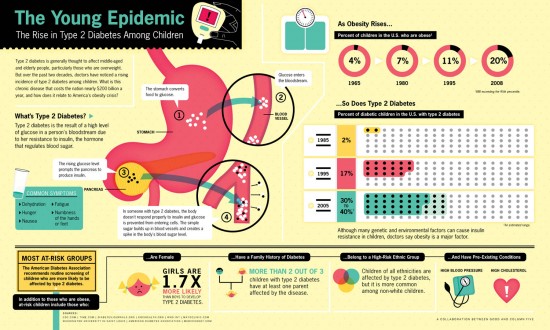
Source: GOOD
Assessment
What is this chronic disease, and how does it relate to America’s obesity crisis?
Conclusion
Your thoughts and comments on this ME-P are appreciated. Feel free to review our top-left column, and top-right sidebar materials, links, URLs and related websites, too. Then, subscribe to the ME-P. It is fast, free and secure.
Speaker: If you need a moderator or speaker for an upcoming event, Dr. David E. Marcinko; MBA – Publisher-in-Chief of the Medical Executive-Post – is available for seminar or speaking engagements. Contact: MarcinkoAdvisors@msn.com
OUR OTHER PRINT BOOKS AND RELATED INFORMATION SOURCES:
- PRACTICES: www.BusinessofMedicalPractice.com
- HOSPITALS: http://www.crcpress.com/product/isbn/9781466558731
- CLINICS: http://www.crcpress.com/product/isbn/9781439879900
- ADVISORS: www.CertifiedMedicalPlanner.org
- FINANCE: Financial Planning for Physicians and Advisors
- INSURANCE: Risk Management and Insurance Strategies for Physicians and Advisors
- Dictionary of Health Economics and Finance
- Dictionary of Health Information Technology and Security
- Dictionary of Health Insurance and Managed Care


Share this:

Filed under: Quality Initiatives, Research & Development | Tagged: diabetes, type II diabetes |
 The Leading Business Education Network for Doctors, Financial Advisors and Health Industry Consultants
The Cost of Obesity
US hospitals are ripping out wall-mounted toilets and replacing them with floor models to better support obese patients.
The Federal Transit Administration wants buses to be tested for the impact of heavier riders on steering and braking. And, cars are burning nearly a billion gallons of gasoline more a year than if passengers weighed what they did in 1960.
http://www.msnbc.msn.com/id/47211549/ns/health-diet_and_nutrition/
So, what is the true [indirect] cost of obesity?
Viola
LikeLike
Dramatic Rise Expected in Obesity-Related Costs
Medical costs associated with treating preventable obesity-related diseases are estimated to increase by $48 billion to $66 billion a year by 2030, according to a report from the Trust for America’s Health and the Robert Wood Johnson Foundation.
The loss in economic productivity was estimated by the study called “F as in Fat: How Obesity Threatens America’s Future 2012,” to be between $390 billion and $580 billion annually by 2030. The current cost of adult obesity was estimated to range from $147 billion to nearly $210 billion a year.
Source: Paul Barr, Modern Healthcare [9/18/12]
LikeLike
Health Care Spending on Diabetes: 2009-2013
The Health Care Cost Institute recently released an issue brief regarding the financial impact of diabetes from 2009-2013. Here are some key findings from the report:
• In 2012 diabetes cost $245 billion in direct medical costs in the United States.
• $14,999 was spent per capita on healthcare for people with diabetes in 2013.
• Per capita spending for children with diabetes rose 7% from 2011-2012 and 9.6% from 2012-2013.
• Between 2011 and 2013, children with diabetes had the fastest per capita spending growth
• People with diabetes spent on average 2.5 times more out of pocket than people without diabetes.
• The average per capita spending difference between people with and without diabetes was $10,310.
Source: Health Care Cost Institute, May 2015
LikeLike