







 Support our online development, and advance our onground research initiatives in free market economics, as we seek to showcase the brightest Next-Gen minds.
THE ME-P DISCLAIMER: Posts, comments and opinions do not necessarily represent iMBA, Inc., but become our property after submission. Copyright © 2006 to-date. iMBA, Inc allows colleges, universities, medical and financial professionals and related clinics, hospitals and non-profit healthcare organizations to distribute our proprietary essays, photos, videos, audios and other documents; etc. However, please review copyright and usage information for each individual asset before submission to us, and/or placement on your publication or web site. Attestation references, citations and/or back-links are required. All other assets are property of the individual copyright holder.
Support our online development, and advance our onground research initiatives in free market economics, as we seek to showcase the brightest Next-Gen minds.
THE ME-P DISCLAIMER: Posts, comments and opinions do not necessarily represent iMBA, Inc., but become our property after submission. Copyright © 2006 to-date. iMBA, Inc allows colleges, universities, medical and financial professionals and related clinics, hospitals and non-profit healthcare organizations to distribute our proprietary essays, photos, videos, audios and other documents; etc. However, please review copyright and usage information for each individual asset before submission to us, and/or placement on your publication or web site. Attestation references, citations and/or back-links are required. All other assets are property of the individual copyright holder.


The Unknown Killer

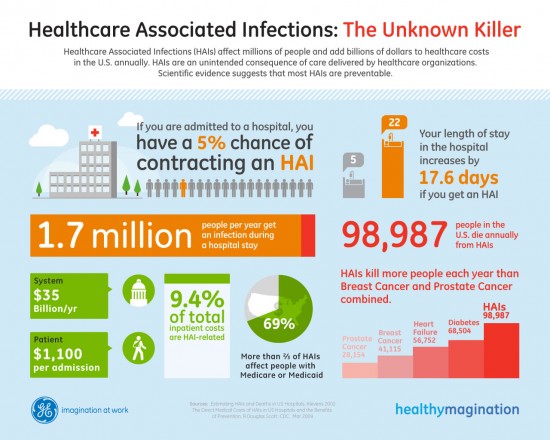
Each year, Healthcare Associated Infections (HAIs) affect millions of patients and add billions of dollars to healthcare costs in the U.S. GE’s Healthcare division is aggressively working to find ways to address this issue and prevent the widespread occurrence of HAIs in the future.
GE and JESS3 partnered to create an infographic which visualizes several statistics related to the spread of HAIs such as the number of people who die of HAIS in the US annually, the staggering number of people who are affected by HAIs annually and the incredible cost it creates per patient and to the healthcare system. By laying out the complex numbers in this sharp and colorful graphic, GE hopes to raise awareness about the widespread problem which scientific evidence suggests could often be preventable.
Conclusion
Your thoughts and comments on this ME-P are appreciated. Feel free to review our top-left column, and top-right sidebar materials, links, URLs and related websites, too. Then, subscribe to the ME-P. It is fast, free and secure.
Link: http://feeds.feedburner.com/HealthcareFinancialsthePostForcxos
Speaker: If you need a moderator or speaker for an upcoming event, Dr. David E. Marcinko; MBA – Publisher-in-Chief of the Medical Executive-Post – is available for seminar or speaking engagements. Contact: MarcinkoAdvisors@msn.com
OUR OTHER PRINT BOOKS AND RELATED INFORMATION SOURCES:
DICTIONARIES: http://www.springerpub.com/Search/marcinko
PHYSICIANS: www.MedicalBusinessAdvisors.com
PRACTICES: www.BusinessofMedicalPractice.com
HOSPITALS: http://www.crcpress.com/product/isbn/9781466558731
CLINICS: http://www.crcpress.com/product/isbn/9781439879900
BLOG: www.MedicalExecutivePost.com
FINANCE: Financial Planning for Physicians and Advisors
INSURANCE: Risk Management and Insurance Strategies for Physicians and Advisors


Share this:

Filed under: "Doctors Only", Breaking News, Research & Development | Tagged: HAIs, Healthcare Associated Infections, hospital acquired infections, nosocomial infections |
 The Leading Business Education Network for Doctors, Financial Advisors and Health Industry Consultants
Introducing the Safe Surgery Initiative
This new website is home to a collection of tools and resources used to help raise awareness, increase knowledge, and change behavior related to the prevention of surgical site infection (SSI), a major source of preventable postoperative illness.
An introductory video message from my colleague David Nash, MD MBA, Dean of the Jefferson School of Population Health on the campus of Thomas Jefferson University in Philadelphia, is included.
https://www.jjhcsfoundations.com/?quality-safety/login.html
Dr. David Edward Marcinko MBA
[Editor-in-Chief]
LikeLike
Checklist prompts low infection rates at Dartmouth-Hitchcock
Healthcare-acquired infection (HAI) rates at Dartmouth-Hitchcock Medical Center (DHMC) were below national averages, according to a New Hampshire Department of Health & Human Services report.
So, how did they do it? Through a statewide patient safety checklist!
http://www.fiercehealthcare.com/story/checklist-prompts-low-infection-rates-dartmouth-hitchcock/2011-08-09?utm_medium=nl&utm_source=internal
Dr. David Edward Marcinko MBA
[Editor-in-Chief]
LikeLike
Statewide infection rates drop with insurance pressure
With Medicare dollars at stake, healthcare facilities are trying to reduce–and eventually eliminate–healthcare-associated infections (HAIs).
For example, hospitals in California have found relative success through a three-year initiative that involves 160 hospitals across the state, reports the Los Angeles Times.
http://www.latimes.com/business/la-fi-hospital-infections-20110823,0,1452290.story
Hayward
LikeLike
Safety checklists offer tenfold return on investment
Using a hospital safety checklist to reduce lethal bloodstream infections in hospital intensive-care units (ICUs) not only saves lives but also thousands of dollars, according to new Johns Hopkins research.
http://www.fiercehealthcare.com/press-releases/program-reduces-infections-saves-lives-and-money?utm_medium=nl&utm_source=internal
Dr. David Edward Marcinko MBA
http://www.BusinessofMedicalPractice.com
LikeLike
Hospital garb harbors nasty bacteria, new study says
Sixrt percent [60%] of uniforms tested positive. Should workers wear duds outside?
http://www.msnbc.msn.com/id/44334682/ns/health-infectious_diseases/
Kathy
LikeLike
Nothing new to report here, folks!
Kathy – Relative to the above comment – these clothes, uniforms, surgical scrubs or ties are called fomites.
According to Wikipedia: A fomite is any inanimate object or substance capable of carrying infectious organisms (such as germs or parasites) and hence transferring them from one individual to another. A fomite can be anything (such as a cloth or mop head). Skin cells, hair, clothing, and bedding are common hospital sources of contamination.
Fomites are associated particularly with hospital acquired infections (HAI), as they are possible routes to pass pathogens between patients. Stethoscopes and neckties are two such fomites associated with health care providers. Basic hospital equipment, such as IV drip tubes, catheters, and life support equipment can also be carriers, when the pathogens form biofilms on the surfaces. Careful sterilization of such objects prevents cross-infection.
Researchers have discovered that smooth (non-porous) surfaces (e.g. door knobs) transmit bacteria and viruses better than porous materials (e.g. paper money).The reason is that porous, especially fibrous, materials absorb and trap the contagion, making it harder to contract through simple touch.
Nevertheless, I believe we should not take, or wear, such fomites outside the hospital; both to protect patients and the community at-large.
Still, most HAIs are avoidable and should rightly be considered “never-events”.
Dr. David Edward Marcinko MBA
http://www.BusinessofMedicalPractice.com
LikeLike
Doctors are just filthy, Huh!
This topic is a pet peeve of mine. So, here is some more information from Aaron Carroll and my colleague Austin Frakt PhD, over at the “Incidental Economist”, blog.
http://theincidentaleconomist.com/wordpress/doctors-are-just-filthy-huh/
The essay contains a good historical review from the CDC, as well.
Dr. David Edward Marcinko MBA
http://www.BusinessofMedicalPractice.com
LikeLike
Is It Time To Ditch The White Coats?
A recent study suggests that doctors might want to hang up their iconic white coats and long sleeves to prevent the spread of dangerous bacteria.
Why? Dr. Yonit Weiner-Well and his colleagues sampled uniforms of 135 physicians and nurses at the Hebrew-University-Hadassah Medical School in Jerusalem. They found that overall 60 percent had disease-causing bacteria, including some that were resistant to antibiotics.
The study, which was published in the most recent issue of the American Journal of Infection Control, also reports that there was very little difference in the amount of bacteria found on the uniforms of physicians and nurses.
http://www.ajicjournal.org/
Dr. David Edward Marcinko MBA
LikeLike
[Antibiotic] Resistance Is Futile
Megan McArdle’s new article on antibiotic resistance was just published in The Atlantic (Resistance is Futile). She correctly identifies the problem as a market failure.
Antibiotics are an exhaustible resource. We should be treating them like an oil field, or an endangered species. Instead, we handle them like consumer electronics. And, the patent system is designed to promote human invention, not conserve what has already been discovered.
So, I fear we won’t stop the rising tide of infections until we develop a new business model to fight them.
http://www.theatlantic.com/magazine/archive/2011/10/resistance-is-futile/8647/
Dr. David Edward Marcinko MBA
http://www.BusinessofMedicalPractice.com
LikeLike
Cubist Pharmaceuticals is developing a new drug to combat a
“difficult-to-treat family of bacteria, called gram-negatives, that are developing resistance to existing medicines and spreading among hospital patients”
writes Bloomberg, here:
http://www.bloomberg.com/news/2011-09-15/resistant-bacteria-neglected-by-drugmakers-give-cubist-2-billion-market.html
Dr. David Edward Marcinko MBA
LikeLike
Wash ‘Em – Hand Hygiene Music Video
At Jefferson University Hospitals, they take preventing infections seriously. For example, their latest effort to boost hand washing is a video they created called “Wash ‘Em.”
Watch their staff dance around the Hospital while showing the importance of hand washing. You’ll be singing their song all day!
Source: Josh Goldstein
http://www.jeffersonhospital.org/The-Daily-Dose/2011/September/hand-washing-other-practices-prevent-infections.aspx
LikeLike
Visualizing Antibiotic Resistance with a New Online Tool
The problem of antibiotic resistance tends to reach public consciousness in a scattershot manner — when ground turkey is recalled because it’s tainted with salmonella that can’t be treated by common drugs, for example.
But it’s hard to get a comprehensive picture of the extent to which certain infections have become impervious to treatment. So, check out this new online tool.
http://blogs.wsj.com/health/2011/09/21/visualizing-antibiotic-resistance-with-a-new-online-tool/
Dr. David Edward Marcinko MBA CMP™
[Editor-in-Chief]
http://www.BusinessofMedicalPractice.com
LikeLike
Is the Famed Cleveland Clinic Experiencing Sour Grapes?
In a controversial turn in patient safety reporting, Cleveland Clinic, along with Henry Ford in Detroit and Parkview Health in Indiana, have stopped reporting hospital-acquired infection (HAI) rates to The Leapfrog Group, which examines national hospital standards of safety, quality, and efficiency, reported the Consumer Reports recently.
• http://www.consumerreports.org/health/doctors-hospitals/hospital-infection/deadly-infections-hospitals-can-lower-the-danger/overview/deadly-infections-hospitals-can-lower-the-danger.htm
• http://www.consumerreports.org/health/doctors-hospitals/hospital-ratings.htm
Dr. David Edward Marcinko MBA
[Founder and CEO]
LikeLike
Hospital Infection Rates Decreasing
There is good news on the subject of hospital acquired infections –new CDC data shows a significant decline in rates. CDC reported for 2010:
• A 33 percent reduction in central line-associated bloodstream infections: a 35 percent reduction among critical care patients and a 26 percent reduction among non-critical care patients. A central line is a tube that is placed in a large vein of a patient’s neck or chest to give important medical treatment. When not put in correctly or kept clean, central lines can become a freeway for germs to enter the body and cause serious bloodstream infections.
• A 7 percent reduction in catheter-associated urinary tract infections throughout hospitals
• A 10 percent reduction in surgical site infections
• An 18 percent reduction in the number of people developing health care-associated invasive methicillin resistant Staphylococcus aureus (MRSA) infections
http://www.cdc.gov/media/releases/2011/p1019_healthcare_infections.html
Dr. David Edward Marcinko MBA
[Founder and CEO]
LikeLike
Wearing Gloves Does Not Prevent Spread of Germs
A new study of hand hygiene in hospitals found that wearing latex gloves makes health care workers less likely to clean their hands before and after treating patients.
The finding is concerning, researchers say, because germs can travel through latex gloves, and because they’re often worn when doctors work with bodily fluids and the sickest, most infectious patients. Taking off latex gloves can also cause a “back spray” effect, in which fluids and germs are snapped back onto the wearer’s hands.
http://well.blogs.nytimes.com/2011/11/08/gloves-are-no-guarantee-your-doctors-hands-are-clean/?ref=health
As a result, doctors and nurses who don’t wash up after using latex gloves can spread infections through contaminated hands.
Dr. David Edward Marcinko MBA
[Editor-in-Chief]
LikeLike
Confused hospitals underreport infections
According to Alicia Caramenico, despite reports that catheter infection rates are nearly 50 percent lower than the national average, California public health officials are investigating whether the reports accurately reveal the infections occurring at hospitals, reported the North County Times.
The probe even demonstrates a larger trend, as hospital infection reports are under scrutiny in Colorado and Connecticut, among other states.
http://www.nctimes.com/lifestyles/health-med-fit/health-state-hospital-infection-rates-look-low-but-may-not/article_67696952-2c3a-529b-8216-9abace395b8e.html
A pet peeve of mine.
Dr. David Edward Marcinko MBA
[Editor-in-Chief]
LikeLike
Infection rate too high in seven Georgia hospitals
According to The Atlanta Journal-Constitution, seven Georgia hospitals, including four in metro Atlanta, scored worse than the national benchmark for cases of potentially deadly bloodstream infections.
Emory Midtown, Northside Hospital, Piedmont Henry Hospital and Southern Regional Medical Center all performed worse than their peers for rates of central line-associated bloodstream infections in intensive care units, according to new data released by the U.S. Centers for Medicare & Medicaid Services.
http://www.ajc.com/news/infection-rate-too-high-1348882.html
Dr. David Edward Marcinko MBA
[Editor-in-Chief]
LikeLike
The Infection Game?
Sepsis [infections] are no laughing matter–but a new tool [Game] aims to at least make learning about the dangers of infection a little more pleasant for docs.
http://med.stanford.edu/ism/2012/february/septris.html
I am not so sure, at all, about this. ME-P readers, please opine?
Dr. David Edward Marcinko MBA
[Publisher-in-Chief]
LikeLike
Healthcare-acquired infections down but still a problem
Dr. Marcinko, inpatient infection rates are down, but there is still more work to be done.
In a report just released, the Pennsylvania Health Care Cost Containment Council said 21,319 of the 1.89 million patients admitted to Pennsylvania hospitals in 2010 acquired an infection. That is a rate of 1.13 percent, down from 1.20 percent the previous year.
Click to access hai2010report.pdf
Laura
Infection Control Nurse
LikeLike
Dr. Marcinko
In light of a March study from the CDC about the growing death rate from C. difficile, I thought you’d be interested in this report.
http://www.cdc.gov/mmwr/preview/mmwrhtml/mm6109a3.htm
Hope you find it of interest.
Andrea
LikeLike
Hospital-acquired infections quadruple ICU deaths
An analysis of a U.S. hospital database found that in-hospital mortality is four times higher in patients with a hospital-acquired infection (HAI) than in those without.
http://registration.akm.ch/einsicht.php?XNABSTRACT_ID=142676&XNSPRACHE_ID=2&XNKONGRESS_ID=161&XNMASKEN_ID=900
Moreover, the length of stay in the ICU doubled for infected patients, up from a mean of 8.1 days to 15.8 days.
Dr. David Edward Marcinko MBA
[Editor-in-Chief]
LikeLike
1:6 Cancer Deaths Caused by Preventable Infections
One in every six cancer deaths worldwide is caused by preventable infections, a total of 1.5 million deaths yearly that could be halted by widespread vaccination programs, researchers just reported recently.
http://www.latimes.com/health/boostershots/la-heb-infections-cancer-20120509,0,4395656.story
And, since 1990, that number has grown by about half a million, suggesting that vaccination programs are losing ground in the battle rather than gaining it.
Dr. David Edward Marcinko MBA
[Editor-in-Chief]
LikeLike
SafeHand touchscreen tech tracks doc handwashing
Doctors and nurses love their iPads, swishing and tapping on touchscreens all day.
So, now there’s a new technology that turns patients effectively into a touchscreen themselves, capable of detecting exactly when a clinician has made physical contact with a patient–and whether they’ve washed their hands before doing so.
http://www.ereleases.com/pr/apples-ipad-touch-technology-save-50000-lives-78684
Hope Rachel Hetico RN MHA
LikeLike
HAIs
Hospitals are beefing up hygiene amid growing recognition that drug-resistant organisms can lurk on the most common surfaces, as the WSJ’s Informed Patient column reports.
http://blogs.wsj.com/health/2012/06/05/hospitals-zero-in-on-drug-resistant-infections-as-pressure-builds/?mod=WSJBlog
Hope Rachel Hetico RN MHA
LikeLike
Nurse Burnout and Infection Rates Linked
A new study shows a link between nurse burnout and health care-acquired infections. Researchers suggest that hospitals can “alleviate job-related burnout in nurses at a much lower cost than those associated with health care-associated infections.”
http://www.hhnmag.com/hhnmag/HHNDaily/HHNDailyDisplay.dhtml?id=9650009405
Ann Miller RN MHA
LikeLike
Infections
Four years after the Centers for Medicare & Medicaid Services discontinued payments for preventable hospital-acquired conditions (HACs), new research finds that the policy had no effect on curbing infections, just published by The New England Journal of Medicine.
http://www.nejm.org/doi/full/10.1056/NEJMsa1202419?query=featured_home
Dr. David Edward Marcinko MBA
[Editor-in-Chief]
LikeLike
How Leadership and Culture Can Prevent Infections
According to Deborah Bohr, promising results from Comprehensive Unit-Based Safety Programs are showing that with leadership engagement and promotion of a genuine safety culture, deadly central-line associated bloodstream infections are preventable.
http://www.hhnmag.com/hhnmag/HHNDaily/HHNDailyDisplay.dhtml?id=033000904
Dr. David Edward Marcinko MBA
[Editor-in-Chief]
LikeLike
Wash your Hands
As a kick off to National Handwashing Awareness Week, this essay profiles a hospital that increased hand hygiene compliance in its ICU from less than 10 percent to more than 80 percent in roughly four weeks.
http://www.hhnmag.com/hhnmag/HHNDaily/HHNDailyDisplay.dhtml?id=2460009406
The unit has sustained those scores for more than two-and-a-half years.
Hope Rachel Hetico RN MHA
LikeLike
Surgeon infects Patients
Five heart patients at Cedars-Sinai Medical Center are reported to have contracted staph infections after a doctor operated on them with bacteria on his hands.
http://vitals.nbcnews.com/_news/2012/12/10/15818069-surgeons-infected-hands-led-to-hospital-staph-outbreak?lite=
Ann Miller RN MHA
LikeLike
Preventable hospital infections cost $9.8 billion a year in US
[New Study]
A new study has found that the national cost of five common and preventable health care-associated infections is $9.8 billion annually
http://www.healthpolicyreview.org/daily_review/2013/09/study-preventable-hospital-infections-cost-98-billion-a-year-in-us.html?utm_source=feedburner&utm_medium=feed&utm_campaign=Feed%3A+typepad%2Fhealthpolicyreview+%28Ohio+Health+Policy+Review%29
(Source: “Infections costing hospitals, patients,” Columbus Dispatch, Sept. 4, 2013).
Dr. David Edward Marcinko MBA
[Editor-in-Chief]
LikeLike
“Doc, have you washed your hands?”
It’s a simple enough request, but for patients and families who feel vulnerable, scared or uncomfortable in a hospital room, the subject can be too intimidating to even bring up with a doctor or nurse: Have you washed your hands?
Why? Infections associated with hand hygiene affect more than one million patients and are linked to nearly 100,000 deaths a year, according to the CDC.
http://online.wsj.com/article/SB10001424052702303918804579107202360565642.html?utm_source=Copy+of+9.30.13&utm_campaign=11713&utm_medium=email
But now, hospitals are encouraging patients to be more assertive, amid growing concern about infections that are resistant to antibiotics.
This has been a pet peeve of mine for three decades.
Dr. David Edward Marcinko MBA
[Editor-in-Chief]
LikeLike
Stethoscope Dirtier Than Doctor’s Hands
It turns out stethoscopes can carry even more bacteria than most parts of physicians’ hands, according to a new study from the University of Geneva.
http://abcnews.go.com/blogs/health/2014/02/28/how-germy-is-your-doctors-stethoscope/?utm_source=2.28.14&utm_campaign=11713&utm_medium=email
The results were published Thursday in the journal Mayo Clinic Proceedings, but there is nothing new here. All these things like ties, paper charts, shoes, briefcases etc., are called FOMITES.
Germ transporters; all.
Dr. David Edward Marcinko MBA CMP™
[Editor-in-Chief]
FROM WIKIPEDIA:
A fomes (pronounced /ˈfoʊmiːz/) or fomite (/ˈfoʊmaɪt/) is any object or substance capable of carrying infectious organisms, such as germs or parasites, and hence transferring them from one individual to another. Skin cells, hair, clothing, and bedding are common hospital sources of contamination.
Fomites are associated particularly with hospital acquired infections (HAI), as they are possible routes to pass pathogens between patients. Stethoscopes and neckties are two such fomites associated with health care providers. Basic hospital equipment, such as IV drip tubes, catheters, and life support equipment can also be carriers, when the pathogens form biofilms on the surfaces. Careful sterilization of such objects prevents cross-infection.
Researchers have discovered that smooth (non-porous) surfaces (e.g. door knobs) transmit bacteria and viruses better than porous materials (e.g. paper money).
LikeLike
One in 25 Infected in U.S. Hospitals
According to Maggie Fox and others, one in 25 U.S. hospital patients has caught an infection while in the hospital, according to new federal data just released.
http://www.nbcnews.com/health/health-care/one-25-infected-u-s-hospitals-report-finds-n62776
http://news.msn.com/us/hospital-infections-kill-200-daily-in-us
Dr. David Edward Marcinko MBA CMP™
[Editor-in-Chief]
LikeLike
Medicare Cuts Payments to 721 Hospitals With Highest Rates of Infections, Injuries
In its toughest crackdown yet on medical errors, the federal government is cutting payments to 721 hospitals for having high rates of infections and other patient injuries, records released Thursday show. One out of every seven hospitals in the nation will have their Medicare payments lowered by 1 percent over the fiscal year that began October 1 and continues through September 2015. The health law mandates the reductions for the quarter of hospitals that Medicare assessed as having the highest rates of “hospital-acquired conditions,” or HACs. These conditions include infections from catheters, blood clots, bed sores, and other complications that are considered avoidable.
The penalties, which are estimated to total $373 million, are falling particularly hard on academic medical centers: Roughly half of them will be punished, according to a Kaiser Health News analysis. The new penalties are harsher than any prior government effort to reduce patient harm. Since 2008, Medicare has refused to pay hospitals for the cost of treating patients who suffer avoidable complications.
Source: Jordan Rau
Medscape News [12/22/14]
LikeLike
Hospitals you might want to avoid?
http://www.msn.com/en-us/health/medical/12-hospitals-you-might-want-to-avoid/ar-AAeXlwv?li=AAa0dzB&ocid=U348DHP
Or – at least check out.
Janice
LikeLike
Hospital-Associated Sepsis Cost $70,000 Per Case in 2018
Premier, Inc. recently released an analysis on hospital-associated sepsis. Here are some key findings from the report:
• 1.7 million adults in America are impacted by sepsis each year.
• Sepsis accounts for more than $24 billion in annual hospital costs.
• 92.5% of those diagnosed with sepsis develop the infection in the community.
• Average cost for present-on-admission sepsis cases is $22,000 per case.
• Cost for hospital-acquired sepsis rose 20% ($58,000 in 2015 to $70,000 in 2018).
Source: Premier, Inc., March 21, 2019
LikeLike