







 Support our online development, and advance our onground research initiatives in free market economics, as we seek to showcase the brightest Next-Gen minds.
THE ME-P DISCLAIMER: Posts, comments and opinions do not necessarily represent iMBA, Inc., but become our property after submission. Copyright © 2006 to-date. iMBA, Inc allows colleges, universities, medical and financial professionals and related clinics, hospitals and non-profit healthcare organizations to distribute our proprietary essays, photos, videos, audios and other documents; etc. However, please review copyright and usage information for each individual asset before submission to us, and/or placement on your publication or web site. Attestation references, citations and/or back-links are required. All other assets are property of the individual copyright holder.
Support our online development, and advance our onground research initiatives in free market economics, as we seek to showcase the brightest Next-Gen minds.
THE ME-P DISCLAIMER: Posts, comments and opinions do not necessarily represent iMBA, Inc., but become our property after submission. Copyright © 2006 to-date. iMBA, Inc allows colleges, universities, medical and financial professionals and related clinics, hospitals and non-profit healthcare organizations to distribute our proprietary essays, photos, videos, audios and other documents; etc. However, please review copyright and usage information for each individual asset before submission to us, and/or placement on your publication or web site. Attestation references, citations and/or back-links are required. All other assets are property of the individual copyright holder.


How the National Debt Affects You

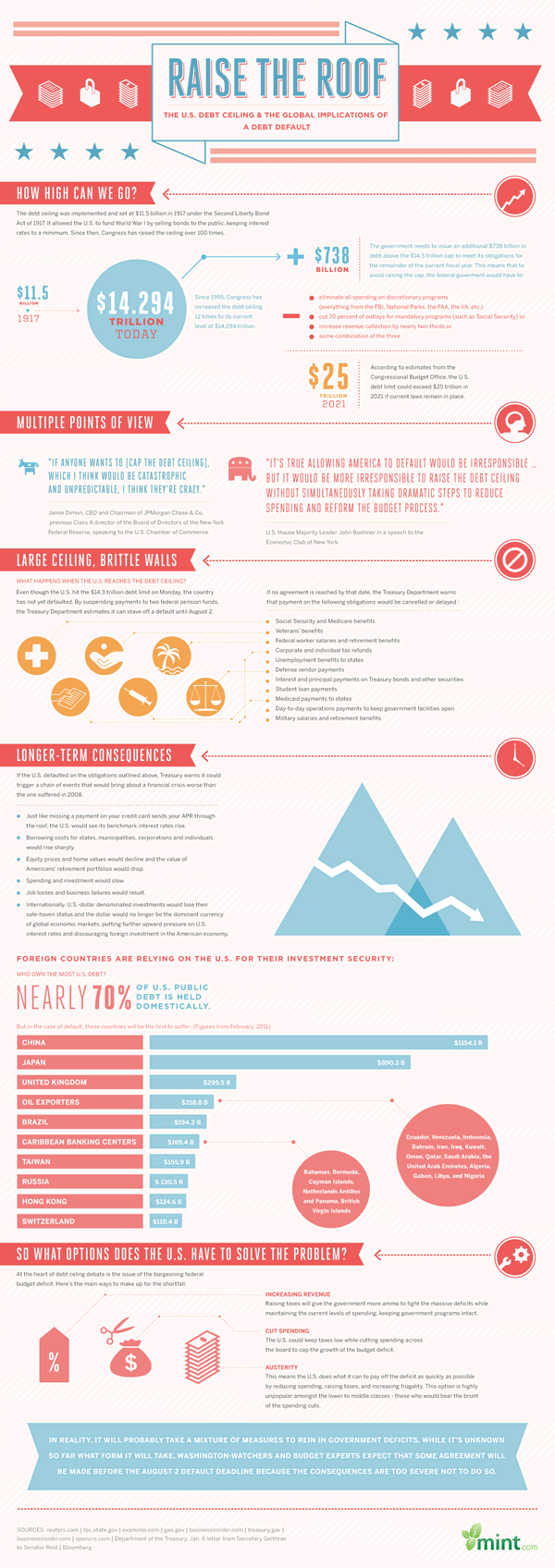
The Debt Ceiling and its’ impact on World Markets! Brought to you by mint.com in collaboration with columnfivemedia.com
Conclusion
And so, your thoughts and comments on this ME-P are appreciated. Feel free to review our top-left column, and top-right sidebar materials, links, URLs and related websites, too. Then, subscribe to the ME-P. It is fast, free and secure.
Link: http://feeds.feedburner.com/HealthcareFinancialsthePostForcxos
Speaker: If you need a moderator or speaker for an upcoming event, Dr. David E. Marcinko; MBA – Publisher-in-Chief of the Medical Executive-Post – is available for seminar or speaking engagements. Contact: MarcinkoAdvisors@msn.com
Our Other Print Books and Related Information Sources:
Health Dictionary Series: http://www.springerpub.com/Search/marcinko
Practice Management: http://www.springerpub.com/product/9780826105752
Physician Financial Planning: http://www.jbpub.com/catalog/0763745790
Medical Risk Management: http://www.jbpub.com/catalog/9780763733421
Healthcare Organizations: www.HealthcareFinancials.com
Physician Advisors: www.CertifiedMedicalPlanner.com
Subscribe Now: Did you like this Medical Executive-Post, or find it helpful, interesting and informative? Want to get the latest ME-Ps delivered to your email box each morning? Just subscribe using the link below. You can unsubscribe at any time. Security is assured.
Link: http://feeds.feedburner.com/HealthcareFinancialsthePostForcxos
Sponsors Welcomed: And, credible sponsors and like-minded advertisers are always welcomed.
Link: https://healthcarefinancials.wordpress.com/2007/11/11/advertise


Share this:

Filed under: Accounting, Taxation | Tagged: U.S. Debt Ceiling |
 The Leading Business Education Network for Doctors, Financial Advisors and Health Industry Consultants
President Obama and Speaker Boehner Negotiate
President Obama and Speaker John Boehner (R-OH) have been meeting each week to seek a solution for the budget crisis. Both indicate that there has not yet been an agreement on how to resolve the issue. Both have been advised by a small group of finance advisors from the White House and the Office of the Speaker.
President Obama spoke to the press on July 15. He stated, “We don’t need more studies, we don’t need a balanced budget amendment, but we simply need to make these tough choices and take on our bases.” The President was indicating that many of the Democratic Members of the House and Senate are unhappy with some of the potential budget cuts. In an address to the nation on Friday, July 22 President Obama stated that negotiations with Speaker Boehner are on hold. However, given the need to avoid a default, it is likely that there will be further negotiations between the President and the Speaker before the August 2 deadline.
Speaker Harry Reid (D-NV) was not in their meeting. However, he stated, “The President always talked about balance. There had to be some fairness in this. There has to be some revenue in the cuts. My caucus agrees with that. I hope the President sticks with that. I’m confident he will.” Majority Leader Reid continues to emphasize that Senate Democrats are hopeful there will be a balance between budget cuts and tax increases.
Several Washington commentators noted that a potential change this week occurred when a key “no tax” advocate for the first time discussed the potential for increased tax rates on upper-income Americans. While the majority of House and Senate Republicans have signed the “no tax increase” pledge, it is possible that a failure to extend the Bush tax cuts might “technically” be considered to be a retention of the Clinton era top tax bracket of 39.6%. Therefore, it may not be “technically” considered a tax increase.
Sen. Charles Schumer (D-NY) suggested, “This is a coded message from one of the truest believers in the Republican Party that it’s time for conservatives to step back from the brink.” He indicated that the door may be open to a “balanced approach that both cuts spending and raises revenue.”
When asked about this option, Speaker Boehner and Majority Leader Eric Cantor indicated that they remain opposed to any tax increases.
Editor’s Note: The bipartisan debate by House and Senate Members and the negotiations by President Obama and Speaker Boehner will continue. President Obama states that he is still hopeful to achieve a “grand bargain.” Speaker Boehner has remained low profile during the past week, but set a vote deadline of Wednesday, July 27 for the House and Senate to meet the August 2 deadline. As that date grows ever closer, there will need to be a compromise before the U.S. is in imminent risk of default. However, even an expected final compromise still faces an uncertain vote in both the House and Senate.
Source: Children’s Home Society of Florida Foundation
LikeLike
Senate “Gang of Six” Publishes Proposal
Following release of the plan created by the Fiscal Commission in 2010, six Senators committed to preparing a bipartisan plan based on that report.
Sen. Richard Durbin (D-IL), Sen. Kent Conrad (D-ND), Sen. Mark Warner (D-VA), Sen. Saxby Chambliss (R-GA), Sen. Mike Crapo (R-ID) and Sen. Tom Coburn (R-OK) published their report on July 19, 2011.
The “Gang of Six” senators stated that they have created “a comprehensive plan with immediate savings and the process to achieve savings in both defense and non-defense spending, enact cost-saving health reforms, insure 75-year Social Security solvency, fundamentally reform the United States tax code, and reduce spending elsewhere in the budget.”
The proposed plan includes three principal sections. First, there are discretionary spending caps that are designed to produce immediate spending cuts of $500 billion. In addition, all of the government inflation indexing would use a “chained CPI” that is believed to be a more accurate indexing method.
Second, taxes would be lowered to a top rate of 29%. There would be no alternative minimum tax. Through a major change in the permitted itemized deductions, the rate would be lowered, AMT would be eliminated and the income tax would generate an additional $1 trillion over 10 years. The changes that would reduce itemized deductions are not listed.
Third, there would be specific spending caps on different sections within the government. If Congress did not pass legislation within the targeted spending limits, there would be triggers that require spending cuts within those departments. The result of the three-part plan would be a reduction of $3.7 trillion over 10 years.
President Obama stated, “It would not match perfectly with some of the approaches that we’ve taken, but I think that we’re in the same playing field. And my hope is that we can start gathering everybody over the next couple days to choose a clear direction and get this issue resolved.”
House Majority Leader Eric Cantor (R-VA) indicated, “We have begun reviewing the Gang of Six proposal and while there are still portions that are unclear and need more detail, this bipartisan plan does seem to include some constructive ideas to deal with our debt.”
Editor’s Note: Both the Fiscal Commission and the “Gang of Six” are bipartisan solutions. There is now a growing recognition in Washington of the need for a budget solution. The proposal by the “Gang of Six” will be helpful to both President Obama and Speaker Boehner. After they achieve a proposed solution by August 2, it will be necessary to obtain approval in both the House and the Senate. The developing bipartisan consensus that action is necessary will be helpful in that effort.
Source: Children’s Home Society of Florida Foundation
LikeLike
Senate Rejects Cut, Cap and Balance
On a largely party-line vote, the House of Representatives passed H.R. 2560, the “Cut, Cap and Balance Act of 2011.” The bill would reduce federal spending, create a cap on spending and require passage of a balanced budget act.
The cut in spending is projected to be $111 billion in 2012. Total federal spending would be reduced from approximately 24% of the economy today to 22.5% in 2012 and 19.9% by 2017. The balanced budget amendment to the Constitution would require a 2/3 favorable vote in the House and Senate and ratification by 3/4 or 38 of the states.
The White House stated that it “strongly opposes” the act. It indicated, “Neither setting arbitrary spending levels nor amending the Constitution is necessary to restore fiscal responsibility.”
Minority Leader Mitch McConnell (R-KY) stated, “Americans get it. And I want to thank every American who’s spoken out in favor of the Cut, Cap and Balance Plan. Today the American people will now know where we stand.”
Editor’s Note: Your editor and this organization do not take a specific position on this debate over the budget deficit in Washington. We offer these updates as a service to our readers because this pending compromise will have impact on every American.
Source: Children’s Home Society of Florida Foundation
LikeLike