





 Support our online development, and advance our onground research initiatives in free market economics, as we seek to showcase the brightest Next-Gen minds.
THE ME-P DISCLAIMER: Posts, comments and opinions do not necessarily represent iMBA, Inc., but become our property after submission. Copyright © 2006 to-date. iMBA, Inc allows colleges, universities, medical and financial professionals and related clinics, hospitals and non-profit healthcare organizations to distribute our proprietary essays, photos, videos, audios and other documents; etc. However, please review copyright and usage information for each individual asset before submission to us, and/or placement on your publication or web site. Attestation references, citations and/or back-links are required. All other assets are property of the individual copyright holder.
Support our online development, and advance our onground research initiatives in free market economics, as we seek to showcase the brightest Next-Gen minds.
THE ME-P DISCLAIMER: Posts, comments and opinions do not necessarily represent iMBA, Inc., but become our property after submission. Copyright © 2006 to-date. iMBA, Inc allows colleges, universities, medical and financial professionals and related clinics, hospitals and non-profit healthcare organizations to distribute our proprietary essays, photos, videos, audios and other documents; etc. However, please review copyright and usage information for each individual asset before submission to us, and/or placement on your publication or web site. Attestation references, citations and/or back-links are required. All other assets are property of the individual copyright holder.


220 Million Diabetes Patients are Main Target for Developers in 5 Years
By Markus Pohl
[A research2guidance Press Release]

The majority of today’s mHealth smartphone applications fall into the category of general health tracking and fitness tools. Generally these apps have a low to medium sophistication level. Chronically ill people have not yet been the focus of today’s app developers. This will change with the entrance of traditional health industry players into the mHealth app market.
WHO Numbers
With the potential for sophisticated monitoring, compliance, time-management and a host of other applications to improve healthcare delivery to chronically ill patients, mHealth solutions promise to bring significant advances in the management of chronic diseases. In addition the target group size is very impressive. According to the OECD and WHO there are more than 2 billion patients with chronic diseases worldwide.
Chronic Diseases
Chronic disease is a major cost-driver in developed countries. In the US the cost of treating chronic disease constitutes is 83% of total Medicaid and 96% of the total Medicare expenditure (Source: Centers for Disease Control and Prevention).
In some countries healthcare expenditure on a person with one chronic condition is double that of expenditure on someone without a chronic condition.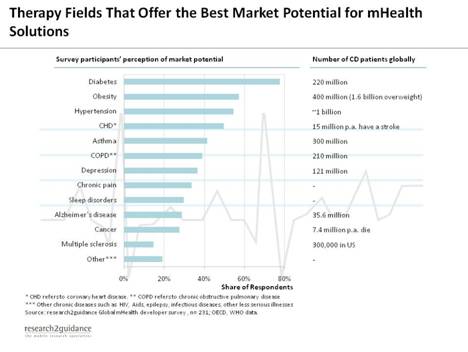
From the data above, we can see why established healthcare players are bringing out first pilot apps.
And, the graph illustrates market potential for mobile applications, specific for chronic diseases and the size of the overall addressable market for patients with chronic diseases today.
Assessment
Among chronic diseases diabetes is ranked highest in terms of business potential for mHealth applications according to a global survey on mHealth. And, there is supporting evidence that diabetes applications will become as popular as envisaged by the developers: target group size is growing, huge costs saving potential, geographical match, excellent use case potential, etc.
For a more detailed analysis on the mHealth market please have a look at the “Mobile Health Market Report 2010-2015”
Contact Info: research2guidance
+49 30 609 893 363
Conclusion
Your thoughts and comments on this ME-P are appreciated. Feel free to review our top-left column, and top-right sidebar materials, links, URLs and related websites, too. Then, subscribe to the ME-P. It is fast, free and secure.
Link: http://feeds.feedburner.com/HealthcareFinancialsthePostForcxos
Speaker: If you need a moderator or speaker for an upcoming event, Dr. David E. Marcinko; MBA – Publisher-in-Chief of the Medical Executive-Post – is available for seminar or speaking engagements. Contact: MarcinkoAdvisors@msn.com
OUR OTHER PRINT BOOKS AND RELATED INFORMATION SOURCES:
DICTIONARIES: http://www.springerpub.com/Search/marcinko
PHYSICIANS: www.MedicalBusinessAdvisors.com
PRACTICES: www.BusinessofMedicalPractice.com
HOSPITALS: http://www.crcpress.com/product/isbn/9781466558731
CLINICS: http://www.crcpress.com/product/isbn/9781439879900
BLOG: www.MedicalExecutivePost.com
FINANCE: Financial Planning for Physicians and Advisors
INSURANCE: Risk Management and Insurance Strategies for Physicians and Advisors

Share this:

Filed under: Alerts Sign-Up, Information Technology | Tagged: m-Health, m-Health Apps |
 The Leading Business Education Network for Doctors, Financial Advisors and Health Industry Consultants
Dear David,
Did you know that currently, only 1.2% of diabetics use a diabetes app? Until 2018 the share will rise to 7.8%.
The addressable market for diabetes apps will rise to 310M diabetics. Mobile Apps supporting diabetes patients are currently only used by 1.2% of the target group (2013). Although the market penetration will grow to 7.8% by 2018, the full market potential is not yet exhausted. The next five years will bring the diabetes app market to a new level. Chances for a major market breakthrough have improved.
By the end of 2013, only 1.2% of the diabetics with a capable device use a diabetes app (1.6M users). Over the course of the next five years the market environment for diabetes apps will improve. The usage of diabetes apps within the addressable market will reach 7.8% in 2018. 24M people will actively use a diabetes app to manage their health condition.
These are findings from research2guidance’s latest “Diabetes App Market Report 2014”.
The main factors that will drive the penetration rate for diabetes apps within the target group are:
1. The ongoing growth of people with diabetics that are addressable with an app.
2. The changing of the role of mobile apps. From a stand-alone product to a bundle product, that leverages the app as a tool to sell devices (e.g. plug-in glucometers and wearable sensors) and services (e.g. remote monitoring and consultation).
3. An ongoing increase of the total supply of apps and of apps that adopt best practice elements for diabetes apps.
4. The beginning of the reimbursement of diabetes apps costs by traditional payers in countries with high yearly treatment costs for a diabetic patient.
Based on the value mobile apps can have and the size of the addressable market, diabetes apps are being constantly rated in research2guidance’s yearly mHealth app market surveys as the therapeutic area with the highest business potential for mHealth apps (76% of mHealth app publishers).
Mobile applications promise to play an invaluable role in assisting people who suffer from diabetes to empower them to better manage their condition and as a consequence reduce healthcare costs. Mobile apps can aid in the daily management of diabetes by supporting behaviour changes, facilitating communication and easing the hassle of keeping track of all relevant parameters that have an influence on the disease.
Currently diabetes apps are not meeting the expectations of app publishers, healthcare professionals and diabetic patients, which leads to a low acceptance rate within the target group.
The main reason is that the majority of today’s 1,100 diabetes apps do not meet best practice standards. Apps still rely to a great extent on manual input of e.g. test results. Interoperability with existing glucose meters and health & fitness apps to import blood sugar test, activity and food intake data is only an exception. Only a few diabetes apps take care of the important motivational aspect of diabetes management by using gamification elements, a supporting design as well as communication features to get feedback from friends and the physician.
Another reason is that traditional healthcare payers have not yet started to integrate diabetes apps into their reimbursement schemes. In their view the quality of the numerous existing clinical studies is not good enough to justify the expenditure.
Diabetes has become a global epidemic with significant impact on the society and the economy in a country. In 2013 around 382M people around the world were estimated to suffer from diabetes. By 2035, the number of people with diabetes is expected to reach 592M (IDF Diabetes Atlas, 6th edition).
The above findings are based on the results of the “Diabetes App Market Report 2014”. The report includes a comprehensive market analysis of the diabetes app market from 2008 to 2018.
Sources:
Link to report:
http://www.research2guidance.com/shop/index.php/diabetes-app-market-report-2014
Link to graph:

Link to logo:

Ralf-Gordon Jahns
research2guidance
+49 30 609 893 360
rgj@research2guidance.com
LikeLike
Health apps and hackers?
Doctors – Hackers have gained access to nearly 90 percent of Android health apps already. Will that make you think twice before using or prescribing one?
http://www.medicalpracticeinsider.com/news/hacked-health-apps-your-biggest-security-crisis?email=%%EmailAddress%%&GroupID=90115&mkt_tok=3RkMMJWWfF9wsRokuajLZKXonjHpfsX56O0kXK6zlMI%2F0ER3fOvrPUfGjI4DSsVjI%2BSLDwEYGJlv6SgFQ7LHMbpszbgPUhM%3D
So, are apps your biggest security crisis?
Zina
LikeLike
Do not forget Wearables and Bands
Smart bands — Part of the wearables market before it was cool, smart bands were conceived with health tracking in mind. Paired with smartphones, these bands allow their wearers to not only track their health vitals, but interact with them.
Microsoft made considerable waves in the smart band market when it announced its Microsoft Band mere months ago, a device that does its share of fitness tracking while also alerting users to emails and texts. Other smart band options include Jawbone’s new line.
http://www.medicalpracticeinsider.com/news/wearables-market-enters-new-frontier-smart-clothes?email=%%EmailAddress%%&GroupID=116654&mkt_tok=3RkMMJWWfF9wsRokvqrPZKXonjHpfsX56O0kXK6zlMI%2F0ER3fOvrPUfGjI4CTMRgI%2BSLDwEYGJlv6SgFQ7LHMbpszbgPUhM%3D
And, make the human condition computable
Among the many other innovations coming with the mapping of healthcare data [wearables and bands] are ways to give doctors a more holistic view of their patients’ care.
http://www.medicalpracticeinsider.com/best-practices/making-human-condition-computable?email=%%EmailAddress%%&GroupID=116654&mkt_tok=3RkMMJWWfF9wsRokvqrPZKXonjHpfsX56O0kXK6zlMI%2F0ER3fOvrPUfGjI4CTMRgI%2BSLDwEYGJlv6SgFQ7LHMbpszbgPUhM%3D
Mallory
LikeLike