The entry point for medical app publishers into the healthcare market

Coaching Services

ralf

By Ralf-Gordon Jahns

Dear David,

Please find below Research2Guidance’s latest insights on “Coaching services: The entry point for medical app publishers into the healthcare market.”

Majority of mHealth app solutions are still operating outside the traditional healthcare market. App supported coaching services are more and more seen as the missing bridge between digital Health start-ups and healthcare incumbents. Coaching services are a win/win for both sides.

What are the six success factors of best in class digital enabled health coaching services?

Thank you for your time!Kind regards,
Research2Guidance

The mHealth app Market is getting CROWDED

Join Our Mailing List 

There are 259,000 mHealth apps now

ralfBy Ralf-Gordon Jahns

ralf.jahns@research2guidance.com

Almost 100,000 mHealth apps have been added since the beginning of last year, amounting to 259,000 currently available on major app stores. In addition, 13,000 mHealth publishers have entered the market since the beginning of 2015, totaling 58,000. The largest global study on mHealth app publishing reveals a massive increase in competition in the mHealth app market.

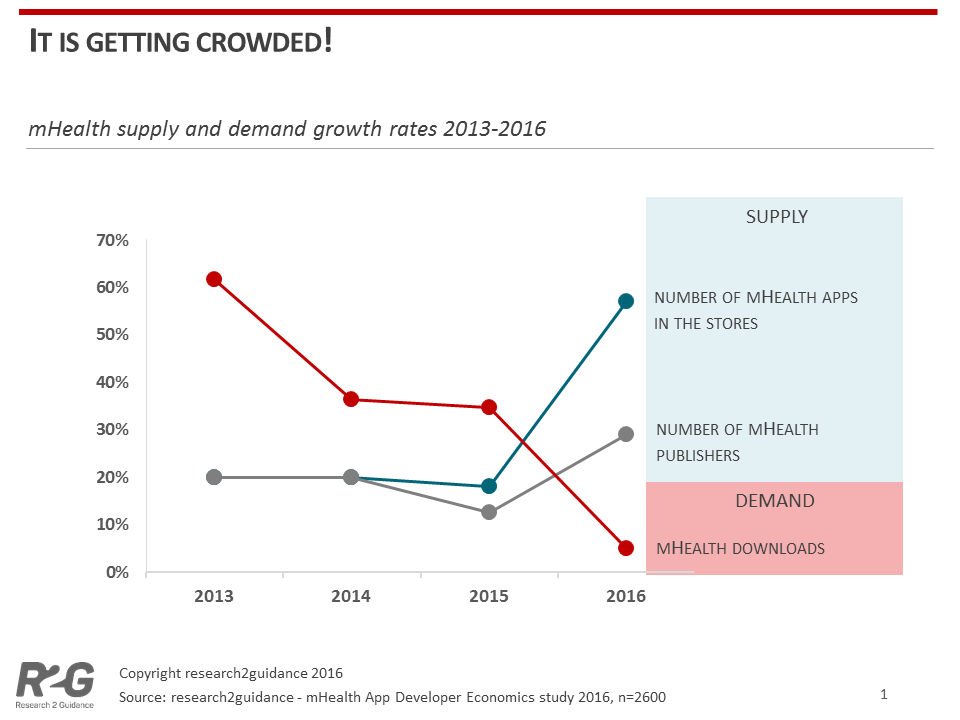
The results of this year’s mHealth App Developer Economics 2016 study show a steep increase in competition level among mHealth app publishers. The supply side of mHealth apps is measured in the number of available apps and publishers. They are growing significantly faster than the demand side which is quantified by the number of mHealth app downloads. The number of mHealth apps and active mHealth app publishers has seen strong growth since 2015. This year, the total number of mHealth apps listed on major app stores across the globe grew by 57% to 259,000 apps.

“This impressive growth is based on three main developments; the growing number of mHealth app publishers, the increased importance of multi-platform app publishing and the expansion of existing mHealth app portfolios”

The number of mHealth app publishers grew in line with the number of apps. There are currently 58,000 mHealth app publishers app on major app stores, 28% more since the beginning of 2015. There appears to be no immediate end to the number of companies rushing into the market to launch their first mHealth app. Multi-platform publishing also contributes to the growth on the supply side of the mHealth app market.

***

it-is-getting-crowded

***

Currently 75% of mHealth publishers are developing their mHealth apps both on iOS and Android platforms. Multi-platform publishing is even more significant for HTML5 and Windows Phone developers, however these platforms are still niche and don’t contribute a lot to the overall number of mHealth apps yet.

In contrast, growth rates of mHealth app store downloads are estimated to be only +7% in 2016, having been +35% the previous year, reaching a total of 3.2B in 2016. This is in line with other app market categories and reflects the fact that growth of capable devices that can download apps has slowed down in most western countries. As a consequence of this increased competition, it will be even more difficult to stand out and gain significant downloads. Only 14% of mHealth app publishers generated more than 100,000 downloads with their mHealth app portfolio in one year. This share increased only marginally by 3pp since 2014.

“Consumers are still downloading mHealth apps because they have heard about them or found them in the app store” explains Audrone Skardziute, Analyst at research2guidance. “The next push on the demand side will come from recommendations of traditional healthcare companies that are pushing apps to their employees or members.”

With hundreds of new mHealth apps released daily, companies have to consider their app launch as if it were a familiar product in a saturated market. The mHealth Developer Economics 2016 research program is the largest research program about mHealth app publishing. This year more than 2,600 mHealth app developers and decision makers participated and shared their experiences and views about the mHealth app market. There is much more and we will continue to write about the results of the study. Read the full report to see all results.

MORE: Download the free 28 page report here.

About

research2guidance is a Berlin-based mobile app economy specialist. The company’s service offerings include app strategy consulting, market studies and research.

Link to the report:

http://research2guidance.com/product/mhealth-app-developer-economics-2016/

Link to the blog post: http://research2guidance.com/2016/10/11/mhealth-app-market-getting-crowded-259000-mhealth-apps-now/ Link to the image: http://research2guidance.com/wp-content/uploads/2016/10/It-is-getting-crowded.png

Conclusion

Your thoughts and comments on this ME-P are appreciated. Feel free to review our top-left column, and top-right sidebar materials, links, URLs and related websites, too. Then, subscribe to the ME-P. It is fast, free and secure.

Speaker: If you need a moderator or speaker for an upcoming event, Dr. David E. Marcinko; MBA – Publisher-in-Chief of the Medical Executive-Post – is available for seminar or speaking engagements. Contact: MarcinkoAdvisors@msn.com

OUR OTHER PRINT BOOKS AND RELATED INFORMATION SOURCES:

Product DetailsProduct Details

***

Why Health Insurance Companies Fail To Generate Significant Reach with Their App Portfolio

Join Our Mailing List

The “Health Insurance App Benchmarking Report for 2015”

***

AN ME-P SPECIAL REPORT

By Ralf Gordon Jahns

rgj@research2guidance.com

The majority of health insurance companies can be described as hesitant in their app publishing activities, even those that have a larger app portfolio fail to have a significant impact. A new report from research2guidance analyses global app publishing activities of the leading health insurance companies.

***

Some of the reasons are that health insurance companies are not leveraging their assets, their apps are not compliant with state-of-the-art app publishing rules and missing cross promotion.

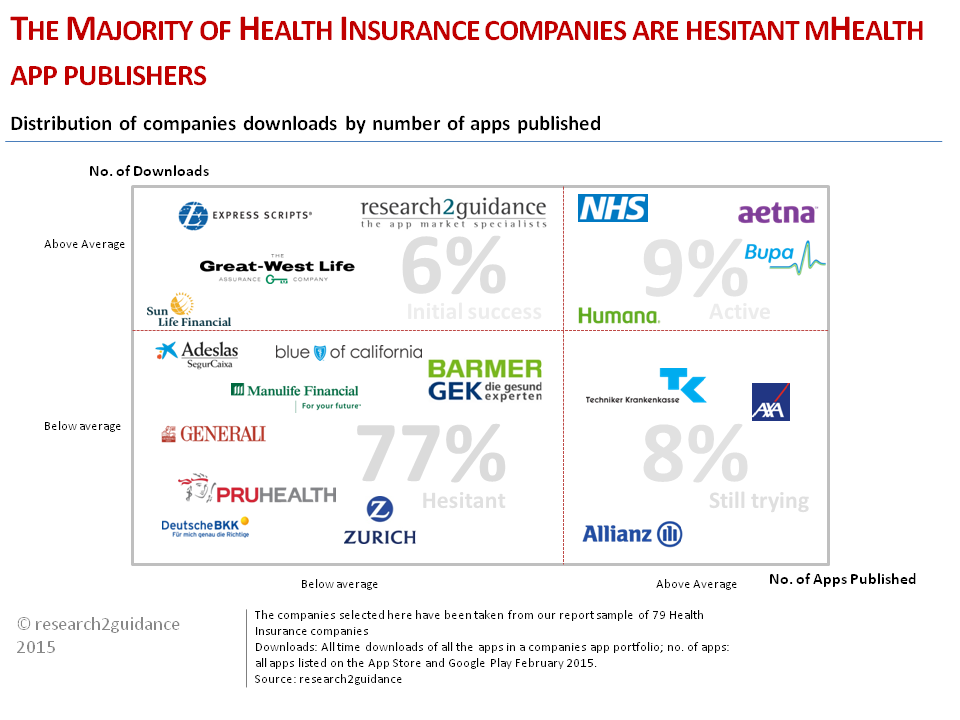
The vast majority of health insurance companies have failed to generate a significant reach with their app portfolio, with 67% of health insurance companies having achieved less than 100,000 downloads. The majority of apps in the portfolio of healthcare payers belong to the long-tail:

  • 70% of health insurance companies can be described as hesitant publishing only 1 or 2 apps. However, if health insurance companies were to publish more apps they wouldn’t necessarily generate higher download numbers.
  • 77% of health insurance companies belong to the low impact category having published less than average apps with less than average download numbers. Only 9% of health insurance app publishers could be described as active with above average impact.

AETNA

Aetna is the one health insurance company that stands out. Having published 28 apps across both iOS and Android Aetna have achieved more than 14million downloads, significantly more than any other health insurance company. That being said 85% of those download come from just on app within their app portfolio, iTriage. This is not uncommon amongst those health insurance companies that have generated a large number of downloads.

For example, 7 of the top 10 biggest health insurance companiesapp portfolios generate more than 50% of downloads from the top performing app. What are the reasons for the little impact the traditional payers of the healthcare systems have in the app economy?

RESULTS

These are some findings from research2guidance’s latest report “Health Insurance App Benchmarking 2015”. The report provides information on app categories health insurance companies concentrate on, the number of apps they have published, target user groups and the organization of their app business model.

***

cell

***

The study results indicate that:

  • Most health insurance companies fail to produce ‘state of the art’ apps – Apps in most cases do not incorporate the 6 key elements of best practice: Tracking and coaching, automated input, remote consultation, secure use of mHealth data, integrating their solutions into the current IT healthcare infrastructure and beautiful design and usability.
  • Companies fail to realize the potential of app integrated incentive schemes – Health insurance companies are best positioned to link financial rewards via incentive schemes to healthy and cost saving behavior of their members. However, currently there are only a few companies that link healthy behavior to financial rewards with the help of an app.
  • Health insurance companies fail to successfully cross-promote their app portfolio– Companies do not successfully leverage their app portfolio through cross-promotion. Best practice mHealth app publishers manage to have almost equally successful apps in their portfolio by cross promotion using for example, “more apps” screens, pop-ups and push notifications. This is not being done at all by health insurance companies.

More:

Conclusion

Your thoughts and comments on this ME-P are appreciated. Feel free to review our top-left column, and top-right sidebar materials, links, URLs and related websites, too. Then, subscribe to the ME-P. It is fast, free and secure.

Speaker: If you need a moderator or speaker for an upcoming event, Dr. David E. Marcinko; MBA – Publisher-in-Chief of the Medical Executive-Post – is available for seminar or speaking engagements. Contact: MarcinkoAdvisors@msn.com

OUR OTHER PRINT BOOKS AND RELATED INFORMATION SOURCES:

Product DetailsProduct Details

Six groups that will shape mHealth apps of the future

Join Our Mailing List 

A Special ME-P Report

The Distinct Segment Publishers

By Ralf-Gordon Jahns and Markus Pohl

ralphmarkus


Introduction

Dr. Marcinko and ME-P Readers and Subscribers,

Did you know that mHealth app publishers can be grouped into 6 distinct segments?

Segments differ mainly by goals, business approaches and performance. Their desire to help others distinguishes them from the rest of the app community. Knowing these segments is a pre-requisite for all those who wish to successfully participate in the new mHealth app ecosystem.

The Publishers

So, who is behind the 100,000 mHealth apps published in today’s app stores? How do the publishers differ in terms of motivation, development tool usage and satisfaction about goals achieved? The mHealth app publisher segmentation distinguishes 6 groups of current mHealth app publishers. This segmentation is based on the results of themHealth App Developer Economics 2014study.

A deeper knowledge about the mHealth app publishers is essential to all health market participants who wish to successfully navigate inside the newly emerging mHealth app ecosystem.

mHealth app publishers are not like game or tool app developers. 46% publish apps, because they want to help others. They also have objectives like revenue generation or raising brand awareness, but this “altruistic” attitude clearly distinguishes them from the rest of the app economy.

Within the six mHealth app companies, publishers with a strong medical background and those who leverage existing app development tools & APIs seem to accomplish their goals better than those who do that to a lesser extent.

Traditional healthcare players like Pharma, Med-tech or insurance companies have not been able to define their role in the market yet. Established Healthcare Players are the only segment “mainly not” satisfied with their goal achievement.

These are the profiles of the 6 distinct mHealth app publisher segments:

1) Established healthcare players:

This group includes Pharma, hospitals, health insurance and Med-tech companies, representing 3.4% of the total number of app publishers. These players usually belong to the mHealth app publishers with > 5,000 employees. Their primary objective for being in the market is to raise brand awareness and they have published the largest number of mHealth apps. Nevertheless, average reach in terms of downloads is far below the market’s average. App publishers in this group are so far the least satisfied with the achievements in the mHealth app market. The usage of tools and APIs to improve the efficiency of the app development process and app monitoring as well as the value of the app is below its competitors.

2) App specialists:

App specialists are small companies, which typically hire 3-10 employees. They have entered the mHealth app market in order to benefit from its potential. They have an app developer background and are familiar with available development and support tools. The share of medical experts on board is relatively low. This group constitutes 14% of the mHealth app publisher community.

3) Helpers:

Helpers’ primary motivation for publishing apps is to help others and they are usually organized into small companies of 3-10 employees. Revenue generation is only a minor factor. Typically Helpers have already achieved or over-achieved their goals. In terms of downloads, they have the highest share of companies (61%) that achieved less than 5,000 downloads last year. Helpers represent 32% of the market.

4) Medical specialists:

Medical specialists leverage their medical know-how to develop mobile apps. Similar to the Helper group, Medical specialist have a large share of members who publish apps to help others. By far they have partly reached their goals. They have the highest share of companies, which in 2013 earned more than USD 1m with their mHealth app portfolio. They represent 20% of the market.

5) Fitness specialists:

This group of app developers represents around 10% of the total mHealth app developer community. They primarily develop fitness apps with a clear objective to generate revenue. They connect more often to medical databases and sensors and use app development tools above average. The usual company size is 11-100 employees.

6) Connecters:

This group of mHealth app publishers represents 18% of the total mHealth app developer community. Their strategy is to create value rich apps by enabling connection to other apps, sensors and databases. This group generates the highest average revenue and has the highest goal achievement level.

Apps

Assessment 

The mHealth app publisher segmentation is a snapshot of the current state of the market. It will change as segments become more important (medical specialists) or new groups appear.  One of the main questions will be if and how traditional healthcare players will be able to compete with these small and agile companies that are driving the market today.

More:

Conclusion

Your thoughts and comments on this ME-P are appreciated. Feel free to review our top-left column, and top-right sidebar materials, links, URLs and related websites, too. Then, subscribe to the ME-P. It is fast, free and secure.

Link: http://feeds.feedburner.com/HealthcareFinancialsthePostForcxos

References:

Link to blog post:

http://mhealtheconomics.com/mhealth-segmentation-of-app-publishers-business-approaches/

Link to graph:

http://mhealtheconomics.com/wp-content/uploads/2014/05/research2guidance_mHealth_6_segments_business_approaches.jpg

Link to free report:

http://mhealtheconomics.com/mhealth-developer-economics-report/

Speaker: If you need a moderator or speaker for an upcoming event, Dr. David E. Marcinko; MBA – Publisher-in-Chief of the Medical Executive-Post – is available for seminar or speaking engagements. Contact: MarcinkoAdvisors@msn.com

OUR OTHER PRINT BOOKS AND RELATED INFORMATION SOURCES:

Product Details

Product DetailsProduct Details

Market for Mobile Health App Services Will Reach $26 Billion By 2017

Join Our Mailing List

mHealth services start to leverage apps to become commercially successful

[By Markus Pohl]

The market for mHealth services has now entered the commercialization phase and will reach $ 26 billion globally by 2017 says the new “Global Mobile Health Market Report 2013-2017 ”by research2guidance. Smartphone applications have begun to enable the mHealth industry to successfully monetize their services.

The Impending Revolution

Ralf-Gordon Jahns, Head of Research at research2guidance, points out “Our findings indicate that the long-expected mobile revolution in healthcare is set to happen. Both healthcare providers and consumers are embracing smartphones as a means to improving healthcare.”

The Publishers

Top mHealth publishers manage to generate more than 3 million free and 300.000 paid downloads in the USA on the iOS platform. The reach on other platforms and in other countries differ at lot but show also the increase of business potential for mHealth apps.

Not only are consumers taking advantage of smartphones to manage and improve their own health, but also healthcare professionals. A significant number (15%) of mHealth applications are primarily designed for healthcare professionals. These include CME (Continued Medical Education), remote monitoring and healthcare management applications.

The Climate

Currently there are 97,000 mHealth applications in major app stores, 42% of them adhering to the paid business model. With more and more traditional healthcare providers joining the mobile applications market, the business models will broaden to include healthcare services, sensor, advertising and drug sales revenues.

“With the growing sophistication level of mHealth applications, only 9% of the total market revenue in the next 5 years will come from application download revenue”explains Patrick Houck Analyst at research2guidance. “84% of total mHealth application market revenue will come from related services and products such as sensors”.

###

eHRs

Assessment

The “Global Mobile Health Market Report 2013-2017 ”by research2guidance is a business guide for traditional healthcare companies, mHealth specialists as well as for mobile operators wishing to successfully engage into the new mHealth market.

About research2guidance:

research2guidance is a Berlin-based mobile app economy specialist. The company’s service offerings include app strategy consulting, market studies and research.

Link to blog post: http://www.research2guidance.com/the-market-for-mhealth-app-services-will-reach-26-billion-by-2017/

Link to graph: http://www.research2guidance.com/wp-content/uploads/2013/03/the-mhealth-market-has-reached-the-commercialization-phase.png

Link to report: http://www.research2guidance.com/shop/index.php/mhealth-report-2

Contact:

Ralf-Gordon Jahns [+49 30 609 893 362] ralf.jahns@research2guidance.com

Conclusion

Your thoughts and comments on this ME-P are appreciated. Feel free to review our top-left column, and top-right sidebar materials, links, URLs and related websites, too. Then, subscribe to the ME-P. It is fast, free and secure.

Speaker: If you need a moderator or speaker for an upcoming event, Dr. David E. Marcinko; MBA – Publisher-in-Chief of the Medical Executive-Post – is available for seminar or speaking engagements. Contact: MarcinkoAdvisors@msn.com

OUR OTHER PRINT BOOKS AND RELATED INFORMATION SOURCES:

Product DetailsProduct Details