





 Support our online development, and advance our onground research initiatives in free market economics, as we seek to showcase the brightest Next-Gen minds.
THE ME-P DISCLAIMER: Posts, comments and opinions do not necessarily represent iMBA, Inc., but become our property after submission. Copyright © 2006 to-date. iMBA, Inc allows colleges, universities, medical and financial professionals and related clinics, hospitals and non-profit healthcare organizations to distribute our proprietary essays, photos, videos, audios and other documents; etc. However, please review copyright and usage information for each individual asset before submission to us, and/or placement on your publication or web site. Attestation references, citations and/or back-links are required. All other assets are property of the individual copyright holder.
Support our online development, and advance our onground research initiatives in free market economics, as we seek to showcase the brightest Next-Gen minds.
THE ME-P DISCLAIMER: Posts, comments and opinions do not necessarily represent iMBA, Inc., but become our property after submission. Copyright © 2006 to-date. iMBA, Inc allows colleges, universities, medical and financial professionals and related clinics, hospitals and non-profit healthcare organizations to distribute our proprietary essays, photos, videos, audios and other documents; etc. However, please review copyright and usage information for each individual asset before submission to us, and/or placement on your publication or web site. Attestation references, citations and/or back-links are required. All other assets are property of the individual copyright holder.


Achieving Proper Healthcare Alignment
[Number 3 in a Series of 6]
By Sam Muppalla – Vice President, McKesson Health Solutions, Network Performance Management (NPM)
Last week, on this ME-P, I wrote about Health Plans and the Three Levers of Innovation for Affordable Care. We looked at a number of innovations taking place in the areas of products, care models, reimbursement, and network designs. It’s vitally important to be able to innovate in each of these areas, but even more important to be able to align these network elements properly. The key to affordable care is enabling every member to get the right care, at the right time, from the right provider, and for the right price. But, when you look at what it takes to deliver such care, the interdependencies of design of care models, payment, products and networks become apparent, as you can see in Figure 1 below: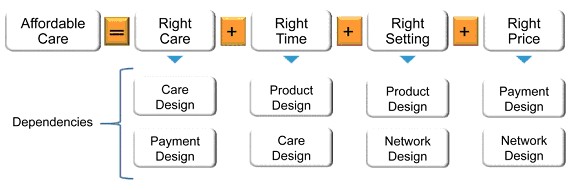
Figure 1: Affordable care requires alignment of product, network, care model, and payment design.
Steering the member to the right provider at the right setting is influenced by the member incentives built into the product design and the provider choice component of the network design. The right care is dependent on the care model design and the provider reimbursement design. Overall affordability of care is obviously tied to payment design. Not so obvious are the dependencies between product design and payment design. The member behavior targeted by product incentives should be reinforced by the provider engagement influenced by reimbursement design. All these interdependencies necessitate alignment between product, care model, reimbursement and network design. Alignment is fundamental to scaling innovation.
Network Design Drives Alignment
As shown in Figure 2, network design drives alignment between product, care model, and payment approaches. As an illustration, it facilitates the alignment of products and care models by enabling steerage of members to the appropriate care teams or sub-segments of the network. This steerage can only occur if member benefits and incentives (which are embodied in the product design) and the structure of care teams (which are described in the network design) are systematically matched. This systematic matching has to be governed by network-level guidelines for provider performance management.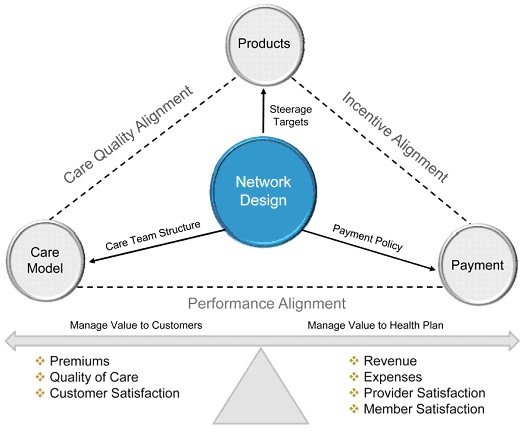
Figure 2: Network design drives the alignment that delivers affordable, high-quality care.
Focusing on the alignment between products and payment, network design enables this by ensuring that the goals of member incentives are supported by the provider behavior driven by payment design. This enablement is achieved through network-level reimbursement guidelines being automatically enforced during provider contracting.
Finally, network design incorporates network-level reimbursement guidelines to drive alignment between care model and payment design by ensuring that provider behavior envisioned in the care model design is incented by payment design.
As health plans productize new care models and payment innovations, the complexity and the frequency of the abovementioned alignment efforts will mushroom. Customer segmentation and the need for tailored products to serve these customer segments will further amplify the alignment challenge.
The approach of using network design automation to efficiently operationalize alignment is a critical core competency for health plans. By innovating with this approach, it will be possible for health plans to strike the optimal balance between the value to their customers (competitive premiums, high-quality care) and the value to themselves (revenue enablement, reduced medical and administrative cost).
Assessment
Are there barriers to operationalizing alignment? Of course! But stay tuned: Next week, I’ll be writing about the barriers to alignment — and after that, I’ll go into more detail about why it takes an integrated approach to remove these barriers. As before, if you don’t want to wait to read more, you can read the entire Unlocking Affordable Care by Aligning Products white paper now; it’s available on our website.
Conclusion
Your thoughts and comments on this ME-P are appreciated. Feel free to review our top-left column, and top-right sidebar materials, links, URLs and related websites, too. Then, subscribe to the ME-P. It is fast, free and secure.
Link: http://feeds.feedburner.com/HealthcareFinancialsthePostForcxos
Speaker: If you need a moderator or speaker for an upcoming event, Dr. David E. Marcinko; MBA – Publisher-in-Chief of the Medical Executive-Post – is available for seminar or speaking engagements. Contact: MarcinkoAdvisors@msn.com
OUR OTHER PRINT BOOKS AND RELATED INFORMATION SOURCES:
DICTIONARIES: http://www.springerpub.com/Search/marcinko
PHYSICIANS: www.MedicalBusinessAdvisors.com
PRACTICES: www.BusinessofMedicalPractice.com
HOSPITALS: http://www.crcpress.com/product/isbn/9781466558731
CLINICS: http://www.crcpress.com/product/isbn/9781439879900
BLOG: www.MedicalExecutivePost.com
FINANCE: Financial Planning for Physicians and Advisors
INSURANCE: Risk Management and Insurance Strategies for Physicians and Advisors



Share this:

Filed under: Health Economics, Healthcare Finance | Tagged: healthcare networks, McKesson Health Solutions, Medical Cost Savings, Performance Based Medical Networks, Sam Muppalla | 2 Comments »
 The Leading Business Education Network for Doctors, Financial Advisors and Health Industry Consultants