







 Support our online development, and advance our onground research initiatives in free market economics, as we seek to showcase the brightest Next-Gen minds.
THE ME-P DISCLAIMER: Posts, comments and opinions do not necessarily represent iMBA, Inc., but become our property after submission. Copyright © 2006 to-date. iMBA, Inc allows colleges, universities, medical and financial professionals and related clinics, hospitals and non-profit healthcare organizations to distribute our proprietary essays, photos, videos, audios and other documents; etc. However, please review copyright and usage information for each individual asset before submission to us, and/or placement on your publication or web site. Attestation references, citations and/or back-links are required. All other assets are property of the individual copyright holder.
Support our online development, and advance our onground research initiatives in free market economics, as we seek to showcase the brightest Next-Gen minds.
THE ME-P DISCLAIMER: Posts, comments and opinions do not necessarily represent iMBA, Inc., but become our property after submission. Copyright © 2006 to-date. iMBA, Inc allows colleges, universities, medical and financial professionals and related clinics, hospitals and non-profit healthcare organizations to distribute our proprietary essays, photos, videos, audios and other documents; etc. However, please review copyright and usage information for each individual asset before submission to us, and/or placement on your publication or web site. Attestation references, citations and/or back-links are required. All other assets are property of the individual copyright holder.


The Case for Fully Informed Consent
By Dr. Martin Young
MBChB, FCS(SA)Otol.
The issue of ‘informed consent’ is an ever present bugbear in all healthcare systems around the world, raising its head time after time in journals, weblogs, healthcare administration policies and, above all, medical malpractice lawsuits. Every mention emphasizes the need for improving this difficult issue, but in spite thereof little seems to change. ConsentCare is a new initiative aiming at addressing the challenges of facilitating and enhancing informed consent.
Why the big deal?
Medical ethicists have long known that, if trust is indeed the cornerstone of the successful doctor-patient relationship, that subjecting a person to medical or surgical treatment without discussing all aspects thereof wherever possible, i.e. fully informed consent, constitutes a betrayal of that trust.
Common opinion asserts that good informed consent creates better mental preparation for surgery, decreased anxiety, shorter hospital stays, earlier recognition of complications by patients before they become serious, and a generally higher success rate and satisfaction rate for the surgery.
70% of the detail of discussion about surgical detail and risk held in doctors’ rooms is forgotten by patients by the time the consultation is over. Patients are ordinarily asked to consent to surgical procedures ‘on the spot’ without access to the detailed documentation of the risks of those procedures that they can consider in their own time and own comfortable environment.
A person knowing all the information about his or her procedure acts as another measure of control to avoid outright human error, such as the wrong operation, or operating on the wrong side.
Almost every case of litigation following surgery will address the adequacy of the consent process.
The right to full knowledge about medical or surgical interventions is entrenched as a human right, even legally enforceable by inclusion in the constitutions of some countries.
No longer is a successful surgical outcome adequate protection against litigation, particularly where the consent is deemed to have contained inadequate information.
In an environment where litigation is on the increase, and expectations, demands and knowledge by the public have heightened, adequate and fully informed consent is one of the few protections doctors can apply both to their own benefit and to that of their patients.
The challenges
Good informed consent is not just presentation of a form that demands the patient’s signature on the bottom. The process is dependent on all aspects of a good doctor-patient interaction, i.e. positive and empathetic communication, good bedside manner, open and frank discussion of alternatives and costs, opportunity to ask questions, to seek independent advice, and to make decisions based on full disclosure of relevant facts. The result can however be a valuable clinical record of benefit to all role-players in the process of having a surgical procedure.
The demands of taking fully informed consent are considerable. No patient is the same, and a standard ‘one size fits all’ approach cannot take this into consideration. The same can be said for the doctor taking the consent. All have individual approaches and styles that should facilitated by the consent process. Again, ‘one size fits all’ is as inappropriate for doctors as it is for patients. The challenge for doctors is in documenting the process for both their patients’ and their own benefit. Without technological assistance this is impossible to do, for example, to the satisfaction of a medical malpractice lawyer hell-bent on proving medical negligence.
Solutions
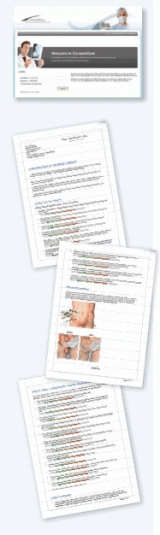
ConsentCare was designed taking all these considerations into account, but preserving the traditional and familiar signed document as a final result . A web-based platform was used, making the system accessible to both doctors and patients through a doctor portal and a patient portal, and opening the possibilities of direct doctor-patient communication around the specified procedure. Call it if you like a ‘mini-Facebook’ around the consent process.
On logging in a doctor adds a new patient, and proceeds through progressive steps, selecting procedure name, adding or editing graphics, and having editorial control over the content at all stages. An “editor’s” function allows preset information to be saved, speeding up the process for subsequent consents.
For all procedures a detailed consent document specific to the doctor, patient and procedure is produced in pdf form within a few minutes. This can be emailed to a patient beforehand, edited digitally using tablet PC’s, or printed out and discussed on the spot, leaving all options open as per the doctor’s preferences.
The potential
No other process leaves better evidence of a doctor’s ethical approach, transparency, patient care and responsibility than the informed consent process. This is a document that should be in the patient’s possession as well as in the medical record, an ethical yardstick of due diligence. It gives very little clinical detail away other than a patient’s name, the procedure, and likelihood of expected risks. As such, this can assist the detailed case management of patients, warn nursing staff of anticipated complications, and allocate patients to different levels of post operative care. It becomes a valuable nursing tool, not just a medicolegal hassle.
The record of a doctor’s approach to his patients in terms of attention to informed consent can be an ethical yardstick that raises that doctor’s profile above the rest. In an era of doctor and hospital ratings, rising healthcare costs, rising litigation, and increasingly limited resources, all payers, i.e. patients, funders and insurers, could benefit from recognizing where their money is best spent.
The doctor’s excuse “I don’t have the time” should no longer be relevant. Technology takes care of that issue. The consent process is so important, and with such cost-saving potential in the long term, that time considerations should be far secondary to ethical considerations. In an era where low markups on doctors’ services promote the push to do high numbers of procedures, the consent process could be the one determinant to start reversing that process.
So, doctors, please make the time, cut the volumes, but, funders and insurers, make sure the doctor does not pay a financial penalty, and is remunerated properly for work done properly. And malpractice insurers, please take note, and lower premiums for users.
Herein lies the true potential of facilitated informed consent, a ‘win-win’ for everyone involved.
Our position
ConsentCare is a working proof-of-concept, available for ‘reskinning’ to the designs of any users /institutions, with the same design elements applied to the final document, and can be hosted on private servers.
Interested users are invited to sign in on the website at www.consentcare.net for more information and a look around with basic functionality, and to contact me for more information.
Conclusion
And so, your thoughts and comments on this ME-P are appreciated. Feel free to review our top-left column, and top-right sidebar materials, links, URLs and related websites, too. Then, subscribe to the ME-P. It is fast, free and secure.
Channel Surfing the ME-P
Have you visited our other topic channels? Established to facilitate idea exchange and link our community together, the value of these topics is dependent upon your input. Please take a minute to visit. And, to prevent that annoying spam, we ask that you register. It is fast, free and secure.
Conclusion
Your thoughts and comments on this ME-P are appreciated. Feel free to review our top-left column, and top-right sidebar materials, links, URLs and related websites, too. Then, subscribe to the ME-P. It is fast, free and secure.
Speaker: If you need a moderator or speaker for an upcoming event, Dr. David E. Marcinko; MBA – Publisher-in-Chief of the Medical Executive-Post – is available for seminar or speaking engagements. Contact: MarcinkoAdvisors@msn.com
OUR OTHER PRINT BOOKS AND RELATED INFORMATION SOURCES:
- PRACTICES: www.BusinessofMedicalPractice.com
- HOSPITALS: http://www.crcpress.com/product/isbn/9781466558731
- CLINICS: http://www.crcpress.com/product/isbn/9781439879900
- ADVISORS: www.CertifiedMedicalPlanner.org
- FINANCE: Financial Planning for Physicians and Advisors
- INSURANCE: Risk Management and Insurance Strategies for Physicians and Advisors
- Dictionary of Health Economics and Finance
- Dictionary of Health Information Technology and Security
- Dictionary of Health Insurance and Managed Care

Share this:

Filed under: Ethics, Experts Invited, Information Technology, Practice Management, Professional Liability | Tagged: consentcare, Dr. Martin Young, informed consent, medical consent forms, surgical consent forms | 5 Comments »
 The Leading Business Education Network for Doctors, Financial Advisors and Health Industry Consultants