ME-P SYNDICATIONS:
WSJ.com,
CNN.com,
Forbes.com,
WashingtonPost.com,
BusinessWeek.com,
USNews.com, Reuters.com,
TimeWarnerCable.com,
e-How.com,
News Alloy.com,
and Congress.org



BOARD CERTIFICATION EXAM STUDY GUIDES
Lower Extremity Trauma
[Click on Image to Enlarge]
The “Medical Executive-Post” is about connecting doctors, health care executives and modern consulting advisors. It’s about free-enterprise, business, practice, policy, personal financial planning and wealth building capitalism. We have an attitude that’s independent, outspoken, intelligent and so Next-Gen; often edgy, usually controversial. And, our consultants “got fly”, just like U. Read it! Write it! Post it! “Medical Executive-Post”. Call or email us for your FREE advertising and sales consultation TODAY [678.779.8597] Email: MarcinkoAdvisors@outlook.com



ePodiatryConsentForms.com
Suite #5901 Wilbanks Drive, Norcross, Georgia, 30092 USA [1.678.779.8597]. Our location is real and we are now virtually enabled to assist new long distance clients and out-of-town colleagues.
If you want the opportunity to work with leading health care industry insiders, innovators and watchers, the “ME-P” may be right for you? We are unbiased and operate at the nexus of theoretical and applied R&D. Collaborate with us and you’ll put your brand in front of a smart & tightly focused demographic; one at the forefront of our emerging healthcare free marketplace of informed and professional “movers and shakers.” Our Ad Rate Card is available upon request [678-779-8597].

“Providing Management, Financial and Business Solutions for Modernity”
Whether you’re a mature CXO, physician or start-up entrepreneur in need of management, financial, HR or business planning information on free markets and competition, the "Medical Executive-Post” is the online place to meet for Capitalism 2.0 collaboration.

Support our online development, and advance our onground research initiatives in free market economics, as we seek to showcase the brightest Next-Gen minds.
THE ME-P DISCLAIMER: Posts, comments and opinions do not necessarily represent iMBA, Inc., but become our property after submission. Copyright © 2006 to-date. iMBA, Inc allows colleges, universities, medical and financial professionals and related clinics, hospitals and non-profit healthcare organizations to distribute our proprietary essays, photos, videos, audios and other documents; etc. However, please review copyright and usage information for each individual asset before submission to us, and/or placement on your publication or web site. Attestation references, citations and/or back-links are required. All other assets are property of the individual copyright holder.







 The Leading Business Education Network for Doctors, Financial Advisors and Health Industry Consultants
Running to the Ball
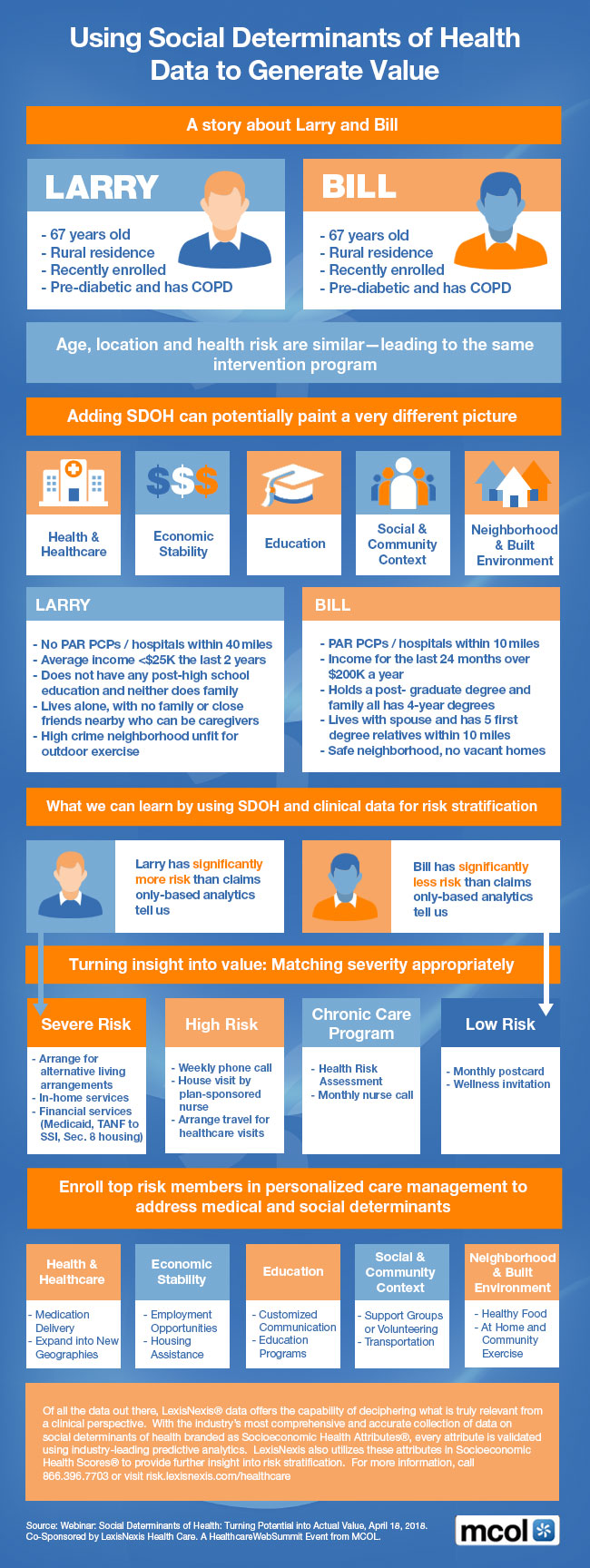
The Shiny Object of Social Determinants of Health.
Ann Miller RN MHA
LikeLike
OH MY – SDoH?
https://www.linkedin.com/pulse/eventually-social-determinants-nightmare-cms-other-health-bowman/?trackingId=agQKcXJzcbJ3F53YyfFABw%3D%3D
Dr. David E. Marcinko, MBA
LikeLike
SDoH
The biggest lesson from COVID-19 is that healthcare alone cannot improve the health and wellbeing of communities of color. In fact, Black workers face two of the most lethal preexisting conditions for the coronavirus – racism and economic inequality .
Social determinants of health do not happen in a vacuum – they occur in the context of individual and neighborhood resources and the opportunity structures in communities where people of color live. The biggest lessons from the dual crisis of a global pandemic and systemic racial injustice is that we can’t improve health and wellbeing of communities of color unless we also pay attention to both social determinants of health and social determinants of equity which are driving racial disparities in healthcare. Social determinants of equity involve looking at policies, practices, norms and values in our medical care and public health systems through a racial equity lens. It requires us to be monitoring inequality in opportunities and making the connection between social inequities to disparities in health outcomes.
Health plans, health systems, and other institutions have an important role to play in eliminating barriers to SDoH and reducing healthcare disparities. Yes, the healthcare sector has the financial capital to make strategic investments in SDoH and related care coordination tools, like online platforms. However, focusing on SDoH alone will not reduce racial disparities in healthcare. Social determinants of health occur in the context of individual and neighborhood resources and the opportunity structures in communities where people of color live.
Change happens at the speed of trust, and while individual health practitioners may have the trust of their patients, the healthcare sector as a whole does not. The financial capital the healthcare sector brings to the table is critical, however, if we want to move the dial on racial disparities in healthcare we need to leverage social capital built over the years by the social services sector. Unfortunately, some in the healthcare sector are forging ahead alone, sometimes re-creating SDoH services networks that at best serve just their members or patients, and at worst, are duplicative.
Health plans, health systems, and other institutions should view the social sector as a force multiplier, “boots on the ground” to help people navigate the health system and SDoH. We all know our health system is complicated, and frankly, complicated systems can discriminate against vulnerable populations in effect, if not by intent. If the healthcare sector is truly committed to value-based care, now is the time to come to the table and make long-term investments in social sector partners that are building and delivering neighborhood resources, and creating new opportunity structures for under-resourced communities. These investments should be for general operating support and for services like outreach and engagement and navigation supports – services people need, but rarely reimbursed by payers and never adequately funded by government and philanthropic grants.
The pandemic has caused economic downturns in nearly every state, which will likely translate into cuts in government spending on SDoH and community resources at the very time when we need it the most. Now is the time for bold action. Is your health plan or health system ready to move from talk to action?
via Barbara Otto – CEO
Smart Policy Works
LikeLike