





 Support our online development, and advance our onground research initiatives in free market economics, as we seek to showcase the brightest Next-Gen minds.
THE ME-P DISCLAIMER: Posts, comments and opinions do not necessarily represent iMBA, Inc., but become our property after submission. Copyright © 2006 to-date. iMBA, Inc allows colleges, universities, medical and financial professionals and related clinics, hospitals and non-profit healthcare organizations to distribute our proprietary essays, photos, videos, audios and other documents; etc. However, please review copyright and usage information for each individual asset before submission to us, and/or placement on your publication or web site. Attestation references, citations and/or back-links are required. All other assets are property of the individual copyright holder.
Support our online development, and advance our onground research initiatives in free market economics, as we seek to showcase the brightest Next-Gen minds.
THE ME-P DISCLAIMER: Posts, comments and opinions do not necessarily represent iMBA, Inc., but become our property after submission. Copyright © 2006 to-date. iMBA, Inc allows colleges, universities, medical and financial professionals and related clinics, hospitals and non-profit healthcare organizations to distribute our proprietary essays, photos, videos, audios and other documents; etc. However, please review copyright and usage information for each individual asset before submission to us, and/or placement on your publication or web site. Attestation references, citations and/or back-links are required. All other assets are property of the individual copyright holder.


Appreciating the Pros and Cons of Animal Dissection
[Brought to you by PETA]
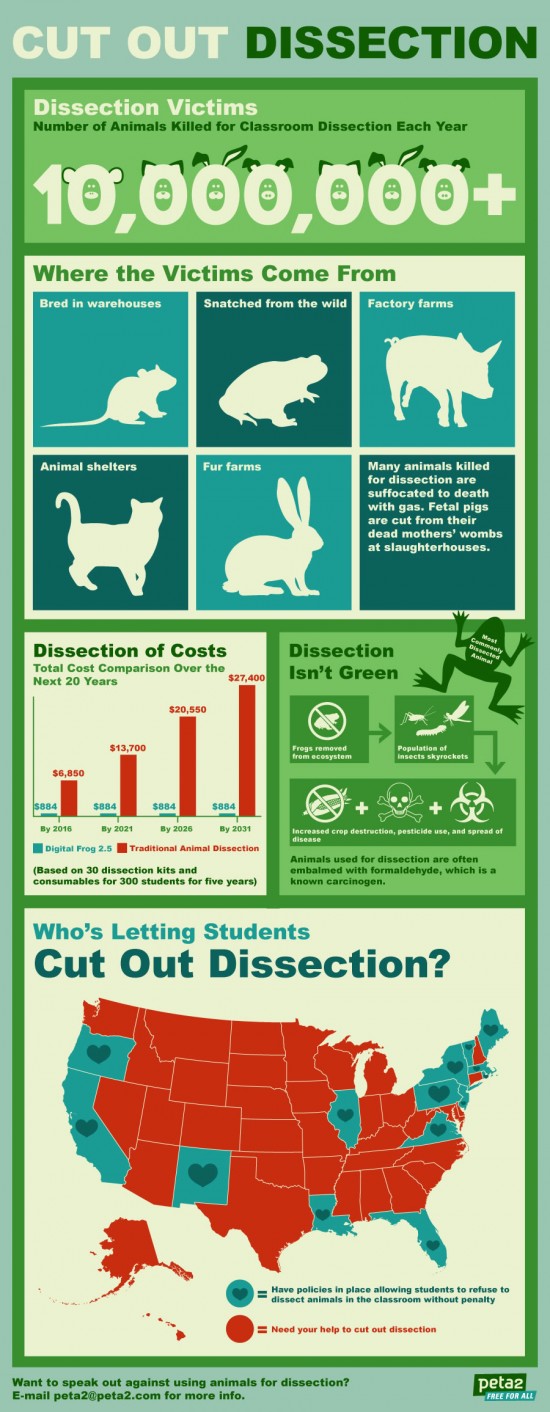
Every year, millions of frogs, rats, cats, mice, and other animals suffer and are killed for dissection. Luckily, there are far better ways to learn biology than by torturing animals, damaging the environment, and teaching insensitivity. With more and more states enacting dissection-choice policies, it’s never been easier to avoid dissection.
And so, October is “Cut Out Dissection Month” and PETA wanted to arm you with the “facts” on animal dissection in the easiest, most eyeball-friendly, sharable way—with our handy-dandy infographic!
Assessment by Dr. David Edward Marcinko MBA
As a Board-Certified surgeon, and Fellow of the American College, I disagree with this sentiment. Of course, I am not in favor of the wanton torture or harm of any animal. But, I still remember the first time I operated on a living, but anesthetized, German Shepard at Temple University in Philadelphia, almost 40 years ago. And, I still can feel the animal’s heart beating in my hands – powerful!
Of course, the anti-vivisectionist crowd scrawled graffiti on the anatomy building walls – the entire semester – to no avail. I also dissected frogs, fetal pigs, sharks, rabbits and several cats before reaching medical school.
Conclusion
Your thoughts and comments on this ME-P are appreciated. Feel free to review our top-left column, and top-right sidebar materials, links, URLs and related websites, too. Then, subscribe to the ME-P. It is fast, free and secure.
Speaker: If you need a moderator or speaker for an upcoming event, Dr. David E. Marcinko; MBA – Publisher-in-Chief of the Medical Executive-Post – is available for seminar or speaking engagements. Contact: MarcinkoAdvisors@msn.com
OUR OTHER PRINT BOOKS AND RELATED INFORMATION SOURCES:
- PHYSICIANS: www.MedicalBusinessAdvisors.com
- PRACTICES: www.BusinessofMedicalPractice.com
- HOSPITALS: http://www.crcpress.com/product/isbn/9781466558731
- CLINICS: http://www.crcpress.com/product/isbn/9781439879900
- ADVISORS: www.CertifiedMedicalPlanner.org
- BLOG: www.MedicalExecutivePost.com
- FINANCE: Financial Planning for Physicians and Advisors
- INSURANCE: Risk Management and Insurance Strategies for Physicians and Advisors



Share this:

Filed under: "Doctors Only", Ethics, Op-Editorials | Tagged: Anatomy Dissection, Animal Dissection, anti-vivisectionists, Cut Out Dissection Month, PETA |
 The Leading Business Education Network for Doctors, Financial Advisors and Health Industry Consultants
WesternU Students Participate in Cadaver Farewell Memorial Service
Western University of Health Sciences students paid their respects to Willed Body Program donors and their families, a gift that left an indelible impression on their early health sciences education. The student-sponsored Cadaver Farewell Memorial Service on Oct. 26th, 2011 at WesternU honored 51 donors, including nine veterans who were recognized with a flag presentation and the playing of “Taps.”
First-year College of Podiatric Medicine student Mark Graeber, Class 2015, compared students to the lower lights of a lighthouse — the smaller lights below the main beam used to guide vessels back safely to harbor at night.
“All of us are going to be entering a health profession, and we will all be responsible for the safety and the very lives of the patients we are given. This is a tremendous privilege and an honor for all of us,” he said.
“Because of the generosity of those who donated themselves as their last gift to people, they have played an enormous role in saving the lives of many. They’ve given us a gift of knowledge, a gift of education, a gift of understanding, and I don’t think there really is a way we can show enough gratitude for this. I think the simplest way is just to say thank you to all those people who donated themselves to us.”
Source: PM News October 29, 2011 #4,292
LikeLike
IOM Says Chimpanzees Aren’t Necessary For Most Medical Research
A new report from the Institute of Medicine says that most biomedical experiments don’t require the use of chimps and that given the genetic ties and physical traits the animals share with humans, the NIH should fund such research only in certain specific circumstances.
http://www.iom.edu/Reports/2011/Chimpanzees-in-Biomedical-and-Behavioral-Research-Assessing-the-Necessity.aspx
Helen
LikeLike
Donate your Body
Donate your body to a medical school as an alternative to burial or cremation. But, you need to research your options and make careful preparations.
http://money.msn.com/family-money/a-cheap-death-donate-your-body-freedman.aspx
Reduce animal dissection rates.
Janice
LikeLike
Doc Group Opposes Use of Kittens in Resident Training
Is it still necessary to use kittens to teach pediatric medical residents how to insert breathing tubes into tiny babies? Well, doctors at Albert Einstein Medical Center say yes. Bit, the Physicians Committee for Responsible Medicine (PCRM) thinks not.
http://www.medscape.com/viewarticle/764321
PCRM said this week that it plans to file a complaint about the practice against Einstein on Thursday. The group contends that practicing on kittens violates the Animal Welfare Act because training programs can use simulators that are just as effective. Kittens could be hurt or killed during the training.
While at Temple University, back in the day, we used German Shepard dogs for in-vivo physiology lab and anatomical dissection class.
Dr. David Edward Marcinko MBA
LikeLike
Donating one’s body to science
http://www.kevinmd.com/blog/2014/10/almost-convert-donating-ones-body-science.html
Well almost; maybe.
Hope R. Hetico RN MHA
LikeLike
The Sad Story of Laika
The First Dog Launched Into Orbit.
http://www.msn.com/en-us/news/technology/the-sad-story-of-laika-the-first-dog-launched-into-orbit/ar-BBcK03l
Monika
LikeLike
Patients Too
A ritual to recover the empathy toward bodies we care for.
http://www.kevinmd.com/blog/2014/11/ritual-recover-empathy-toward-bodies-care.html
Donna
LikeLike