






 Support our online development, and advance our onground research initiatives in free market economics, as we seek to showcase the brightest Next-Gen minds.
THE ME-P DISCLAIMER: Posts, comments and opinions do not necessarily represent iMBA, Inc., but become our property after submission. Copyright © 2006 to-date. iMBA, Inc allows colleges, universities, medical and financial professionals and related clinics, hospitals and non-profit healthcare organizations to distribute our proprietary essays, photos, videos, audios and other documents; etc. However, please review copyright and usage information for each individual asset before submission to us, and/or placement on your publication or web site. Attestation references, citations and/or back-links are required. All other assets are property of the individual copyright holder.
Support our online development, and advance our onground research initiatives in free market economics, as we seek to showcase the brightest Next-Gen minds.
THE ME-P DISCLAIMER: Posts, comments and opinions do not necessarily represent iMBA, Inc., but become our property after submission. Copyright © 2006 to-date. iMBA, Inc allows colleges, universities, medical and financial professionals and related clinics, hospitals and non-profit healthcare organizations to distribute our proprietary essays, photos, videos, audios and other documents; etc. However, please review copyright and usage information for each individual asset before submission to us, and/or placement on your publication or web site. Attestation references, citations and/or back-links are required. All other assets are property of the individual copyright holder.


More on Patient Engagement
[By Innovation Health]
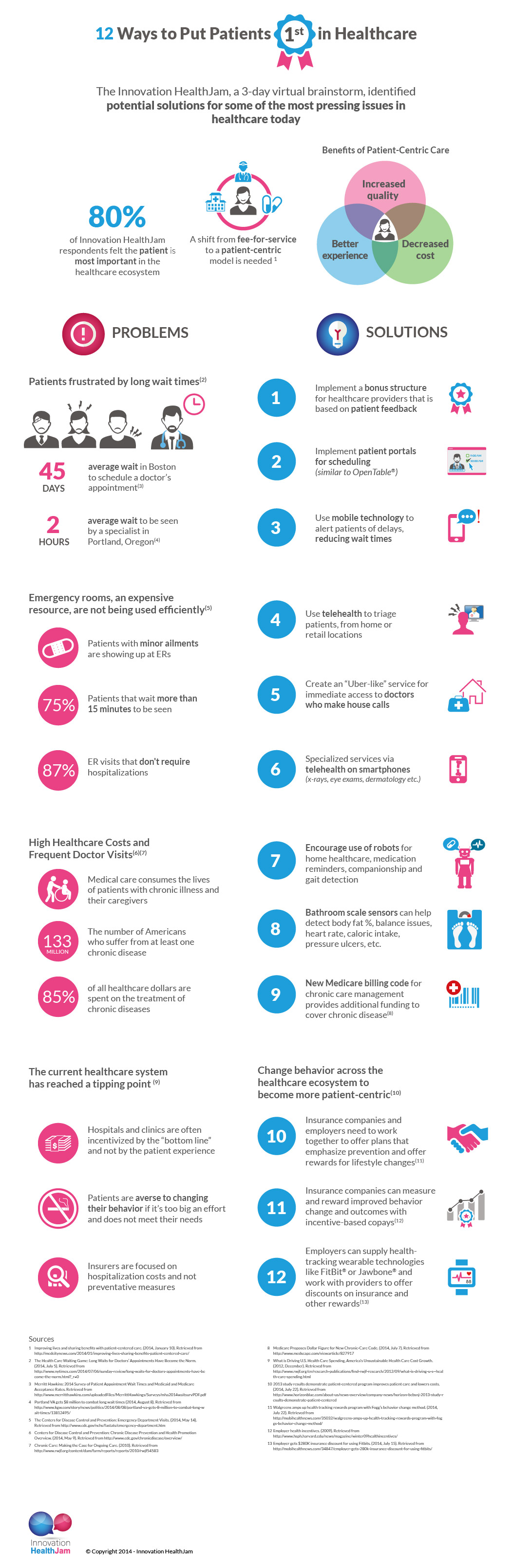
After a 3 day-long virtual brainstorming session, contributors to the Innovation Health Jam shared their conclusions on why patient engagement remains a top healthcare concern.
Assessment
Click through this link for an infographic summarizing the findings:
12 reasons why patients still come first in healthcare
Conclusion
Your thoughts and comments on this ME-P are appreciated. Feel free to review our top-left column, and top-right sidebar materials, links, URLs and related websites, too. Then, subscribe to the ME-P. It is fast, free and secure.
Speaker: If you need a moderator or speaker for an upcoming event, Dr. David E. Marcinko; MBA – Publisher-in-Chief of the Medical Executive-Post – is available for seminar or speaking engagements. Contact: MarcinkoAdvisors@msn.com
OUR OTHER PRINT BOOKS AND RELATED INFORMATION SOURCES:
- DICTIONARIES: http://www.springerpub.com/Search/marcinko
- PHYSICIANS: www.MedicalBusinessAdvisors.com
- PRACTICES: www.BusinessofMedicalPractice.com
- HOSPITALS: http://www.crcpress.com/product/isbn/9781466558731
- CLINICS: http://www.crcpress.com/product/isbn/9781439879900
- ADVISORS: www.CertifiedMedicalPlanner.org
- BLOG: www.MedicalExecutivePost.com
- FINANCE: Financial Planning for Physicians and Advisors
- INSURANCE: Risk Management and Insurance Strategies for Physicians and Advisors


Share this:

Filed under: Ethics, Practice Management | Tagged: Innovation Health, Patient engagement, why patients come first in healthcare |
 The Leading Business Education Network for Doctors, Financial Advisors and Health Industry Consultants
Agreed – Patients First
Healthcare leaders navigate tectonic changes but must never lose sight of caring and hope in human healing.
http://blogs.msdn.com/b/healthblog/archive/2014/08/21/healthcare-leaders-must-navigate-tectonic-changes-but-never-lose-sight-of-caring-and-hope-in-human-healing.aspx
Curtis
LikeLike
It is about the patient – Silly
As we shift from a system that addresses sickness to one that promotes health, we may experience that the more interesting promise of Health 2.0 is less about economics and more about accelerating a sweeping cultural shift that focuses our collective and individual energy on wellness.
And, we know that tools alone—the supports that can help catalyze behavior change—will not be totally responsible for the change in outlook.
But, the tools and other supports in Health 2.0 will serve as some of the key catalysts, ushering in a new era that foregrounds prevention, wellness, and better management of chronic disease, and works to reduce the economic burden on health systems, governments, and individuals themselves; the patients.
Jennifer Tomasik
Carey Huntington
Fabian Poliak
[CFAR.com]
via Ann Miller RN MHA
LikeLike