ME-P SYNDICATIONS:
WSJ.com,
CNN.com,
Forbes.com,
WashingtonPost.com,
BusinessWeek.com,
USNews.com, Reuters.com,
TimeWarnerCable.com,
e-How.com,
News Alloy.com,
and Congress.org



BOARD CERTIFICATION EXAM STUDY GUIDES
Lower Extremity Trauma
[Click on Image to Enlarge]
The “Medical Executive-Post” is about connecting doctors, health care executives and modern consulting advisors. It’s about free-enterprise, business, practice, policy, personal financial planning and wealth building capitalism. We have an attitude that’s independent, outspoken, intelligent and so Next-Gen; often edgy, usually controversial. And, our consultants “got fly”, just like U. Read it! Write it! Post it! “Medical Executive-Post”. Call or email us for your FREE advertising and sales consultation TODAY [678.779.8597] Email: MarcinkoAdvisors@outlook.com



ePodiatryConsentForms.com
Suite #5901 Wilbanks Drive, Norcross, Georgia, 30092 USA [1.678.779.8597]. Our location is real and we are now virtually enabled to assist new long distance clients and out-of-town colleagues.
If you want the opportunity to work with leading health care industry insiders, innovators and watchers, the “ME-P” may be right for you? We are unbiased and operate at the nexus of theoretical and applied R&D. Collaborate with us and you’ll put your brand in front of a smart & tightly focused demographic; one at the forefront of our emerging healthcare free marketplace of informed and professional “movers and shakers.” Our Ad Rate Card is available upon request [678-779-8597].

“Providing Management, Financial and Business Solutions for Modernity”
Whether you’re a mature CXO, physician or start-up entrepreneur in need of management, financial, HR or business planning information on free markets and competition, the "Medical Executive-Post” is the online place to meet for Capitalism 2.0 collaboration.

Support our online development, and advance our onground research initiatives in free market economics, as we seek to showcase the brightest Next-Gen minds.
THE ME-P DISCLAIMER: Posts, comments and opinions do not necessarily represent iMBA, Inc., but become our property after submission. Copyright © 2006 to-date. iMBA, Inc allows colleges, universities, medical and financial professionals and related clinics, hospitals and non-profit healthcare organizations to distribute our proprietary essays, photos, videos, audios and other documents; etc. However, please review copyright and usage information for each individual asset before submission to us, and/or placement on your publication or web site. Attestation references, citations and/or back-links are required. All other assets are property of the individual copyright holder.







 The Leading Business Education Network for Doctors, Financial Advisors and Health Industry Consultants
Mandated EHRs?
“Doctors May Lose Licenses For Not Adopting Electronic Records,” By Zeke Wright, GoLocalWorcester Contributor
http://www.golocalworcester.com/news/ma-doctors-may-lose-licenses-for-not-adopting-electronic-records/
Is it still too early to discuss government/insurer plans for us, Doc?
D. Kellus Pruitt DDS
LikeLike
Actually – Is the Electronic Health Record Defunct?
An essay by J. Carter MD.
http://thehealthcareblog.com/blog/2014/06/30/is-the-electronic-health-record-defunct/
Jules
LikeLike
HHS sets up doctors to fail
The US government sets up doctors to fail, and doctors will be blamed. As if the increased cost and danger of mandated electronic health records weren’t enough, vulnerability to fraud is yet another disadvantage of EHRs over paper health records… which calls for even more taxpayer funding for the ever-widening circle of mandate stakeholders. What did you expect? Physicians and patients have never been the primary concern to those who stand to gain power and/or profit from HIT – including the U.S. Department of HHS.
“Feds push electronic records that make fraud easier,” by Jayne O’Donnell, USA TODAY, July 6, 2014
http://www.usatoday.com/story/news/nation/2014/07/06/electronic-health-records-medicare-healthcare-fraud-funding/12157645/
Quick mash up:
“The federal government is rewarding doctors and hospitals for moving to electronic health records — and will soon punish them if they don’t…. Yet the Centers for Medicare and Medicaid Services still doesn’t require health care providers to keep their audit systems on. HHS has spent more than $22.5 billion in financial incentives for doctors and hospitals to use EHRs, and those that don’t will soon have their Medicare payments reduced.”
Reed Gelzer, a former primary care doctor who is now an EHR consultant to the federal government and private groups, tells USA TODAY that health records which are maintained electronically can be “easily falsified, altered or otherwise misrepresented.” How does that compare to paper?
Physicians were promised that EHRs would save money, yet many find it necessary to hire scribes in order to document the additional information demanded by Meaningful Use requirements – sometimes called busywork. As for saving time, that benefit has proven to be as elusive as a return on investment. Long after many physicians had purchased EHR systems, CMS started discouraging the use of time-saving “templates,” in which records are copied and used in future notes. O’Donnell writes: “The agency said it is also trying to identify best practices for detecting fraud and abuse associated with EHRs with the help of contractors,” like Reed Gelzer.
Gelzer agrees that the best way to do that will be to spur better accuracy and reliability with more funding for regulation and enforcement. He adds, “Investigators I’ve spoken with say that the only constraint on more recoveries is more resources.”
Since nothing is holding down the cost of HIPAA compliance, will EHRs ever be cheaper (and safer) than paper?
This just in: “CMS Seeks Mandated Certified EHRs for Chronic Care,” by Joseph Goedert, HealthDataManagement.com, July 6, 2014.
http://www.healthdatamanagement.com/news/cms-seeks-mandated-certified-ehrs-for-chronic-care-48363-1.html
If it’s mandated, it’s free. Right?
D. Kellus Pruitt DDS
LikeLike
Patients fear EHRs
There are signs that poor security is starting to cause Americans to fear their doctors’ EHRs.
“Provider Use of EHRs Could Deter Patient Disclosure, Study Finds,” iHealthBeat, July 31, 2014.
http://www.ihealthbeat.org/articles/2014/7/31/study-provider-use-of-ehrs-could-deter-patient-disclosure
“Some patients withhold information from their health care provider out of privacy and security concerns related to the use of electronic health records, according to a study published in the Journal of the American Medical Informatics Association, FierceEMR reports (Durben Hirsch, FierceEMR, 7/28)”.
Who didn’t see that coming?
D. Kellus Pruitt DDS
LikeLike
Disappointing outcomes despite a massive investment in EHRs
The Health Information Technology for Economic and Clinical Health Act of 2009 committed to the expanded adoption of health information technology, expecting electronic health records (EHRs) to transform medical care while promising dramatic improvements in quality, efficiency and safety.
http://www.kevinmd.com/blog/2014/08/disappointing-outcomes-despite-massive-investment-ehrs.html
Five years and $25 billion later, the results have fallen short of expectations, and there are multiple reasons for our disappointment.
Hope R. Hetico RN MHA
LikeLike
Seeking the truth about EHRs
Two days ago, I posted an abstract published in the Journal of the American Medical Informatics Association (JAMIA) titled, “The long-term financial impact of electronic health record implementation,” by Michael J Howley, Edgar Y Chou, Nancy Hansen, and Prudence W Dalrymple, August 27, 2014.
http://jamia.bmj.com/content/early/2014/08/27/amiajnl-2014-002686.abstract
According to recent research involving the science of Informatics (coding), even though tedious Meaningful Use requirements prevent doctors from treating as many patients per day, with modern coding – even for seemingly insignificant procedures – informatics can help doctors to earn even more money while curing fewer people. The conclusion of the research: That’s OK.
Today, a physician’s different opinion of EHRs was posted on Philly.com:
“Why doctors hate electronic health records – Imagine you are a car mechanic, and the government offers to help you buy a new computerized tool to make it easier to fix cars. The tool improves automobile safety, it says, by giving you the latest evidence on the most effective repairs and immediate access to all prior work that has been done on the car. If you buy a tool that meets government standards, you will get a government subsidy to help pay for it, but if you don’t, you’ll be fined.” By Robert B. Doherty, Senior Vice President of Governmental Affairs & Public Policy American College of Physicians, posted on Philly.com, September 8, 2014.
http://www.philly.com/philly/blogs/fieldclinic/Why-doctors-hate-electronic-health-records.html#d8o78zdMAeuAxH52.99
I should add that in contrast to physicians’ apparent dissatisfaction with EHRs, in dentistry, the American Dental Association claims that EDRs are better than paper dental records. (See: “EHRs provide long-term savings and convenience,” no byline, ADA News, December 6, 2013).
http://www.ada.org/en/publications/ada-news/2013-archive/december/ehrs-provide-long-term-savings-convenience
In addition, Dr. Gordon Christensen’s Clinicians Report Foundation CEO Dr. Paul Child tells DentistryIQ that EDRs offer dentists a “high return on investment.” (See: “Digital dentistry: Is this the future of Dentistry?” by Paul L. Child Jr., DMD, CDT, CEO CR Foundation, for DentistryIQ, undated).
http://www.dentaleconomics.com/articles/print/volume-101/issue-10/features/digital-dentistry-is-this-the-future-of-dentistry.html.
However, unlike the American Medical Informatics Association, neither the ADA Department of Dental Informatics, nor Clinicians Report responds to requests for research supporting their sales-friendly claims.
D. Kellus Pruitt DDS
cc: American Dental Association
cc: Gordon J Christensen’s Clinicians Report
LikeLike
Docs Say EMRs are a Big Waste of Time
While electronic medical records are supposed to advance the practice of medicine and health maintenance, doctors aren’t so sure.
http://www.physiciansnews.com/2014/09/10/docs-say-electronic-medical-records-waste-time/?utm_source=9.11.14&utm_campaign=11713&utm_medium=email
In fact, the results of a recent survey show that physicians believe EMRs lead to a loss of more than six hours per week of valuable clinic time.
Ann Miller RN MHA
LikeLike
Introducing EMR Transcriptions
[Personalized medical transcription service for doctors who don’t like EMRs]
*******************************************************
I received this email the other day – interesting?
*******************************************************
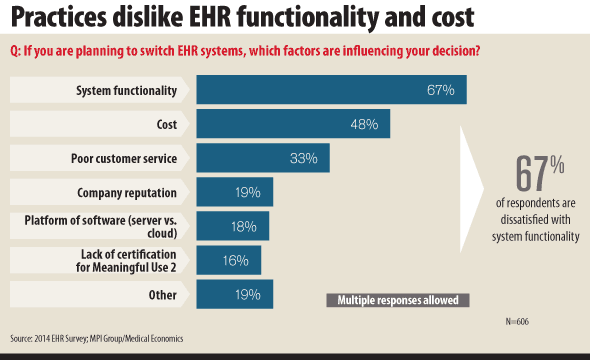
Are you spending too much time on the computer (instead of with your patients)? 34% of doctor’s say “yes,” and that they’re seeing fewer patients as a result.
Introducing EMR Transcriptions
Dictate the way you are most comfortable… the way you work best. And, get the best results for your patients. Work faster, smarter and more efficiently. The way you are used to:
•✓ Avoid the after-hours work of templates and voice recognition.
•✓ Avoid computer driven treatment.
•✓ Avoid touching the wrong button and sending the wrong prescription.
… and get your reports fed right in to your EMR too.
You can get medical dictation and transcription service the way you like it. And get your reports placed in your EMR too, if you like.
Getting started is fast and easy. Here’s how it works:
•✓ No setup fees.
•✓ No software required.
•✓ No long-term contract.
•✓ Easy enrollment can be done within ten minutes.
•✓ Two hours to get started.
•✓ Help available if you need it.
Save this New Year with Sunrise Transcription Service. Fully Integrated with all EMR software’s. 24-hour Turnaround Time. 99.5% accuracy level guarantee.
Signup now and save lot of money.
Sunrise Transcription
monesh@cloudbooksapp.com
LikeLike
Distressed Docs Turn Up Heat on ONC
A coalition of 35 physician organizations led by the American Medical Association says docs are fed up with their electronic health records and the multitude of requirements that come from the federal meaningful use program.
They have a seven-point plan for relief: 1) Decouple EHR certification from the meaningful use program. 2) Reconsider alternative software testing methods. 3) Establish greater transparency and uniformity on user-centered design testing and process results. 4) Incorporate exception handling into EHR certification. 5) Develop CCDA guidance and tests to support exchange. 6) Seek further stakeholder feedback. 7) Increase education on EHR implementation.
“Among physicians there are documented challenges and growing frustration with the way EHRs are performing,” the coalition writes in its Jan. 21 letter to Office of National Coordinator (ONC) Karen DeSalvo, MD. “Many physicians find these systems cumbersome, do not meet their workflow needs, decrease efficiency, and have limited, if any, interoperability.”
Source: Bernie Monegain
Healthcare IT News [1/22/15]
LikeLike
Electronic Medical Records
Many health care providers are currently using these records, but they do not communicate across health care systems and are poorly designed from a user perspective, making it difficult for health care providers to find what they need to know about a patient when they need to know it.
Allen
LikeLike
Got a Beef With Your EHR? Tell the Feds
Are you a provider unhappy with your electronic health records system, or unable to share health data because of the actions of other organizations? Or, are you a healthcare consumer who can’t access your EHRs? The feds want to hear from you.
The Office of the National Coordinator for Health Information Technology has a new online complaint website, healthit.gov/healthitcomplaints. It is the first formal complaint process that ONC has had throughout the journey to EHR meaningful use.
http://www.healthit.gov/healthitcomplaints
Source: Joseph Goedert, Health Data Management [9/18/15]
LikeLike
On EHRs
“Leading Cancer Center Lays Off 1,000 – Escalating costs, electronic records system, reduction in reimbursements all behind MD Anderson’s decision”
By Carleen Wild for Healthzette
January 5, 2017
http://www.lifezette.com/healthzette/leading-cancer-center-lays-off-1000/
D. Kellus Pruitt DDS
LikeLike
3 in 10 Healthcare Professionals Say Ineffective IT is a Barrier to Patient Safety
Health Catalyst recently released results from their recent survey on patient safety. Here are some key findings from the report:
• 9 in 10 healthcare professionals say their organizations are improving patient safety.
• 30% say ineffective information technology is a key barrier to patient safety.
• Lack of resources was cited as a barrier to patient safety by 27%.
• 19% say organization structure, culture or priorities is a barrier to safety.
Source: Healthcare Informatics, July 19, 2018
LikeLiked by 1 person