







 Support our online development, and advance our onground research initiatives in free market economics, as we seek to showcase the brightest Next-Gen minds.
THE ME-P DISCLAIMER: Posts, comments and opinions do not necessarily represent iMBA, Inc., but become our property after submission. Copyright © 2006 to-date. iMBA, Inc allows colleges, universities, medical and financial professionals and related clinics, hospitals and non-profit healthcare organizations to distribute our proprietary essays, photos, videos, audios and other documents; etc. However, please review copyright and usage information for each individual asset before submission to us, and/or placement on your publication or web site. Attestation references, citations and/or back-links are required. All other assets are property of the individual copyright holder.
Support our online development, and advance our onground research initiatives in free market economics, as we seek to showcase the brightest Next-Gen minds.
THE ME-P DISCLAIMER: Posts, comments and opinions do not necessarily represent iMBA, Inc., but become our property after submission. Copyright © 2006 to-date. iMBA, Inc allows colleges, universities, medical and financial professionals and related clinics, hospitals and non-profit healthcare organizations to distribute our proprietary essays, photos, videos, audios and other documents; etc. However, please review copyright and usage information for each individual asset before submission to us, and/or placement on your publication or web site. Attestation references, citations and/or back-links are required. All other assets are property of the individual copyright holder.


Drug use in the 60s and 70s
By Staff Reporters
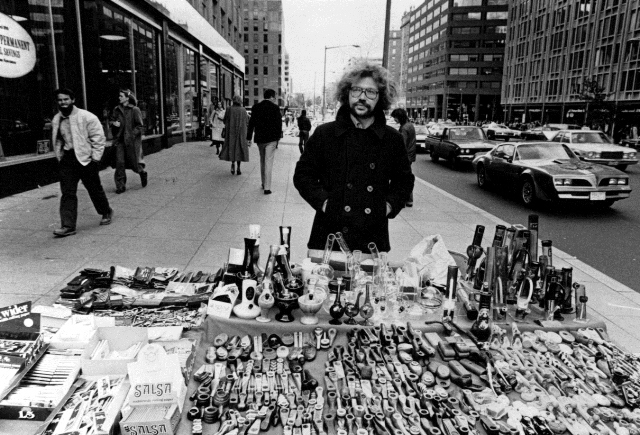
In the 1960’s and 1970’s drug use in the United States continued to grow, peaking in 1979. This was, in part, due to the wide, legal availability of drug paraphernalia like that captured in this picture of a dealer on a street corner near DEA headquarters (then located at 1405 I Street NW in Washington DC) in the late 1970’s.
###
###
In order to combat this trend, DEA was asked by the White House to create a model Drug Paraphernalia Law to be implemented and enforced at the state and local level, giving DEA and other partners another tool in the fight against drug abuse.
Conclusion
Your thoughts and comments on this ME-P are appreciated. Feel free to review our top-left column, and top-right sidebar materials, links, URLs and related websites, too. Then, subscribe to the ME-P. It is fast, free and secure.
Speaker: If you need a moderator or speaker for an upcoming event, Dr. David E. Marcinko; MBA – Publisher-in-Chief of the Medical Executive-Post – is available for seminar or speaking engagements. Contact: MarcinkoAdvisors@msn.com
OUR OTHER PRINT BOOKS AND RELATED INFORMATION SOURCES:
- DICTIONARIES: http://www.springerpub.com/Search/marcinko
- PHYSICIANS: www.MedicalBusinessAdvisors.com
- PRACTICES: www.BusinessofMedicalPractice.com
- HOSPITALS: http://www.crcpress.com/product/isbn/9781466558731
- CLINICS: http://www.crcpress.com/product/isbn/9781439879900
- ADVISORS: www.CertifiedMedicalPlanner.org
- BLOG: www.MedicalExecutivePost.com
- FINANCE:Financial Planning for Physicians and Advisors
- INSURANCE:Risk Management and Insurance Strategies for Physicians and Advisors


Share this:

Filed under: Drugs and Pharma | Tagged: DEA, DEA’s Model Paraphernalia Law, drug enforcement agency, Drug Paraphernalia Law, street drugs |
 The Leading Business Education Network for Doctors, Financial Advisors and Health Industry Consultants
DEA Allows Patients to Return Unused Meds
Concerned by rising rates of prescription drug abuse, the Drug Enforcement Administration announced that it will permit consumers to return unused prescription medications like opioid painkillers to pharmacies.
Harry
LikeLike
As Controlled Substance Use Rises in Medicare, Prolific Prescribers Face More Scrutiny
Despite warnings about abuse, Medicare covered more prescriptions for potent controlled substances in 2012 than it did in 2011.
http://www.propublica.org/article/as-controlled-substance-use-rises-in-medicare-top-prescribers-face-scrutiny?utm_source=et&utm_medium=email&utm_campaign=dailynewsletter&utm_content=&utm_name=
The program’s top prescribers often have faced disciplinary action or criminal charges related to their medical practices.
Stoner
LikeLike
ODs
During the past decade, drug overdose deaths have more than doubled and over 50 percent were related to prescription drugs.
Increases in controlled substance prescribing have coincided with higher rates of misuse, abuse, hospitalizations and deaths. Right now, opioids cause more overdose deaths than heroin and cocaine combined.
Harry
LikeLike
Opioid crisis
Now, the DEA responds to explosive “60 Minutes” report about opioid crisis.
https://www.msn.com/en-us/health/healthtrending/dea-responds-to-explosive-60-minutes-report-about-opioid-crisis/ar-AAtyHBz?li=BBnb7Kz
Lawson
LikeLike
Extortion Scam Targeting DEA Registrants
DEA is aware that registrants are receiving telephone calls and emails by criminals identifying themselves as DEA employees or other law enforcement personnel. The criminals have masked their telephone number on caller id by showing the DEA Registration Support 800 number. Please be aware that a DEA employee would not contact a registrant and demand money or threaten to suspend a registrant’s DEA registration.
If you are contacted by a person purporting to work for DEA and seeking money or threatening to suspend your DEA registration, submit the information through “Extortion Scam Online Reporting” posted on the DEA Diversion Control Division’s website: http://www.DEADiversion.usdoj.gov
Dr. Rick
LikeLike