ME-P SYNDICATIONS:
WSJ.com,
CNN.com,
Forbes.com,
WashingtonPost.com,
BusinessWeek.com,
USNews.com, Reuters.com,
TimeWarnerCable.com,
e-How.com,
News Alloy.com,
and Congress.org


BOARD CERTIFICATION EXAM STUDY GUIDES
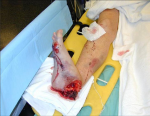
Lower Extremity Trauma
[Click on Image to Enlarge]
The “Medical Executive-Post” is about connecting doctors, health care executives and modern consulting advisors. It’s about free-enterprise, business, practice, policy, personal financial planning and wealth building capitalism. We have an attitude that’s independent, outspoken, intelligent and so Next-Gen; often edgy, usually controversial. And, our consultants “got fly”, just like U. Read it! Write it! Post it! “Medical Executive-Post”. Call or email us for your FREE advertising and sales consultation TODAY [678.779.8597] E-mail: MarcinkoAdvisors1738@outlook.com



ePodiatryConsentForms.com
Suite #5901 Wilbanks Drive, Norcross, Georgia, 30092 USA [1.678.779.8597]. Our location is real and we are now virtually enabled to assist new long distance clients and out-of-town colleagues.
If you want the opportunity to work with leading health care industry insiders, innovators and watchers, the “ME-P” may be right for you? We are unbiased and operate at the nexus of theoretical and applied R&D. Collaborate with us and you’ll put your brand in front of a smart & tightly focused demographic; one at the forefront of our emerging healthcare free marketplace of informed and professional “movers and shakers.” Our Ad Rate Card is available upon request [678-779-8597].

“Providing Management, Financial and Business Solutions for Modernity”
Whether you’re a mature CXO, physician or start-up entrepreneur in need of management, financial, HR or business planning information on free markets and competition, the "Medical Executive-Post” is the online place to meet for Capitalism 2.0 collaboration.

Support our online development, and advance our onground research initiatives in free market economics, as we seek to showcase the brightest Next-Gen minds.
THE ME-P DISCLAIMER: Posts, comments and opinions do not necessarily represent iMBA, Inc., but become our property after submission. Copyright © 2006 to-date. iMBA, Inc allows colleges, universities, medical and financial professionals and related clinics, hospitals and non-profit healthcare organizations to distribute our proprietary essays, photos, videos, audios and other documents; etc. However, please review copyright and usage information for each individual asset before submission to us, and/or placement on your publication or web site. Attestation references, citations and/or back-links are required. All other assets are property of the individual copyright holder.






 The Leading Business Education Network for Doctors, Financial Advisors and Health Industry Consultants
On Cyber Insurance
The costs of data breaches are devastating. Nevertheless, I don’t think dentists are ready to purchase cyber-insurance at $30 per patient per year.
“Cyber-Insurance: Not One-Size-Fits-All – Many Are Still Weighing the Value of Coverage” by Eric Chabrow, was posted today on GovInfoSecurity.
http://www.govinfosecurity.com/cyber-insurance-one-size-fits-all-a-5395?goback=%2Egde_4636751_member_203034048
“Examples of first-party coverage include notification expenses to alert stakeholders of a breach and provide them, when necessary, with credit-monitoring services, which insurer Chubb estimates could cost up to $30 a customer [per year]. Other first-party expenses include repairing reputation harmed by a breach, including public relations costs; restoring systems and data; repaying funds stolen through fraud or extortion; and covering revenue losses associated with computer system disruptions.”
Third-party coverage isn’t included. That would be payments made to others, such as HIPAA fines to HHS and to state attorneys general, and settlements with class action lawsuit plaintiffs and lawyers – which are all becoming more commonplace and increasingly expensive.
If a practice has 5,000 digital dental charts, the yearly cyber-insurance bill would be $150,000 for only first-party coverage. For comparison, the Ponemon Institute estimates that a breach will cost over six-times as much at $200 per chart – $50 for notification of many former patients and $150 in lost income due to reputation damage. According to Ponemon, in 2012, 45% of surveyed health care organizations said they had experienced more than five patient data breaches during the past two years and 33% said they had experienced two to five. I wonder how effectively PR experts can repair dentists’ reputation in the community following a second data breach. How about after the third?
The poor portability of data on paper dental records stored in noisy filing cabinets compared to slippery EDRs is what underlies paper’s inherent safety. And safety is the main reason dentists with paper dental records can increasingly sell dentistry cheaper while still making more profit than dentists with EDRs. As dental software liabilities continue to rise, so do their costs. At a finite tipping point in in the future when a critical number of consumers become aware that paper dental records are both safer and less expensive than EDRs, young dentists who think carbon paper was named after Dr. Carbon are not going to want to give up computerization for pegboards and ledger cards in order to retain wary patients. Inevitably, transparency will be embraced by reticent dental leaders – giving common sense a fighting chance for once.
Tell me, compared to 1950s bookkeeping technology, doesn’t HIPAA-approved de-identification of dentists’ primary EDRs look just a little sweeter each time I suggest it? Wouldn’t it be wonderful if the ADA could offer an opinion about the idea? Hang on. That’s going to happen soon.
D. Kellus Pruitt DDS
LikeLike
SHOCKER! Health IT hasn’t reduced costs as much as we hoped
From Healt Affairs http://content.healthaffairs.org/content/32/1/63.abstract
via Austin Frakt PhD http://theincidentaleconomist.com/wordpress/the-elusive-electronic-medical-record/
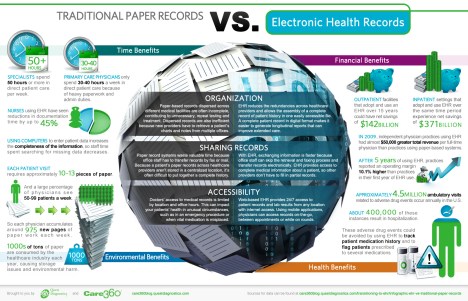
A team of RAND Corporation researchers projected in 2005 that rapid adoption of health information technology (IT) could save the United States more than $81 billion annually. Seven years later the empirical data on the technology’s impact on health care efficiency and safety are mixed, and annual health care expenditures in the United States have grown by $800 billion. In our view, the disappointing performance of health IT to date can be largely attributed to several factors: sluggish adoption of health IT systems, coupled with the choice of systems that are neither interoperable nor easy to use; and the failure of health care providers and institutions to reengineer care processes to reap the full benefits of health IT. We believe that the original promise of health IT can be met if the systems are redesigned to address these flaws by creating more-standardized systems that are easier to use, are truly interoperable, and afford patients more access to and control over their health data. Providers must do their part by reengineering care processes to take full advantage of efficiencies offered by health IT, in the context of redesigned payment models that favor value over volume.
Bottom line is that those savings estimates of $81 were, shall we say, optimistic.
Podcast: http://theincidentaleconomist.com/wordpress/electronic-medical-records-podcast/
Ann Miller RN MHA
LikeLike
What Are the Actual Costs of an EHR?
http://thehealthcareblog.com/blog/2013/01/13/a-tale-of-two-studies-what-are-the-actual-costs-of-an-ehr/
A Tale of Two Studies
Dr. Gigi
LikeLike
Electronic medical records as “gold mines for medical research”
Peter Jaret, writing in The New York Times, said a disappointing report published last week by the RAND Corp. found that electronic health records actually may be raising the nation’s medical bills. But, the report neglected one powerful incentive for the switch to electronic records: the resulting databases of clinical information are gold mines for medical research.
The monitoring and analysis of electronic medical records, some scientists say, have the potential to make every patient a participant in a vast, ongoing clinical trial, pinpointing treatments and side effects that would be hard to discern from anecdotal case reports or expensive clinical trials.
Sharon
LikeLike
A Tale of Two Studies
[What Are the Actual Costs of an EHR?]
http://thehealthcareblog.com/blog/2013/01/13/a-tale-of-two-studies-what-are-the-actual-costs-of-an-ehr/
An essay by Edmund Billings MD.
Ann Miller RN MHA
http://www.BusinessofMedicalPractice.com
LikeLike
Are Criminal Elements Eyeing Patient Records
A patient’s health record is about 15 to 20 times as valuable as a stolen credit card, suggests Robert Wah, M.D., president-elect of the American Medical Association and global chief medical officer of Computer Sciences Corp.
http://www.hhnmag.com/display/HHN-news-article.dhtml?dcrPath=/templatedata/HF_Common/NewsArticle/data/HHN/Daily/2014/Feb/022614-Wah-EHR-Security-AMA&utm_source=daily&utm_medium=email&utm_campaign=%20HHN
In this essay, he says health care providers must undertake “industrial-strength methods” to protect health data.
Eli
LikeLike