





 Support our online development, and advance our onground research initiatives in free market economics, as we seek to showcase the brightest Next-Gen minds.
THE ME-P DISCLAIMER: Posts, comments and opinions do not necessarily represent iMBA, Inc., but become our property after submission. Copyright © 2006 to-date. iMBA, Inc allows colleges, universities, medical and financial professionals and related clinics, hospitals and non-profit healthcare organizations to distribute our proprietary essays, photos, videos, audios and other documents; etc. However, please review copyright and usage information for each individual asset before submission to us, and/or placement on your publication or web site. Attestation references, citations and/or back-links are required. All other assets are property of the individual copyright holder.
Support our online development, and advance our onground research initiatives in free market economics, as we seek to showcase the brightest Next-Gen minds.
THE ME-P DISCLAIMER: Posts, comments and opinions do not necessarily represent iMBA, Inc., but become our property after submission. Copyright © 2006 to-date. iMBA, Inc allows colleges, universities, medical and financial professionals and related clinics, hospitals and non-profit healthcare organizations to distribute our proprietary essays, photos, videos, audios and other documents; etc. However, please review copyright and usage information for each individual asset before submission to us, and/or placement on your publication or web site. Attestation references, citations and/or back-links are required. All other assets are property of the individual copyright holder.


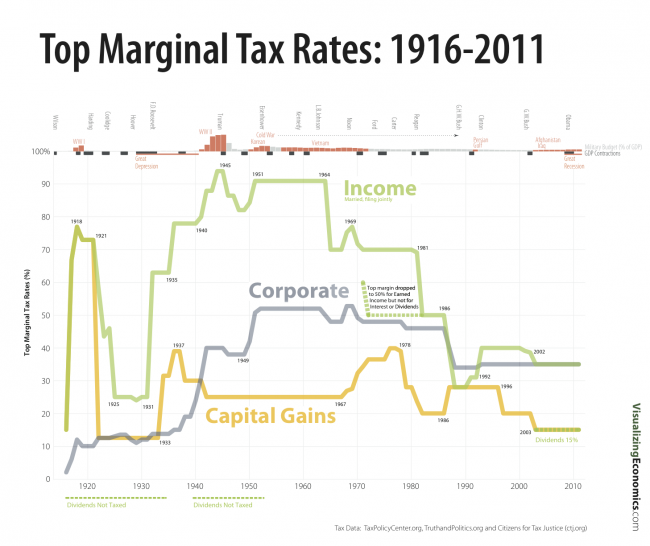
A Historical Review
The marginal tax rate is the rate paid on the “last dollar” earned.
But, when you view the taxes you paid as a percentage of income, the effective tax rate is less than your marginal rate, especially after you take into account the deductions and exemptions, i.e. income that is not subject to any tax.
Conclusion
Your thoughts and comments on this ME-P are appreciated. Feel free to review our top-left column, and top-right sidebar materials, links, URLs and related websites, too. Then, subscribe to the ME-P. It is fast, free and secure.
Link: http://feeds.feedburner.com/HealthcareFinancialsthePostForcxos
Speaker: If you need a moderator or speaker for an upcoming event, Dr. David E. Marcinko; MBA – Publisher-in-Chief of the Medical Executive-Post – is available for seminar or speaking engagements. Contact: MarcinkoAdvisors@msn.com
Our Other Print Books and Related Information Sources:
Health Dictionary Series: http://www.springerpub.com/Search/marcinko
Practice Management: http://www.springerpub.com/product/9780826105752
Physician Financial Planning: http://www.jbpub.com/catalog/0763745790
Medical Risk Management: http://www.jbpub.com/catalog/9780763733421
Hospitals: http://www.crcpress.com/product/isbn/9781439879900
Physician Advisors: www.CertifiedMedicalPlanner.org



Share this:

Filed under: Taxation | Tagged: marginal tax rates |
 The Leading Business Education Network for Doctors, Financial Advisors and Health Industry Consultants
How Financuiakl Advisors Can Use 2012 Tax Breaks Before They Disappear
Most people, not just those earning more than $200,000 a year, probably will be paying more in taxes next year, says Lancaster, Penn.-based planner and retirement specialist Rick Rodgers.
http://www.financial-planning.com/news/How-Advisors-Can-Use-2012-Tax-Breaks-Before-They-Disappear-2681313-1.html?ET=financialplanning:e11881:86235a:&st=email&utm_source=editorial&utm_medium=email&utm_campaign=FP_Daily__101212
The good news is clients still have time to take advantage of 2012 tax rates, which may turn out to be the lowest available for some time. Rodgers offers three strategies that can be implemented before the end of the year.
Gregory
LikeLike
Review timing of your investment sales
As of January 1, tax brackets are scheduled to return to their pre-2001 levels. That means the current six tax brackets (10%, 15%, 25%, 28%, 33%, and 35%) are scheduled to become five (15%, 28%, 31%, 36%, and 39.6%). Also, absent further changes, the maximum tax rate on long-term capital gains, currently at 15%, will increase to 20% (10% for those in the 15% tax bracket); those in the 10% or 15% marginal income tax bracket, who now pay a 0% rate on capital gains, will lose that special rate. Finally, qualified dividends, now taxed at a maximum of 15%, will once again be taxed at ordinary income tax rates.
Another factor for high-income individuals in 2013 is a new 3.8% Medicare contribution tax on some or all of the net investment income of individuals with a modified adjusted gross income over $200,000 ($250,000 for married couples filing jointly, and $125,000 for couples filing separately).
Ordinarily, higher rates in 2013 might suggest taking profits in an investment before those higher rates go into effect. However, the November election could affect the scheduled expiration date of those tax cuts, or even whether they expire at all.
As a result, it’s especially important this year not to let tax considerations be the sole factor in any investment decision. If you’re uncertain about a sale, remember that another way to minimize capital gains taxes is to harvest investment losses that may offset gains.
Good luck!
Dr. David Edward Marcinko MBA
http://www.CertifiedMedicalPlanner.org
LikeLike
How The Premium Assistance Tax Credit For Health Insurance Impacts The Marginal Tax Rate
http://www.kitces.com/blog/how-the-premium-assistance-tax-credit-for-health-insurance-impacts-the-marginal-tax-rate/
An excellent article by Mike Kitces; M.Tax, MSFS, EA
Enjoy.
Hope R. Hetico RN MHA
LikeLike