







 Support our online development, and advance our onground research initiatives in free market economics, as we seek to showcase the brightest Next-Gen minds.
THE ME-P DISCLAIMER: Posts, comments and opinions do not necessarily represent iMBA, Inc., but become our property after submission. Copyright © 2006 to-date. iMBA, Inc allows colleges, universities, medical and financial professionals and related clinics, hospitals and non-profit healthcare organizations to distribute our proprietary essays, photos, videos, audios and other documents; etc. However, please review copyright and usage information for each individual asset before submission to us, and/or placement on your publication or web site. Attestation references, citations and/or back-links are required. All other assets are property of the individual copyright holder.
Support our online development, and advance our onground research initiatives in free market economics, as we seek to showcase the brightest Next-Gen minds.
THE ME-P DISCLAIMER: Posts, comments and opinions do not necessarily represent iMBA, Inc., but become our property after submission. Copyright © 2006 to-date. iMBA, Inc allows colleges, universities, medical and financial professionals and related clinics, hospitals and non-profit healthcare organizations to distribute our proprietary essays, photos, videos, audios and other documents; etc. However, please review copyright and usage information for each individual asset before submission to us, and/or placement on your publication or web site. Attestation references, citations and/or back-links are required. All other assets are property of the individual copyright holder.


Achieving Better Prep, Execution, and Discharge in the OR
By Denice Soyring Higman
By Adam Higman
By Dragana Gough
http://www.soyringconsulting.com

Pre-Operative Phase
The OR should run like a well-oiled machine with patients moving through each stage seamlessly as the slightest factor can have lasting negative effects. As with most things, the process of improvement must start at the beginning with Pre-admission Preparation. Ensuring that patient files have an up-to-date History and Physical (H&P) and Laboratory and Radiology reports, as well as financial clearance will aid in the improvement process.
Some Vital Queries
One of the keys to improving preoperative performance is involving physicians. Assess where things stand by asking these questions:
- Is Anesthesia involved in team decision making?
- Are Medical Staff taking an active role in throughput?
- Is your Anesthesia staff reviewing patient charts for the next day?
- Anesthesia staff should assess a scheduled patient when the health history suggests potential problems
Holding Area or Not?
It depends. Most hospitals do not use holding areas for all patients, even though the areas may exist. Typical uses for holding areas include inpatient surgery patients and anesthesia services for line insertions, etc. For smoother transitions in the OR, you should consider elimination of multiple stops for outpatients.
Operative Phase
Operative throughput should start with an assessment of your instrument and supplies. This begins with a review of your case cart readiness, including the number of trays and instruments, used and unused. The goal of this review is to eliminate any additional unneeded instrument counting/processing. To avoid case delays, ensure that all materials and supplies pulled for the case are correct and your preference cards are updated. As with any procedure, make sure that the equipment is functioning correctly and that all personnel are fully trained for the job. Perform proper maintenance checks ahead of time and review storage and organization procedures to ensure that the equipment is readily available for the next case start time. Unreliable items that frequently break/malfunction can have a huge effect on turnover.
Team Approach to Operating Room Turnover
It is imperative that the OR staff be ready to start on time and every person in surgery should have a part of the turnover process. Surgeons can set the stage for expectations, especially if they are present during turnover/set-up. Do not let them perform a disappearing act. Work with surgeon’s office staff on scheduling issues if there continues to be a problem. For Anesthesia, Scrub, and Circulator staff, create buy-in for quick turnover time, utilize specialty teams, if possible, publicize turnover results (monthly), and celebrate improvements. Anesthesia can help transport patients from Holding/Day Surgery to OR and housekeeping needs to be readily available to assist with cleanup. Nursing staff can assist with cleanup of rooms and patient transport. The bottom line, everyone needs to pitch in whether it is in their “job description” or not.
Post-Operative Phase
To continue the momentum, make strides in post-op procedures starting with discharging from the post-anesthesia care unit (PACU). Acute care facilities should consider discharging select, low acuity patients directly from PACU.
Pre-Order Now
We are now preparing the next edition of our book: “Healthcare Organizations” [Management Strategies, Tools, Techniques and Case Studies]. In-Process from: (c) Productivity Press 2012
http://www.crcpress.com/product/isbn/9781439879900
Conclusion
And so, your thoughts and comments on this ME-P are appreciated. Feel free to review our top-left column, and top-right sidebar materials, links, URLs and related websites, too. Then, subscribe to the ME-P. It is fast, free and secure.
Link: http://feeds.feedburner.com/HealthcareFinancialsthePostForcxos
Our Other Print Books and Related Information Sources:
Health Dictionary Series: http://www.springerpub.com/Search/marcinko
Practice Management: http://www.springerpub.com/product/9780826105752
Physician Financial Planning: http://www.jbpub.com/catalog/0763745790
Medical Risk Management: http://www.jbpub.com/catalog/9780763733421
Healthcare Organizations: www.HealthcareFinancials.com
Physician Advisors: www.CertifiedMedicalPlanner.com
Subscribe Now: Did you like this Medical Executive-Post, or find it helpful, interesting and informative? Want to get the latest ME-Ps delivered to your email box each morning? Just subscribe using the link below. You can unsubscribe at any time. Security is assured.
Link: http://feeds.feedburner.com/HealthcareFinancialsthePostForcxos
Sponsors Welcomed: And, credible sponsors and like-minded advertisers are always welcomed.
Link: https://healthcarefinancials.wordpress.com/2007/11/11/advertise
Share this:

Filed under: Experts Invited, iMBA, Inc., Quality Initiatives, Recommended Books, Research & Development | Tagged: Adam Higman, Denice Soyring Higman, Dragana Gough, Flow-Thru Logistics, http://www.soyringconsulting.com, Operating Room Efficiency |


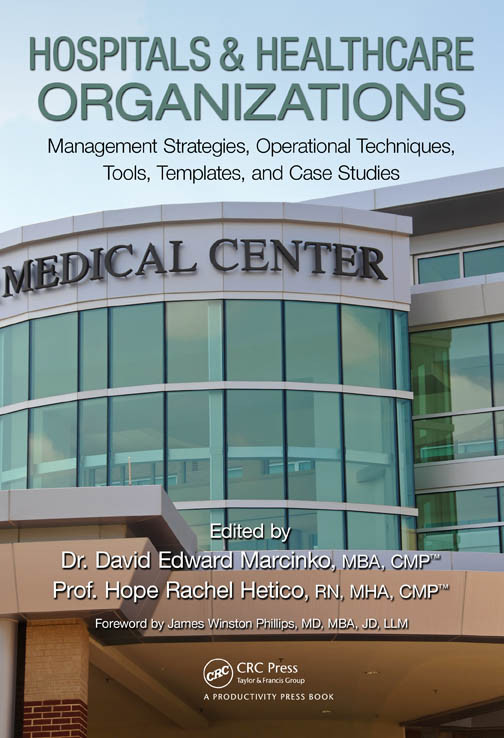
Hospitals and Healthcare Organizations
[Management Strategies, Operational Techniques, Tools, Templates and Case Studies]
FOREWORD
In the business of medicine, there are three ways to increase revenue 1) charge more, 2) do more, and/or 3) do the work more efficiently. In the current health care market where reimbursements are decreasing in the face of increasing expenses, a systemized approach is needed to maximize revenue to remain viable in the current health care arena.
Dr. David Edward Marcinko and Professor Hope Rachel Hetico in their new book, Hospitals and Healthcare Organizations [Management Strategies, Operational Techniques, Tools, Templates and Case Studies] bring their vast healthcare experience along with additional national experts to provide a healthcare model-based framework to allow health care professionals to utilize the checklists and templates to evaluate their own systems, recognize where the weak links in the system are and, applying the well illustrated principles, improve the efficiency of the system without sacrificing quality patient care.
I first became aware of Dr. Marcinko while doing research for the master’s thesis in my post graduate LL.M. program following graduation from law school. The topic of my thesis was The Anatomy and Psychology of Physician Investments. There was no shortage of literature about the psychology of investing. However, health care professionals in general and physician in particular are more unique in the psychological forces that guide their investing. Dr. Marcinko’s previous book, Financial Planning Handbook for Physicians and Advisors, provided the foundation of physician investing allowing me to add to the discussion by bringing the academic ivory tower discussion into the everyday clinical environment of the physician. Since that time I have benefited from his websites, our correspondences and telephone conversations.
As nothing in a health care system is isolated unto itself and is co-dependent upon a number of other departments in the system, maximizing efficiency across departments and among different types of health care workers may prove to be a task many are called upon to undertake but few have succeeded. If the number of assets such as hospital beds, operating rooms, ICU suites are fixed then these units must be maximized by working more efficiently to allow these fixed assets to be utilized more within calendar period thus resulting in increase revenue generation.
My wife and I recently experienced a health care delivery system that could have been detailed as a case history in this book. She had a total knee arthroplasty done by the doctor’s doctor in joint replacement in Florida. This physician does 1,000 total joints a year operating only three days a week. Doing the math you can see he does on average 6 plus joints a day, three days a week, 52 weeks a year. The procedures take on average about two hours, his patients are up walking within one hour of arriving from the recovery room and spend two-three nights in the hospital. The surgeon rounds every morning at 5 a.m. with the head nurse, the head of physical therapy, the discharge planner and his physician assistant to assure everything is done to maximize the patient’s recovery while utilizing the hospital’s resources efficiently. With an average surgeon’s fee of $4,550 per procedure, the billable yearly income for the surgeon is $4,550,000.00. Using a conservative multiplier for hospital billing of 10, the billable income for the hospital is $45,550,000.00. The list could go on about how the hospital and surgeon have combined their efforts to effectively deliver quality medical care while efficiently utilizing resources to maximize revenue.
As detailed in the book, a system like this did not occur overnight. You cannot just look at a single individual department in the hospital and expect that its maximization would deliver a similar system to the above example. Instead, you must look at every department that the patient would come into contact with either directly or indirectly and make sure to identify any processes which might delay, deter or bottle neck the overall delivery system.
Hospital and Healthcare Organizations [Management Strategies, Operational Techniques, Tools, Templates and Case Studies] is divided into three sections; 1) managerial fundaments, 2) policy and procedures and 3) strategies and executions. From these essential topics comes direction and guidance through the use and application of practical health care centered discussion, templates, checklists and clinical examples to provide the framework for building a clinically efficient system.
The health care delivery system is not an assembly line but with persistence and time following established guidelines established in this book, quality patient care can be delivered, efficiently, affordably while maintaining financial viability of institutions and practices.
James Winston Phillips MD MBA JD LLM
Post Office Box #600284
Saint Johns, FL 32260-0284
Ph: (904) 613-3062
http://theothermedicaleducation.com
LikeLike
Changing incentives in the operating room
Last year Nicholas Fogelson MD wrote about a few strategies for decreasing costs in the operating room.
Since beginng in his fellowship, and operating many days per week, he has come up with a new idea, this time a bit more radical.
http://www.kevinmd.com/blog/2011/11/changing-incentives-operating-room.html
Of course, this new book will help doctors, clinics, hospitals and ASCs more pragmatically.
Dr. David Edward Marcinko MBA
[Editor-in-Chief]
LikeLike
Don’t always blame anesthesia for problems in the OR
People blame anesthesia personnel for everything. You name it, they blame the gassers for it. They call them by the umbrella name “Anesthesia” and if there’s a problem, it’s always “Anesthesia’s” fault.
Got into the operating room late? Blame Anesthesia (Even though the anesthetist’s been sitting at the bedside for twenty minutes waiting for the surgeon or the nurses to be ready.) Patient craving ice cream when she woke up? Must be Anesthesia’s fault!
http://www.kevinmd.com/blog/2011/09/blame-anesthesia-problems.html
True or not?
Dr. David Edward Marcinko MBA CMP™
http://www.BusinessofMedicalPractice.com
LikeLike
Using OR efficiency to improve customer and staff satisfaction
In today’s fast-paced, cutting-edge healthcare climate, hospitals must provide an operating room environment that meets the demands of the surgeons and customers, while at the same time providing excellent care and outcomes.
Here is one community-based surgical hospital has successfully met this challenge through efficiency strategies and solutions.
http://www.hospitalimpact.org/index.php/2012/02/15/how_operating_room_efficiency_improves_c
Any thoughts on this follow-up to the above original ME-P?
Ann Miller RN MHA
LikeLike
And now ER best practices improve flow-thru
With half (46 percent) of healthcare leaders saying their emergency department (ED) is overcrowded, hospitals in emergency care are setting their sights on improving patient flow, HealthLeaders Media just reported.
http://www.healthleadersmedia.com/content/COM-281101/Best-EDs-Focus-on-Flow
Hope Rachel Hetico RN MHA
http://www.CertifiedMedicalPlanner.org
LikeLike
10 Questions for Optimizing Patient Flow in Your Organization
Optimizing patient flow in your healthcare organization is crucial to your team’s efforts to deliver top-quality care in an efficient manner.
Enjoy this essay by Yolanda Otero Inman RN, MSN.
https://www.besmith.com/thought-leadership/white-papers/10-questions-optimizing-patient-flow-your-organization
Barbara
LikeLike
Seven [7] ways lean healthcare management reduces cost
With the financial pressures that healthcare organizations are facing, many hospitals are using traditional cost cutting methods to save money by looking at layoffs and staff reductions.
http://www.healthcarefinancenews.com/news/7-ways-lean-healthcare-management-reduces-cost?topic=03,04,14,25,24
Many more hospitals, however, are finding ways to reduce costs through lean management methods that don’t require layoffs and can improve quality for patients.
Ann Miller RN MHA
LikeLike